
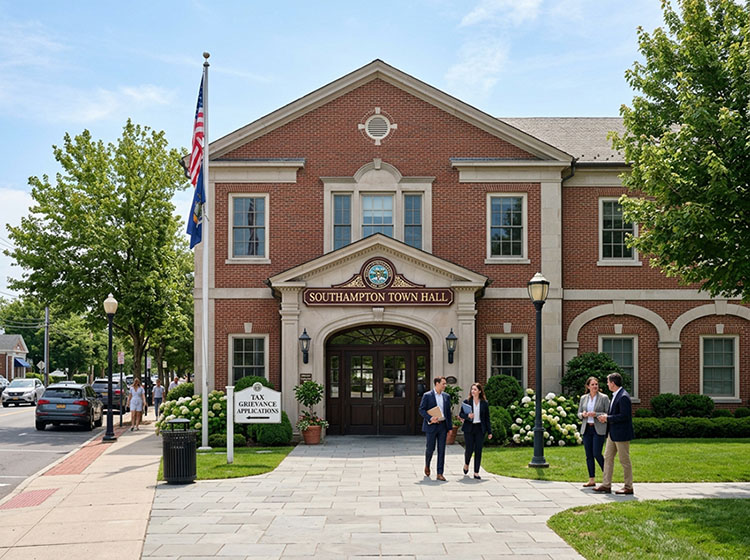
Mastering the West Hampton Tax Grievance Process
Navigating the west hampton tax grievance process requires a clear understanding of the Suffolk County and Town of Southampton assessment cycles. West Hampton properties fall under the jurisdiction of the Southampton Town Assessor’s Office. Every year, the Assessor’s Office maintains an assessment roll, which is essentially a master list of every property in the town and its assigned value for taxing purposes.
The process begins when the Town of Southampton publishes the “Tentative Assessment Roll” on May 1st. This document shows what the Town thinks your home is worth. If that number looks inflated compared to what you could actually sell your home for in today’s market, you have the right to challenge it. We often recommend that homeowners review the Contesting Your Assessment in NY State guide provided by the state to understand the underlying legal framework.
However, knowing the rules is only half the battle. To win a reduction, you must prove that your assessment is “unequal, excessive, or unlawful.” Most West Hampton cases focus on “excessive” assessment—meaning the property is assessed at a higher value than its full market value. For a deeper dive into the specifics of the local landscape, you can find More info about the Suffolk Property Tax Grievance on our dedicated county page.
Key Deadlines for a West Hampton Tax Grievance
In property taxes, timing isn’t just important—it’s everything. If you miss a deadline by even one day, the law generally prohibits the Town from considering your application until the following year.
- March 1st: This is the deadline for filing property tax exemptions (such as STAR, Senior Citizens, or Veterans exemptions). While exemptions are different from a grievance, they both work toward the same goal: lowering your bill.
- May 1st: The Tentative Assessment Roll is filed. This is your first opportunity to see your new assessment for the upcoming tax year.
- The Third Tuesday in May (Grievance Day): This is the “Super Bowl” of tax reduction. In the Town of Southampton (which includes West Hampton), all grievance applications (Form RP-524) must be received by the Board of Assessment Review (BAR) by this date.
- July 1st: This is the “Valuation Date.” When you argue that your home is worth less than the Town says, you must base your evidence on what the home was worth as of July 1st of the prior year.
Understanding the Residential Assessment Ratio (RAR)
One of the most confusing parts of a west hampton tax grievance is that your assessment is almost never 100% of your home’s market value. Instead, Suffolk and Nassau towns use a “fractional assessment.” To find out what the Town thinks your home is worth in “real dollars,” you have to use the Residential Assessment Ratio (RAR).
For example, if the RAR in a nearby town like Huntington is 0.42%, and your assessment is $4,100, you don’t just pay taxes on $4,100. You divide $4,100 by 0.0042 to get an “Indicated Market Value” of $976,190.
If your home’s actual market value is only $850,000, but the math shows the Town thinks it’s worth $976,190, you are overassessed! You would then use the Form RP-524 instructions to fill out your grievance and ask for a reduction that brings your assessment in line with that $850,000 figure.
Determining if Your Property is Overassessed

How do you know if you’re actually overpaying? You can’t just tell the Board of Assessment Review that “taxes are too high”—they hear that from everyone! To win a west hampton tax grievance, you need cold, hard data.
The most effective way to determine overassessment is to look at comparable sales (often called “comps”). These are homes similar to yours in size, style, and condition that have sold recently in West Hampton or the surrounding areas of Southampton. If three houses exactly like yours sold for $1.2 million, but the Town’s assessment implies your house is worth $1.5 million, you have a very strong case.
We provide a Complete Guide to Property Tax Grievance to help you understand how these valuations are calculated. The Town of Southampton looks at the property as it existed on the “Taxable Status Date” (March 1st) but values it based on market conditions from the previous July 1st.
Documentation Needed for Your West Hampton Tax Grievance
To convince the BAR to lower your taxes, you should gather the following:
- A Recent Appraisal: A professional appraisal from a licensed appraiser is the “gold standard” of evidence.
- Comparative Market Analysis (CMA): Often provided by real estate agents, this lists recent sales of similar homes.
- Photographs: If your home has issues that lower its value (an outdated kitchen, structural issues, or proximity to a noisy road), photos can be powerful evidence.
- Form RP-524: This is the official New York State complaint form.
In some cases, the Assessor might offer a “Stipulation” (found in Part Six of the form). This is essentially a settlement offer. If you agree to the reduced value they offer, you sign the stipulation, and the case is closed without needing a hearing.
Identifying Comparable Sales in Suffolk County
When looking for comps, stay as local as possible. A house in Babylon or Huntington might be similar in square footage, but the West Hampton market is unique. Look for homes within a 2-5 mile radius that sold within the last 12 months.
Pay attention to:
- Square Footage: Ensure the comps are within 10-20% of your home’s size.
- Property Condition: A “fixer-upper” shouldn’t be compared to a newly renovated estate.
- Amenities: Does the comp have a pool, a finished basement, or water access? These “extras” add value and must be adjusted for in your argument.
Case Studies: Real-World Reductions in Suffolk County

To understand the potential of a west hampton tax grievance, it helps to look at what has been achieved in other parts of Suffolk and Nassau County. While every property is unique, the trend of overassessment is widespread across Long Island.
| Town | Annual Savings | 10-Year Projected Savings |
|---|---|---|
| Massapequa | $13,085 | $130,850 |
| East Setauket | $16,614 | $166,140 |
| Port Jefferson Station | $14,453 | $144,530 |
| Copiague | $1,522 | $15,220 |
As you can see, a successful grievance doesn’t just save you money this year; it compounds. Because your future tax increases will be based on a lower starting number, the “10-year savings” is often the most accurate way to view the value of a grievance. If you haven’t filed yet, keep in mind that the Suffolk County Property Tax Grievance Season is a limited window that opens and closes quickly each spring.
Navigating the Board of Assessment Review (BAR) and Beyond
After you file your west hampton tax grievance, the Board of Assessment Review will meet to deliberate. The BAR is a group of citizens who are independent of the Assessor’s Office. Their job is to listen to your grievances and decide if the Assessor made a mistake.
You are not required to appear in person at the BAR hearing, though you have the right to do so. Most homeowners choose to submit their written evidence and let the documents speak for themselves. After the hearing, the BAR will mail you a “Notice of Determination.” This letter will tell you if they granted a full reduction, a partial reduction, or no reduction at all.
If you aren’t happy with the decision, don’t panic. You have one more level of appeal. You can find Information regarding SCAR from the New York State Unified Court System to learn about the next step.
Small Claims Assessment Review (SCAR)
SCAR is a specialized court process designed for homeowners of one-, two-, or three-family owner-occupied residences. It is much less formal than a typical court case.
- Filing Fee: There is a nominal $30 filing fee.
- Deadline: You must file your SCAR petition within 30 days of the filing of the Final Assessment Roll (usually by the end of August or September in Suffolk).
- The Hearing: You will meet with a specially trained “Hearing Officer.” This person is often an attorney or an appraiser who will look at your evidence and the town’s evidence and make a final, binding decision.
Post-Grievance Moratoriums
A common question we hear is: “If I win, can I file again next year?” In Suffolk County, if you receive a reduction through a court decision (like SCAR), there is often a one-year moratorium on residential appeals. This means the town generally cannot raise your assessment back up for a year, and you are often barred from grieving again during that same window. For commercial properties, this “lock-in” period can last for three years. However, you always have the right to file an annual grievance if you believe the market value of your home has significantly dropped since your last reduction.
Frequently Asked Questions about West Hampton Taxes
Can filing a grievance increase my property taxes?
This is the number one myth we encounter. Filing a tax grievance cannot increase your property taxes. The Board of Assessment Review only has the power to lower your assessment or leave it the same. They are legally prohibited from raising your assessment because you dared to challenge it. There is absolutely no risk in trying.
Do I need an attorney to file in West Hampton?
While New York law allows you to file on your own, the west hampton tax grievance process—which follows the specific Town of Southampton and Suffolk County regulations—is technical. Professional representation ensures that you don’t miss deadlines, that your evidence is presented in the specific format the BAR prefers, and that your “math” (including the RAR conversions) is flawless. We handle the Suffolk Property Tax Grievance Process from start to finish, so you don’t have to spend your weekends looking through property records.
What are the costs and risks involved?
At Heller & Consultants Tax Grievance, we operate on a contingency fee basis. This means there are no upfront costs to hire us. We only receive a fee if we are successful in winning you a reduction. If we don’t save you money, you owe us nothing. The only potential cost for a homeowner is the $30 SCAR filing fee if the case proceeds to that level, which is a small price to pay for thousands in potential savings.
Conclusion
Becoming a West Hampton tax grievance expert doesn’t happen overnight, but understanding the calendar, the math, and the evidence requirements puts you miles ahead of the average homeowner. Whether you choose to tackle the Board of Assessment Review yourself or hire a professional to lead the charge, the most important thing is that you take action.
At Heller & Consultants Tax Grievance, we’ve made it our mission to protect Long Island homeowners from unfair assessments. With over $160 million saved for our clients and a 98% success rate, we know exactly what the Town of Southampton is looking for. Don’t let another tax season pass you by—reach out to us today for a free consultation.
Ready to see how much you could save? Apply for a Suffolk Property Tax Grievance today and let our experts handle the rest.