
Understanding the High Cost of Homeownership in Syosset
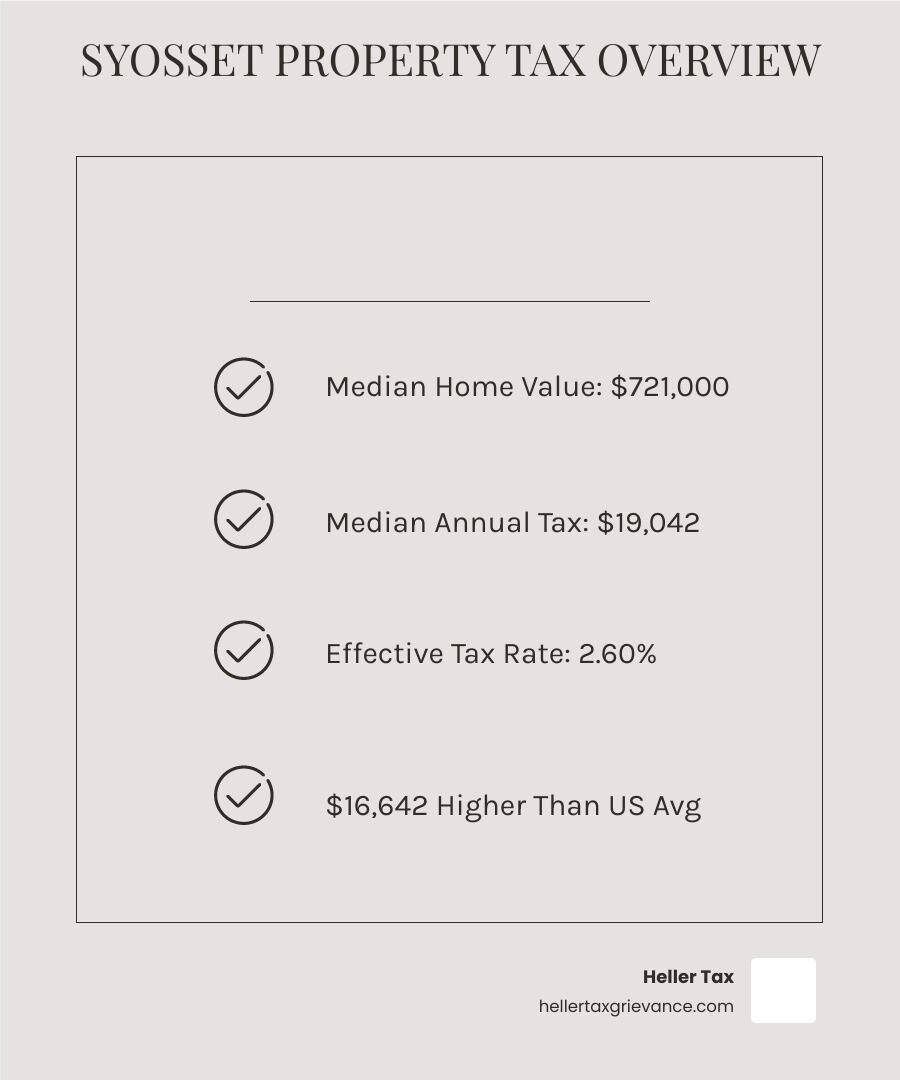
Syosset property tax bills are among the highest in the nation, with homeowners facing significant annual costs that directly impact their financial wellbeing.
Quick Facts:
- Median Home Value: $721,000
- Median Annual Tax Bill: $19,042
- Effective Tax Rate: 2.60%
- Comparison to National Median: $16,642 higher than the U.S. average of $2,400
- Tax Bill Range: From $16,301 (25th percentile) to $32,552 (90th percentile)
If you own a home in Syosset, you’re likely paying more than $19,000 per year in property taxes. That’s not a typo. The median Syosset property tax bill is nearly eight times higher than the national median. Your effective tax rate of 2.60% is more than double the national average of 1.02%, though it sits slightly above the New York State median of 2.39%.
These numbers aren’t just statistics—they represent real money leaving your household budget every year. For many homeowners, property taxes are the second-largest expense after their mortgage, and in some cases, they exceed the mortgage payment itself.
The good news? You have the right to challenge your assessment if it’s unfair. Many homeowners pay more than their fair share simply because they don’t understand how the system works or how to steer the grievance process. Understanding how your Syosset property tax is calculated, what exemptions you qualify for, and when to file an appeal can open up thousands of dollars in potential savings.
I’m Adam Heller, and I’ve spent nearly two decades helping Long Island homeowners reduce their Syosset property tax burden, holding records for the largest tax reductions in both Nassau and Suffolk counties. My team at Heller & Consultants Tax Grievance has worked with over 50,000 clients to ensure they pay no more than their fair share of real estate taxes.
Your Guide to the Syosset Property Tax System
Understanding your Syosset property tax bill can sometimes feel like trying to decipher an ancient scroll. But fear not, we’re here to explain the process. At its core, your property tax bill in Syosset, like anywhere else, is a culmination of your property’s value, various tax rates, and the needs of the local government entities that serve you. Syosset is a hamlet located within the Town of Oyster Bay in Nassau County, New York, which means your taxes contribute to multiple layers of public services.
This section will explain the core components of your tax bill, from how your property’s value is determined to the various entities you pay.
How Are Property Taxes Calculated in Syosset?
The calculation of your Syosset property tax hinges on two primary factors: your property’s assessed value and the applicable tax rates. Let’s break it down.
First, the assessed value of your home. This isn’t necessarily what your home would sell for on the open market (that’s its market value). Instead, the assessed value is the value assigned to your property by the Nassau County Department of Assessment for tax purposes. While ideally, assessed value should reflect market value, it often doesn’t, especially when you factor in property tax exemptions. These exemptions can reduce your property’s taxable assessed value, which is a fantastic way to lower your bill!
Second, the tax rates. These rates are determined by the various local government entities that provide services to Syosset residents. Your total tax bill is an aggregate of these different rates. The main taxing jurisdictions in Syosset include:
- Nassau County: This covers county-wide services like roads, police, and various administrative functions.
- Town of Oyster Bay: As Syosset is part of the Town of Oyster Bay, you contribute to town services such as sanitation, parks, and local government administration.
- Syosset School District: This is often the largest portion of your property tax bill, funding our excellent local schools.
- Special districts: These are smaller entities that provide specific services, such as fire protection, water, or lighting, to defined areas within Syosset.
Each of these entities sets its own budget and, based on the total assessed value within its jurisdiction, determines a tax rate. These rates are often expressed in “mills,” where one mill equals $1 of tax for every $1,000 of assessed value.
So, the basic calculation formula looks something like this:
(Taxable Assessed Value / 1,000) * Tax Rate (in mills) = Property Tax Amount for that Jurisdiction
This calculation is performed for each taxing entity, and then all these amounts are added together to arrive at your total annual Syosset property tax bill. It’s a complex dance of budgets, assessments, and services, all contributing to the vibrant community we call home.
Decoding Your Nassau County Assessment Notice
Every year, usually by mid-May, Nassau County sends out assessment notices. These notices are crucial because they contain the market value, assessed value, and an estimated tax bill for your property. Think of it as your property’s annual report card, but instead of grades, it shows numbers that directly impact your wallet.
The assessment process in Nassau County involves two key stages reflected in the Tentative Assessment Roll and the Final Assessment Roll. The Tentative Roll is a preliminary listing of all property assessments. This is your first chance to review your property’s valuation and identify any potential inaccuracies. If you believe your assessment is too high, this is when you start gathering your evidence. After a period for review and potential challenges, the Final Assessment Roll is published, which is the official, updated version used for calculating your actual tax bill.
A critical concept to grasp here is the distinction between market value and assessed value. As we discussed, market value is what your property would likely sell for. Assessed value, on the other hand, is the value the county uses for tax calculations. Sometimes, assessments are not updated annually to reflect full market value. This is where the Residential Assessment Ratio (RAR) comes into play. The RAR is a ratio assigned to each tax area that represents the relationship between assessed values and current market values. It’s a tool used to ensure fairness when assessments aren’t perfectly current. For example, if your home’s market value is $800,000 and the RAR for your area is 80%, your assessed value might be around $640,000 before exemptions. Understanding your RAR can help you determine if your assessed value is out of sync with your market value.
We always recommend carefully reviewing your annual assessment notice. Check the reported market value, the assessed value, and ensure all property details (like square footage, number of bathrooms, etc.) are accurate. Inaccuracies, however small, can lead to an inflated tax bill. If something looks off, it’s time to consider your options for review and potential challenge.
Syosset Property Tax by the Numbers: A Comparative Look
When we talk about Syosset property tax, it’s impossible to ignore the numbers. They tell a compelling story of what it costs to live in our beautiful community. This section provides a data-driven comparison, showing how Syosset stacks up against state and national figures, giving you a clearer picture of your tax burden.
How Does the Syosset Property Tax Compare?
Let’s put Syosset’s property tax situation into perspective. As we mentioned, our median annual tax bill is significantly higher than both the state and national averages. Here’s a quick comparison:
| Location | Median Home Value | Median Annual Tax Bill | Effective Tax Rate |
|---|---|---|---|
| Syosset, NY | $721,000 | $19,042 | 2.60% |
| Nassau County, NY | – | $11,613 | 2.60% |
| New York State | $384,100 | $5,938 | 2.39% |
| National Average | – | $2,400 | 1.02% |
(Note: Nassau County median home value data was not consistently available across sources, so it has been omitted for clarity in this comparison, but the effective tax rate and median bill are provided.)
As you can see from the table, our median Syosset property tax rate of 2.60% matches the median rate for Nassau County. This rate is higher than the New York State median of 2.39% and more than double the national median of 1.02%. What truly stands out is the median annual tax bill of $19,042, which dwarfs the national median of $2,400. This stark difference highlights the premium associated with homeownership in Syosset, a reflection of our desirable location, top-tier schools, and excellent public services.
While living in Syosset offers undeniable benefits, it also comes with a hefty price tag in terms of property taxes. Understanding these comparisons isn’t about complaining; it’s about recognizing the financial landscape and empowering yourself to ensure you’re not paying a penny more than your fair share.
The Range of Property Tax Bills in Syosset
It’s not just the median that tells the story; the range of property tax bills within Syosset itself is quite broad. This variation reflects the diverse housing stock, property sizes, and market values across the hamlet.
Consider these figures:
- 25th percentile tax bill: $16,301
- 75th percentile tax bill: $24,268
- 90th percentile tax bill: $32,552
What do these percentiles mean? A homeowner at the 25th percentile pays $16,301, meaning 25% of Syosset homeowners pay this amount or less. Conversely, a homeowner at the 75th percentile pays $24,268, meaning 25% of homeowners pay this amount or more. And for those at the 90th percentile, their annual Syosset property tax bill is a staggering $32,552 or higher.
This wide variation in tax liability underscores a few key points. Firstly, it naturally correlates with differences in property values—larger, more luxurious homes will command higher taxes. Secondly, it suggests that some homeowners might be more effectively utilizing available exemptions, while others might be over-assessed. If your tax bill feels disproportionately high compared to similar homes in your neighborhood, it could be a sign that your assessment needs a closer look.
Lowering Your Bill: Exemptions and the Grievance Process
Paying a large Syosset property tax bill can be a bitter pill to swallow, but what if we told you there are legitimate ways to potentially reduce it? You wouldn’t be alone if you thought, “Sign me up!” Many homeowners overlook valuable opportunities to lower their tax liability, either because they’re unaware of available exemptions or intimidated by the grievance process. But fear not, we’re here to guide you.
This section details actionable steps you can take to put some money back in your pocket.
Key Property Tax Exemptions for Syosset Homeowners
Exemptions are a homeowner’s best friend when it comes to property taxes. They reduce the assessed value of your property, meaning you pay taxes on a lower amount. While not everyone qualifies for every exemption, it’s definitely worth checking which ones apply to you.
Here are some of the key exemptions available to homeowners in Syosset and Nassau County:
- STAR Program (School Tax Relief): This is perhaps the most widely known and used exemption.
- Basic STAR: Available to owner-occupants of one-, two-, or three-family homes, condominiums, and cooperative apartments, regardless of age, with a household income of $250,000 or less. It provides a partial exemption from school property taxes.
- Improved STAR: Offers a greater benefit for eligible senior citizens (age 65 and older) whose household income does not exceed a certain limit (which changes annually).
- Senior Citizen Exemption (Improved School Tax Relief – ENHSTAR): Beyond the Improved STAR, low-income seniors (age 65 or older) can apply for this exemption, which provides a reduction in the assessed value of their home for county, town, and special district taxes. Income limits apply.
- Veterans Exemption: Eligible veterans (and their spouses) who served during wartime or in combat zones can receive a reduction in their assessed value for county, town, and special district taxes. The amount of the exemption varies based on service details and disability status.
- Clergy Exemption: Ordained clergy, ministers, or priests who are residents and members of their respective religious denominations may be eligible for an exemption from real property taxes.
- Disabled Homeowners Exemption: Homeowners with disabilities who meet certain income requirements may qualify for a reduction in the assessed value of their home.
Applying for these exemptions is usually a straightforward process through the Nassau County Department of Assessment. We highly encourage all homeowners to investigate which exemptions they might qualify for, as they can significantly reduce your taxable assessed value and, consequently, your annual Syosset property tax bill. It’s like finding money you didn’t know you had!
Challenging Your Assessment: The Nassau County Tax Grievance Process
Even with exemptions, you might still feel like your Syosset property tax bill is too high. This often stems from an over-assessment—meaning the county has valued your property higher than its actual market value or higher than comparable properties. If you suspect an over-assessment, you have the right to challenge it through the tax grievance process.
The deadline for filing a property tax grievance in Nassau County is a critical date to remember: April 1st of each year. Missing this deadline means you’ll have to wait another year to challenge your assessment, so mark your calendars!
The grievance process generally involves two main stages in Nassau County:
- Assessment Review Commission (ARC): This is the first level of appeal. You (or your authorized agent, like us!) file a formal complaint with the ARC, providing evidence that your property is over-assessed. This evidence typically includes comparable sales of similar properties in your neighborhood that have sold for less than your assessed market value, or a professional appraisal. The ARC reviews your complaint and makes a determination.
- Small Claims Assessment Review (SCAR): If you’re not satisfied with the ARC’s decision, you can appeal to the SCAR program, which is part of the New York State Supreme Court. SCAR is designed to be a simpler, less formal process for homeowners to challenge their assessments.
The burden of proof in a tax grievance rests with the homeowner. This means you need to present a compelling case with solid evidence to demonstrate that your assessment is unfair or excessive. This can be a daunting task, requiring a thorough understanding of local real estate values, assessment methodologies, and legal procedures. That’s where experts like us come in. We analyze your property, gather the necessary evidence, and steer the entire grievance process on your behalf, ensuring your case is presented effectively. Challenging your assessment is your right, and it can lead to substantial savings.
Essential Resources for the Syosset Homeowner
Navigating Syosset property tax can feel like a full-time job. Thankfully, there are numerous resources available to help you understand your property’s details, estimate your taxes, and even pay your bills. We’ve compiled some essential links and tools to empower you with information.
Finding Your Syosset Property Tax Information Online
Knowledge is power, especially when it comes to your property taxes. Being able to access detailed property records, assessment data, and historical tax information is invaluable for homeowners. Whether you’re researching your own property or looking at comparable sales in your neighborhood, these online resources are your go-to:
Property Records Search & Assessment Data: The Nassau County Land Records Viewer is an excellent resource. It provides access to assessment roll data, district information, tax maps, property photographs, past taxes, tax rates, exemptions with amounts, and comparable sales. It’s also integrated with the County’s Geographic Information System (GIS).
Paying Your Tax Bill: For the practical step of actually paying your property taxes, the Town of Oyster Bay provides a convenient online portal. This is where you can view your bills and make payments.
These official online tools are designed to provide transparency and accessibility. We encourage you to familiarize yourself with them—they can be incredibly helpful for budgeting, research, and ensuring the accuracy of your property information.
Tools to Estimate and Understand Your Taxes
Beyond just looking up your current bill, having tools to estimate your taxes and understand how they’re calculated can be incredibly beneficial for budgeting and checking for fairness.
- Nassau County Tax Estimator: This tool allows you to calculate the estimated ad valorem taxes for your property. It’s a great way to get a projection of your tax liability, especially if you’re considering purchasing a new property or want to understand the impact of a potential assessment change.
Using online calculators like this can give you a better grasp of your financial obligations and help you budget more effectively. They also serve as a useful benchmark. If your actual tax bill significantly deviates from what these estimators suggest, it might be a red flag prompting a deeper dive into your assessment. Understanding your taxes isn’t just about paying them; it’s about making sure they’re fair.
Frequently Asked Questions about Syosset Property Tax
We know you’ve got questions, and we’re here to provide clear, concise answers to some of the most common inquiries about Syosset property tax.
What is the difference between market value and assessed value?
This is a fundamental distinction that often confuses homeowners. Market value is simply the price your home would likely sell for on the open market if you put it up for sale today. It’s influenced by factors like location, size, condition, recent comparable sales, and overall market demand.
Assessed value, on the other hand, is the value assigned to your property by the Nassau County Department of Assessment for the sole purpose of calculating your property taxes. While it’s often related to market value, it’s not always the same. In Nassau County, your assessed value might be a percentage of your full market value, and crucially, it can be lowered by any eligible property tax exemptions you receive (like STAR or veterans exemptions). So, your property taxes are based on this often lower, “taxable assessed value,” not necessarily the full market value.
When is the deadline to appeal my property taxes in Nassau County?
Mark your calendars, set a reminder, and tell your neighbors! The deadline to file a property tax grievance (appeal your assessment) with the Nassau County Assessment Review Commission is April 1st of each year. This is a hard deadline, and if you miss it, you’ll have to wait until the following year to challenge your assessment. We can’t stress enough the importance of being aware of this date if you believe your property is over-assessed.
Where can I pay my Syosset property tax bill?
Your Syosset property tax bills are collected by the Town of Oyster Bay Receiver of Taxes. You have several convenient options for making your payments:
- Online: The easiest way for many is through the Town of Oyster Bay’s official online tax payment portal. This allows you to pay from the comfort of your home. You can find the link in the “Finding Your Syosset Property Tax Information Online” section above.
- By Mail: You can always mail a check or money order to the Receiver of Taxes office. Be sure to include your tax bill stub and mail it well in advance of the due date to ensure it’s received on time.
- In Person: If you prefer, you can pay your property tax bill directly at the Town of Oyster Bay tax office. Check their website for current operating hours and location.
Remember to pay attention to payment due dates to avoid any late fees!
Conclusion
As we’ve explored, the Syosset property tax landscape is undeniably complex, with homeowners facing some of the highest tax bills in the nation. From understanding how your assessed value is determined to deciphering the various taxing jurisdictions, there’s a lot to keep track of. However, what we hope you’ve taken away from this guide is a crucial insight: you are not powerless in the face of these high taxes.
Your right to review your assessment, use available exemptions, and formally challenge any perceived over-assessment is a powerful tool. Challenging your assessment isn’t just a bureaucratic task; it’s a key step in ensuring fairness and protecting your financial well-being. It’s about making sure you pay no more than your equitable share, allowing you to invest more in your home, your family, and your future in this wonderful community.
At Heller Tax Grievance, we’ve dedicated ourselves to helping Long Island homeowners like you steer this intricate system. With our “You Don’t Pay Unless You Save” guarantee, we stand by our commitment to secure the largest possible tax reductions for our clients. We believe that understanding your property’s financial story is the first step, and challenging your assessment is key to writing a happier ending.