
Why Locust Valley Property Taxes Are Among the Highest in the Nation
Locust Valley property taxes are a serious financial burden for most homeowners in this Nassau County community. Here’s a quick snapshot of what you need to know:
| Metric | Locust Valley | Nassau County | New York State | National |
|---|---|---|---|---|
| Median Home Value | $727,000 | $537,000 | $255,644 | $235,294 |
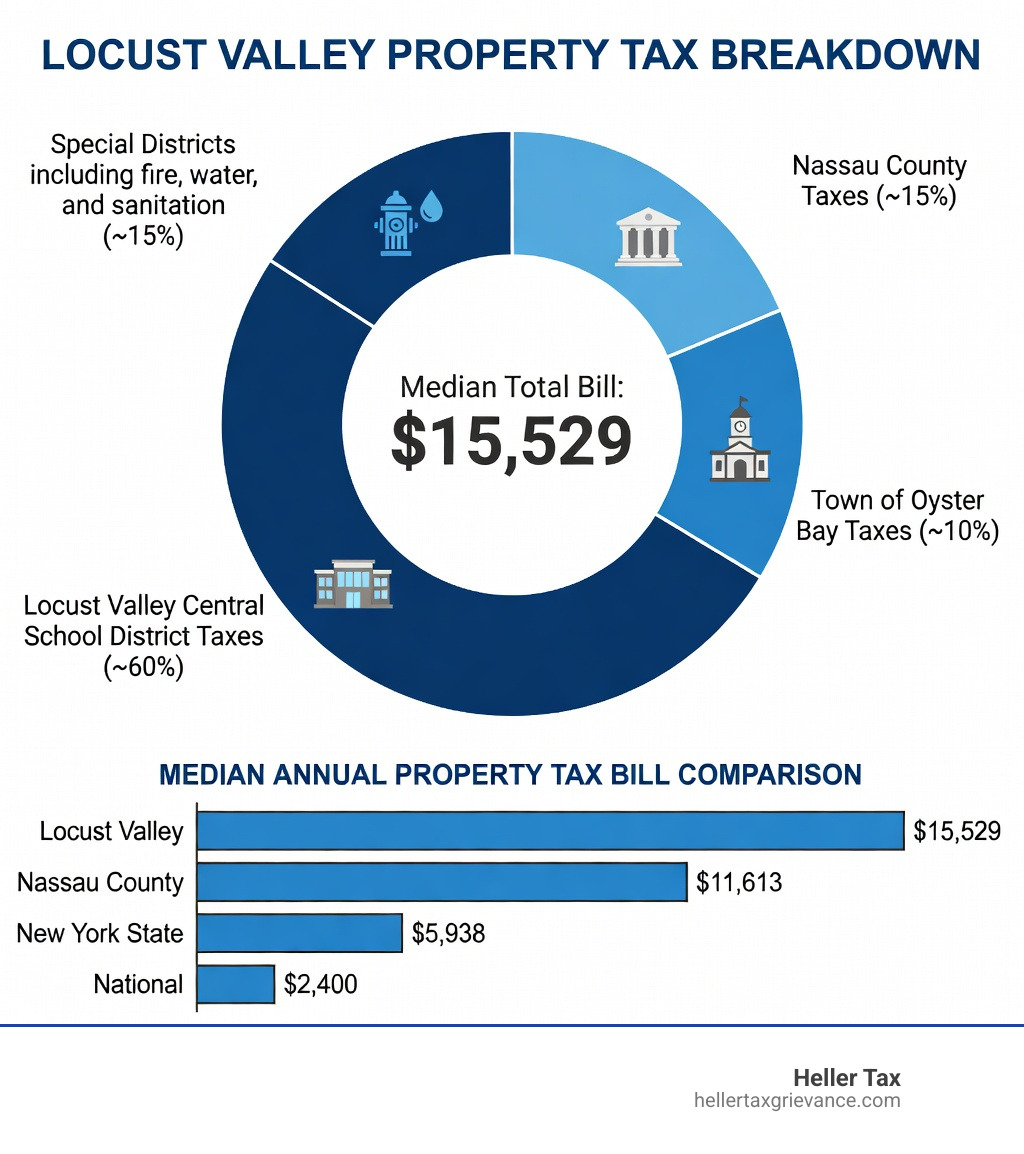
| Median Annual Tax Bill | $15,529 | $11,613 | $5,938 | $2,400 |
| Effective Tax Rate | 2.13% | 1.79% | 2.39% | 1.02% |
The typical Locust Valley homeowner pays $15,529 per year in property taxes – that’s more than six times the national median of $2,400.
Tax bills in the area commonly range from $11,100 to $28,950, with the average sitting around $15,750. And here’s the thing most homeowners don’t realize: Nassau County will not voluntarily lower your assessment. If you’re overpaying, it’s up to you to take action.
This guide breaks down exactly how Locust Valley property taxes work, what drives your bill, and what you can do to reduce it.
I’m Adam Heller, founder of Heller Tax Grievance and a Long Island resident with over 15 years of experience helping homeowners reduce their Locust Valley property taxes and assessments across Nassau County. Before launching this firm, I spent years in real estate – which is where I first saw how crushing high property taxes could be for homeowners and sellers alike.
Understanding Your Property Assessment and Tax Bill
To understand your Locust Valley property taxes, we first have to look at how the county views your home. Every year, Nassau County issues an Assessment Notice. This document is the foundation of your tax bill, but it can be as confusing as a tax code written in Morse code.

Market Value vs. Assessed Value
The “Market Value” on your notice is what the county thinks your home would sell for in the current market. The “Assessed Value” is a fraction of that market value. In Nassau County, residential properties (Class 1) are assessed at a small percentage of their market value.
The math sounds simple: Assessed Value x Tax Rate = Your Tax Bill. However, if the county’s starting “Market Value” is too high, your assessed value follows suit, and you end up overpaying.
Property Class and Exemptions
Most homes in Locust Valley are “Class 1” properties (one-to-three-family homes). Within this classification, you may be eligible for exemptions that lower your taxable value:
- STAR (School Tax Relief): The most common exemption for primary residences.
- Senior Citizens Exemption: For homeowners 65 and older with limited income.
- Veterans Exemption: For those who served in the armed forces.
How to Read Your Tax Bill
Locust Valley is an unincorporated area within the Town of Oyster Bay. This means your tax collection is handled by the Town of Oyster Bay Receiver of Taxes. When you look at your bill, you aren’t just paying one entity; you are paying a “bundle” of jurisdictions.
- Nassau County: Covers county-wide services and the police department.
- Town of Oyster Bay: Covers town-wide services and highway maintenance.
- School District: For most of us, this is the Locust Valley Central School District, which typically makes up about 60-70% of your total bill.
- Special Districts: These include your district-specific water, fire protection, and library districts.
Finding Your Property’s Details
To truly understand if you are being overcharged, you need the “receipts” on your property’s data. The Nassau County Land Records Viewer is an invaluable tool for this. By entering your address or your Section, Block, and Lot (SBL) number, you can see:
- Property Characteristics: Square footage, number of bathrooms, and lot size (the average lot in Locust Valley is 0.323 acres).
- Sales History: What you and your neighbors paid for your homes.
- Assessment History: How your value has changed over the years.
If the Land Records Viewer says your house has five bathrooms but you only have three, you are being taxed for “phantom” plumbing! These errors are more common than you’d think.
Locust Valley Property Tax Rates and Statistics
Locust Valley is known for its beautiful estates, polo clubs, and “white shoe” culture, but it’s also known for some of the highest effective tax rates in the region.
The median home value in Locust Valley sits at approximately $727,000, with many properties selling for much more—the average sale price is actually closer to $1,100,000. Because the property values are high and the community service needs (especially schools) are significant, the tax bills follow suit.
Calculating Your Locust Valley Property Taxes
The tax rate isn’t a static number; it’s determined by school, town, and county budgets. Every year, the school board, the town, and the county sit down to figure out how much money they need to run. They take that total budget and divide it by the total assessed value of all property in the area.
The Locust Valley Central School District budget is the biggest driver here. For the 2021-2022 fiscal year, the district had a total revenue of over $93 million, with 89% of that coming from district taxpayers like you. You can see the full breakdown of their spending and revenue through the National Center for Education Statistics.
Comparing Locust Valley Property Taxes to Other Areas
How does Locust Valley stack up? It’s a bit of a “good news, bad news” situation.
| Metric | Locust Valley | Nassau County Avg | NY State Median | National Median |
|---|---|---|---|---|
| Effective Tax Rate | 2.13% | 1.79% | 2.39% | 1.02% |
| Average Tax Bill | $15,750 | $11,623 | $5,938 | $2,400 |
While our effective rate of 2.13% is slightly lower than the New York State median of 2.39%, our actual bills are much higher because our homes are worth significantly more. Compared to the national average, Locust Valley residents are paying a massive premium for the privilege of living on the Gold Coast.
The Nassau County Grievance Process for Locust Valley
If you feel like your tax bill is a work of fiction, you have the right to challenge it. This is called a tax grievance. In Nassau County, over-assessment is incredibly common. The county uses mass-appraisal computer models that often fail to account for the unique quirks of a specific property.
Key Dates and Deadlines
The most important thing to remember about Locust Valley property taxes is the Nassau County property tax grievance calendar. If you miss the window, you have to wait an entire year to try again.
- January: The County publishes the Tentative Assessment Roll. This is your first look at next year’s proposed value.
- January – March 1st: This is the “Grievance Season.” You must file your appeal during this window.
- March 1st: The hard deadline for filing a grievance in Nassau County.
- April – August: The Assessment Review Commission (ARC) reviews the filings.
- Following Year: If successful, your tax reduction appears on your future tax bills.
How to File a Property Tax Grievance
You file your grievance with the Nassau County Assessment Review Commission (ARC). To win, you generally need to prove that your “Market Value” is lower than what the county claims. We do this by presenting “comparable sales”—similar homes in Locust Valley that sold for less than your assessment implies.
If ARC denies your claim or doesn’t offer a sufficient reduction, the next step is Small Claims Assessment Review (SCAR). This is a hearing held in the New York State Supreme Court where an impartial hearing officer reviews the evidence.
Potential Savings and Guarantees
At Heller Tax Grievance, we’ve seen homeowners save thousands of dollars a year. In fact, some properties in nearby areas have seen reductions as high as $20,000 or even $70,000 annually.
The best part? Your taxes cannot be raised because you filed a grievance. New York State law protects homeowners from “retaliatory” assessments. Filing a grievance is a “no-lose” scenario: your assessment either goes down, or it stays the same.
Resources for Paying and Researching Your Taxes
Managing your Locust Valley property taxes requires staying organized. Fortunately, the Town of Oyster Bay has modernized many of its systems.
Paying Your Taxes
You can pay your school taxes and general taxes through the Town of Oyster Bay Receiver of Taxes.
- Online: You can use the Town of Oyster Bay Online Tax Payment Portal.
- Payment Methods: They accept credit cards (MasterCard, VISA, American Express, and Discover) and debit cards, though there is a convenience fee involved.
- In-Person: You can visit the tax office in Oyster Bay.
School tax bills are typically mailed in October, and general tax bills follow in January.
Research and Information
For deep dives into your specific parcel, check out Locust Valley Property Records. This site provides a wealth of data on building sizes, construction dates (most Locust Valley homes were built between 1926 and 1975), and historical tax payments.
Frequently Asked Questions about Locust Valley Property Taxes
How are property taxes calculated in Locust Valley?
It’s a three-step formula:
- Assessed Value: The county’s valuation of your home.
- Tax Rate: The combined rates of the School District, Town, County, and Special Districts.
- Exemptions: Any deductions like STAR or Veterans benefits. (Assessed Value x Tax Rate) – Exemptions = Your Annual Tax Bill.
What is the deadline to file a property tax grievance in Nassau County?
The deadline is March 1st of each year. Because this date is set by law, there are almost no extensions. It is critical to get your paperwork in early to avoid any last-minute system glitches.
Can filing a tax grievance raise my property taxes?
Absolutely not. This is the #1 myth we hear. By law, the Nassau County Assessment Review Commission can only lower your assessment or leave it exactly where it is. There is zero risk to your current tax rate by filing a grievance.
Conclusion
There is no getting around it: Locust Valley property taxes are high. Between a median tax bill of over $15,000 and an effective rate that dwarfs the national average, homeowners here carry a heavy load. However, you aren’t powerless.
The “Market Value” the county assigns to your home is just an estimate—and often, it’s an overestimation. By reviewing your assessment, utilizing the Land Records Viewer, and filing a timely grievance with Nassau County, you can ensure you aren’t paying more than your fair share.
At Heller Tax Grievance, we make this process effortless. We operate on a “You Don’t Pay Unless You Save” guarantee. We handle all the paperwork, the market analysis, and the negotiations with Nassau County. We’ve saved Long Island homeowners over $160 million to date, and we’d love to help you next.
Don’t let another March 1st deadline pass you by. Start the process of appealing your property tax assessment today and keep more of your hard-earned money where it belongs—in your pocket.