
Introduction: What Every Long Island Homeowner Should Know
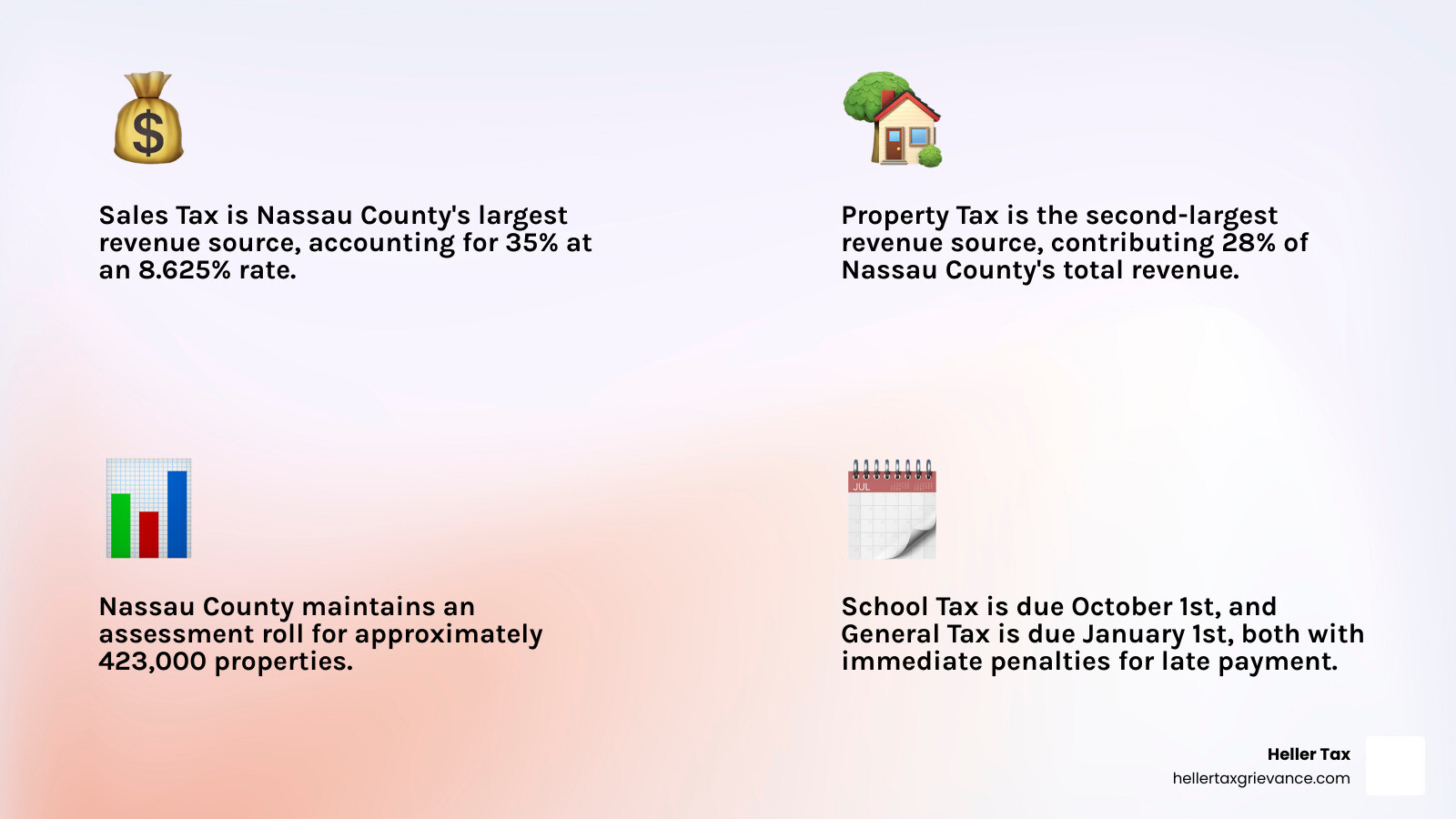
Nassau taxes are a significant financial burden for Long Island homeowners, accounting for 28% of Nassau County’s total revenue. Here’s what you need to know:
Quick Facts About Nassau Taxes:
- Property Tax is the second-largest revenue source for Nassau County (28% of total revenue)
- Sales Tax is the largest revenue source (35% of revenue) at a rate of 8.625%
- Nassau County has approximately 423,000 properties on the tax roll
- Payment methods include online, mail, and in-person with varying convenience fees
- Tax deadlines vary by town and type (School Tax vs. General Tax)
- You have the right to challenge your assessment if you believe it’s too high
Property taxes in Nassau County are determined by your property’s assessed value, local millage rates, and the budgets of various taxing authorities including your town, school district, and special districts. The Nassau County Department of Assessment establishes property values that form the basis for your tax bill.
How Your Tax Bill Breaks Down:
- Assessed property value (set by the Department of Assessment)
- School district taxes (typically the largest portion)
- Town/city taxes
- Special district fees (fire, water, sewer, etc.)
- Less any applicable exemptions (STAR, Senior, Veteran)
Most homeowners receive two tax bills per year: School Tax (due in fall/winter) and General Tax (due in winter/summer). Payment deadlines are strict, with penalties applied immediately after the due date. However, various exemptions and the right to grieve your assessment can significantly reduce your tax burden.
I’m Adam Heller, and I’ve spent nearly two decades helping Long Island property owners steer Nassau taxes and reduce their property tax burden. After selling my real estate firm to Douglas Elliman in 2006, I founded Heller & Consultants Tax Grievance and have since helped over 50,000 clients challenge unfair assessments, including securing the record for the largest property tax reduction in Nassau County history at $73,000.
Decoding Your Bill: How Nassau Taxes Are Calculated
Understanding your property tax bill can feel like deciphering a cryptic message. But don’t worry, we’re here to shine a light on the process and help you understand how your Nassau taxes are determined. It all starts with your property assessment, which then gets combined with various tax rates set by local authorities.
The Role of the Department of Assessment
The Nassau County Department of Assessment plays a pivotal role in the property tax process. Think of them as the initial evaluators of your property’s worth. Their primary responsibility is to establish values for land and improvements (like your home) which then become the basis for your property taxes. Nassau County is a busy place, with approximately 423,000 properties under their watchful eye, making it the second-largest assessing jurisdiction in New York State.
The Department of Assessment maintains a comprehensive assessment roll, which includes crucial information about each property. This data is vital for determining how much tax each property owner contributes to the county’s services. For more official assessment information, you can always visit the Nassau County Property Assessment page.
Key Factors That Determine Your Nassau Taxes
So, once the Department of Assessment has valued your property, what happens next? Several factors come into play to shape your final tax bill:
- Property Classification: Properties in Nassau County are classified (e.g., residential, commercial, industrial). This classification can influence how your property is taxed.
- Assessed Value Calculation: The assessed value is a percentage of your property’s market value. While the Department of Assessment sets this value, it’s not always a perfect reflection of what your home would sell for today. An increase in assessed value is a common reason for a tax hike.
- Millage Rates: These are the tax rates applied to your assessed value. A millage rate represents the amount of tax per $1,000 of assessed property value. These rates are determined by various taxing authorities, including your local school district, town, and county. Each authority sets its own rate to fund its budget.
- Special District Fees: Beyond general property taxes, you might see “special assessments” or “district fees” on your bill. These are charges for specific services or improvements within a defined area, such as fire protection, water, sewer, or even park maintenance. We’ll dig deeper into these later, but for now, know they are distinct from your general property tax.
- How Local Budgets Affect Your Bill: The budgets of your local school district, town, and county directly impact the millage rates. If these entities require more funding for services, infrastructure, or education, the millage rates may increase, leading to higher tax bills.
To get a clearer picture of your property’s specific data, including assessment roll data, district information, tax maps, property photographs, past taxes, tax rates, exemptions with amounts, and comparable sales, we highly recommend checking the Nassau County Land Records Viewer. This public service tool, linked to the County’s Geographic Information System (GIS), is an invaluable resource for homeowners. Just remember that the County Assessor and County Clerk databases may have different formatting for section, block, and lot information, so always verify against official records.
A Homeowner’s Calendar: Paying Your Taxes and Avoiding Penalties
Staying on top of your property tax payments is crucial to avoid unnecessary penalties and interest. In Nassau County, we typically deal with two main property tax bills: School Tax and General Tax, each with its own set of deadlines.
How to Pay Your Nassau Taxes: Online, Mail, and In-Person
We understand that convenience is key when it comes to managing your finances. Fortunately, Nassau County offers several ways to pay your property taxes:
Online Payments: Many towns within Nassau County provide online portals for viewing and paying your tax bills. For instance, residents of the Town of Hempstead can view and pay their General and School Tax Bills online via the Receiver of Taxes Payment Center. You’ll need your Parcel ID (school district, section, block, and lot numbers) or tax bill number. If you don’t know your Parcel ID, you can look it up on the Nassau County’s Land Records Viewer.
Be aware that online payments often come with convenience fees:
- Credit Card Payments: Typically incur a convenience fee of 2.3% of your total payment, with a minimum fee of $1.50.
- Electronic Check Payments (e-checks): Usually have a flat fee, such as $1.50 in the Town of Hempstead or $1.75 in the Town of North Hempstead.
- Visa/Mastercard Debit Cards: May have a flat fee, like $3.95 per transaction in the Town of North Hempstead.
These fees are charged by the payment processor, not the county or town, and are required by New York General Municipal Law.
- Paying by Mail: If you prefer the traditional route, you can mail your payment. Ensure your check or money order is made out to the correct Receiver of Taxes (e.g., Mary Jo Collins, Receiver of Taxes for the Town of North Hempstead). Always include your bill number and section, block, and lot with your remittance stub. Crucially, the U.S. Postal Service postmark is the official postmark for mailed payments. Office postage meters are not considered official, so plan accordingly to ensure your payment is postmarked by the due date to avoid penalties.
- In-Person Payments: For those who prefer a face-to-face transaction, you can pay your taxes at the respective Receiver of Taxes office for your town or city. For example, the Town of North Hempstead’s Tax Receiver’s Office is located at 200 Plandome Road, Manhasset, NY 11030. Many towns also offer extended office hours around deadlines and sometimes even community collection sites. Some offices provide after-hours dropboxes for checks or money orders (never cash!), and in-office kiosks for credit/debit card payments. Remember to bring your entire bill when paying in person.
Understanding Tax Deadlines and Late Fees
Missing a deadline can be a real headache, so let’s break down the typical schedule for Nassau taxes:
- School Tax:
- First-half School Tax is generally due around October 1st.
- The last day to pay the first-half without penalty is usually around November 12th.
- Second-half School Tax is typically due around April 1st.
- The last day to pay the second-half without penalty is usually around May 12th.
- General Tax:
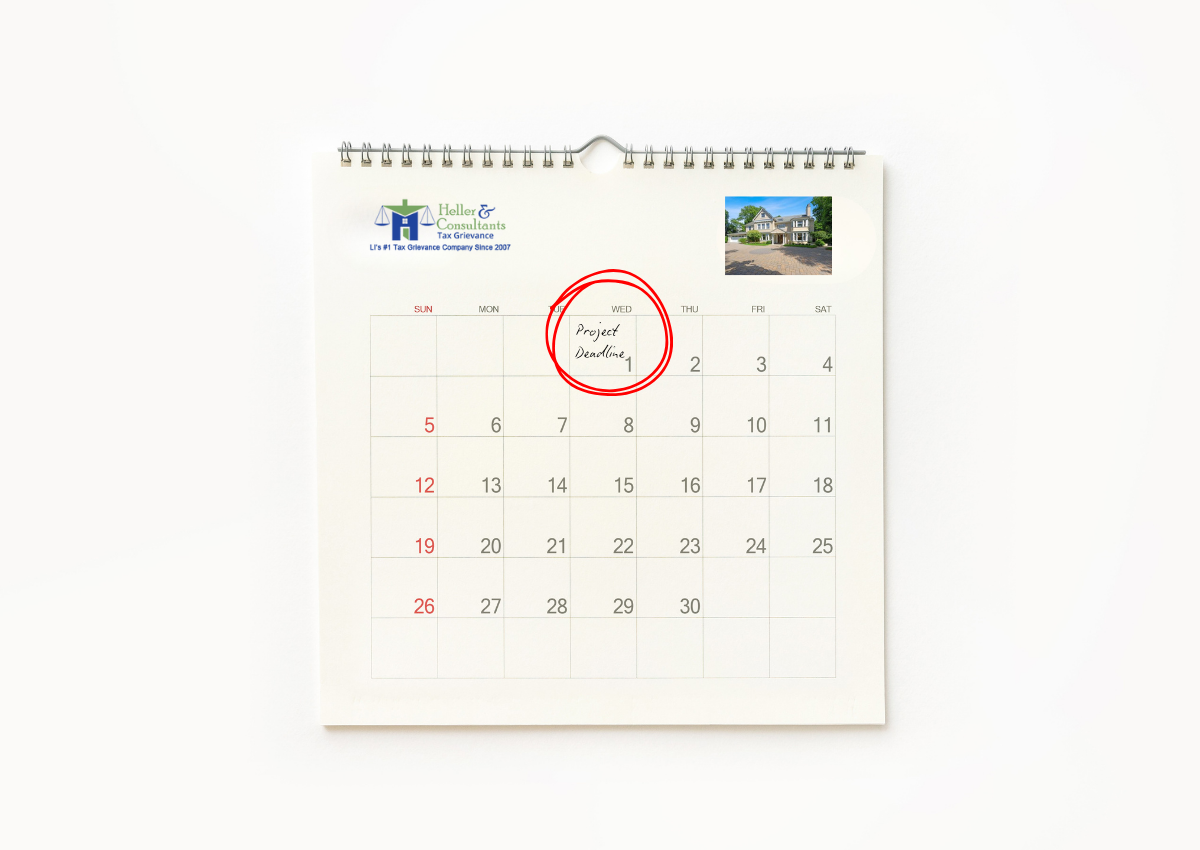
- First-half General Tax is generally due around January 1st.
- The last day to pay the first-half without penalty is usually around February 10th.
- Second-half General Tax is typically due around July 1st.
- The last day to pay the second-half without penalty is usually around August 11th.
What happens if a deadline falls on a weekend or holiday? Good news! If the last day to pay without penalty falls on a weekend or holiday, the deadline is typically extended to the following business day.
Consequences of Late Payment:
Taxes are not considered paid until your payment has cleared the bank. If your payment is late, penalties and interest will be applied. For example, a $20.00 fee is mandated for any check returned as uncollected. The payment websites being unavailable does not waive late fees, so it’s always best to pay early or use an alternative method if you’re cutting it close.
Challenging Your Assessment: A Path to Lower Property Taxes
One of the most powerful tools available to us as homeowners in Nassau County is the right to challenge our property assessment. We believe nobody should pay more than their fair share of property tax, and sometimes, the county’s assessment doesn’t quite get it right.
Over-assessment Explained: An over-assessment occurs when the assessed value of your property, as determined by the Department of Assessment, is higher than its actual market value or is disproportionately higher than similar properties in your neighborhood. This can happen for various reasons, including outdated data, market fluctuations, or errors in the assessment process. When your property is over-assessed, you end up paying more in Nassau taxes than you rightfully should.
The Significance of the Tentative Assessment Roll Release: Each year, typically around January 2nd, the Department of Assessment releases the Tentative Assessment Roll. This is a preliminary valuation of your property for the upcoming tax year. This release is a critical date for homeowners because it marks the beginning of the grievance period – your window of opportunity to review and challenge your assessment. It’s an informational announcement that serves as an urgent call to action.
The Annual Grievance Period: The grievance period is a limited time frame during which you can formally dispute your property’s assessed value. For Nassau County, this deadline is usually from January 2nd to March 1st. For Suffolk County, typically a filing must occur between May 1st and the 3rd Tuesday in May. We cannot stress enough how important it is to act within this window.
Are You Eligible for Tax Exemptions?
Before we dive into the grievance process, let’s talk about exemptions. These are reductions in the assessed value of your property, which in turn lower your tax bill. Many homeowners are eligible but might not even know it! Applying for these can significantly cut down your Nassau taxes.
- STAR Program (School Tax Relief): This is New York State’s largest school property tax relief program.
- Basic STAR: Available to owner-occupied primary residences regardless of the owner’s age, with an income limit. It’s a partial exemption from school taxes.
- Improved STAR: Offers a greater exemption for senior citizen homeowners (age 65 and older) who meet specific income requirements.
- Senior Citizen Homeowners’ Exemption (SCHE): This exemption can reduce the assessed value of your property by up to 50% for qualifying seniors (65 or older) with limited incomes.
- Veterans’ Exemption: Eligible veterans and their surviving spouses can receive exemptions based on their service during wartime or in combat zones.
- Other Exemptions: There are also exemptions for people with disabilities, agricultural properties, new construction, and more.
How and where to apply for valuable exemptions: Homestead and other exemption applications are processed by the Property Appraiser’s office. You can visit their website for more information. It’s crucial to check eligibility requirements and deadlines for each exemption, as they can vary. Applying for these exemptions is a proactive step towards reducing your Nassau taxes.
The Grievance Process: How to Challenge Your Assessment
If you believe your property has been over-assessed, you have the right to challenge it. This process, known as grieving your assessment, is how you can seek a reduction in your property’s assessed value, and consequently, your tax bill.
Filing a Grievance with the Assessment Review Commission:
The first step is to file a formal complaint with the Nassau County Assessment Review Commission (ARC). This is your official opportunity to present evidence that your property’s assessment is unfair or inaccurate. The critical deadline for filing a grievance in Nassau County is March 1st. Mark your calendars, because missing this deadline means you’ll likely have to wait until the next year to challenge your assessment.
Small Claims Assessment Review (SCAR):
If you’re not satisfied with the ARC’s decision, or if you believe they haven’t adequately addressed your concerns, you have the option to pursue a Small Claims Assessment Review (SCAR) petition in New York State Supreme Court. This is a more formal legal proceeding but is designed to be accessible to homeowners without extensive legal knowledge.
Evidence Needed for a Successful Appeal:
To build a strong case for your grievance, you’ll need compelling evidence. This typically includes:
- Comparable Sales Data: Information on recent sales of similar properties in your neighborhood. The Nassau County Land Records Viewer can be a great resource for finding comparable sales.
- Property Photographs: Photos highlighting any negative features of your property or differences compared to assessed comparables.
- Professional Appraisal: A recent appraisal from a certified appraiser can provide a strong, independent valuation of your property.
- Documentation of Damage or Defects: Evidence of any issues that might reduce your property’s value (e.g., structural problems, water damage).
- Market Analysis: A detailed analysis of current market conditions that might indicate a decline in property values in your area.
Comparing your assessment to similar properties: This is one of the most effective ways to challenge an assessment. By identifying properties in your immediate area that are similar in size, age, condition, and amenities, but have a lower assessment, you can argue for a reduction in your own. The goal is to demonstrate that your property is assessed at a higher percentage of market value than comparable properties.
Frequently Asked Questions About Nassau County Taxes
We know that navigating Nassau taxes can bring up a lot of questions. Here, we’ll address some of the most common inquiries we hear from homeowners.
What is a tax lien sale and how does it work in Nassau County?
A tax lien sale is a mechanism used by municipalities to collect delinquent property taxes. When a property owner fails to pay their property taxes, the county places a lien on the property. This lien represents the amount of unpaid taxes, plus interest and penalties.
In Nassau County, the county conducts an Annual Tax Lien Sale. Instead of selling the property itself, the county sells these tax liens to private investors. The investor pays the delinquent tax amount to the county, and in return, they acquire the right to collect that money (plus interest) from the property owner.
Consequences for Delinquent Property Owners: If you own a property with a tax lien sold, you will owe the investor the original delinquent amount plus a high rate of interest. If you still fail to pay the investor within a certain period (known as the redemption period), the investor can initiate foreclosure proceedings, potentially leading to the loss of your property. This is why it’s crucial to address delinquent Nassau taxes promptly.
Public Notices for Purchasers: For those interested in purchasing tax liens, Nassau County publishes public notices detailing the properties with outstanding liens that are up for sale. This information is typically available through the county’s official website. You can find information regarding the Nassau County Tax Lien Sale.
Where can I find official tax forms for Nassau County?
Finding the right tax forms can sometimes feel like a treasure hunt. Luckily, Nassau County provides centralized resources to help you.
- Nassau County Tax Forms & Resources: For a comprehensive list of forms and information related to Nassau taxes, including property assessment and review forms, we recommend visiting the official Nassau County Tax Forms & Resources page.
- Town and Village Forms: Many towns and villages within Nassau County also have their own specific tax forms, especially for property tax matters. For example, the Town of Hempstead provides Town of Hempstead Tax Forms, and the Village of New Hyde Park offers forms through their Village of New Hyde Park Tax Forms page.
- New York State and Federal Tax Forms: For state-level tax forms and instructions, you can visit the New York State Department of Taxation and Finance website. For federal tax forms, the IRS website is your go-to resource.
These resources cover a wide range of tax-related needs, from property tax assessment review forms to business and individual taxpayer information.
How do special assessments differ from general property taxes?
This is a common point of confusion! While both appear on your tax bill and contribute to your overall Nassau taxes, special assessments and general property taxes serve different purposes and are calculated differently.
General Property Taxes: These are the broad-based taxes we’ve been discussing, calculated based on your property’s assessed value and the millage rates set by the county, town, and school district. They fund general government services that benefit the entire community, such as education, police and fire services (where not covered by special districts), general administration, and road maintenance.
Special Assessments or District Fees: These are charges levied against properties that directly benefit from a specific service or improvement within a defined geographic area, known as a special district.
- Purpose of Special Districts: Special districts are created to provide specialized services that general government might not offer uniformly, or to fund specific infrastructure projects. Common examples include fire districts, water districts, sewer districts, garbage collection districts, lighting districts, and even specific park or ambulance districts.
- How Fees Are Calculated and Approved: Unlike general property taxes, special assessment fees are often a flat rate or are calculated based on the benefit received by the property, not solely on its assessed value. For example, a water district fee might be based on water usage or a flat service charge. These fees are typically approved by the residents within the special district or by the governing body creating the district.
- How They Appear on Your Tax Bill: Special assessment fees are usually listed separately on your property tax bill, clearly indicating the district or service they fund. The Nassau County Property Appraiser’s office can assist with estimating general property tax amounts but often does not have access to non-ad valorem assessment amounts (like CDD fees in some areas). You might need to contact the specific special assessment entity directly for estimated amounts.
General property taxes fund the big picture, while special assessments fund the specific needs of smaller, localized areas. Both are part of your comprehensive Nassau taxes commitment.
Conclusion: Take Control of Your Property Tax Burden
We’ve covered a lot of ground today, from understanding how your Nassau taxes are calculated to navigating payment options, exemptions, and the crucial grievance process. The key takeaway is this: understanding your property tax bill is the first step towards managing one of your largest household expenses.
You have the right to challenge your assessment, and you don’t have to overpay. We know the process can seem daunting, filled with deadlines, forms, and complex terminology. That’s why we, Heller Tax Grievance, are here to help Long Island homeowners like you.
With nearly two decades of experience and a track record of saving our clients over $160 million, we pride ourselves on securing the largest tax reductions in both Nassau and Suffolk counties. Our unique selling proposition is simple and homeowner-friendly: a “You Don’t Pay Unless You Save” guarantee. This means we only charge a fee equal to 50% of the tax reductions we achieve for you, and if we don’t reduce your taxes, you pay us nothing. We have locations across Long Island.
Don’t let an unfair assessment impact your financial well-being. Take control of your property tax burden.
Learn more about the property tax grievance process and how we can help you potentially reduce your Nassau taxes today.