

Why Every Old Westbury Homeowner Should Review Their Assessment
Old Westbury property tax grievance is the official process homeowners use to challenge their property’s assessed value and potentially lower their annual tax bill. Here’s what you need to know:
- What it is: A formal complaint filed with Nassau County and/or the Village of Old Westbury claiming your property is over-assessed
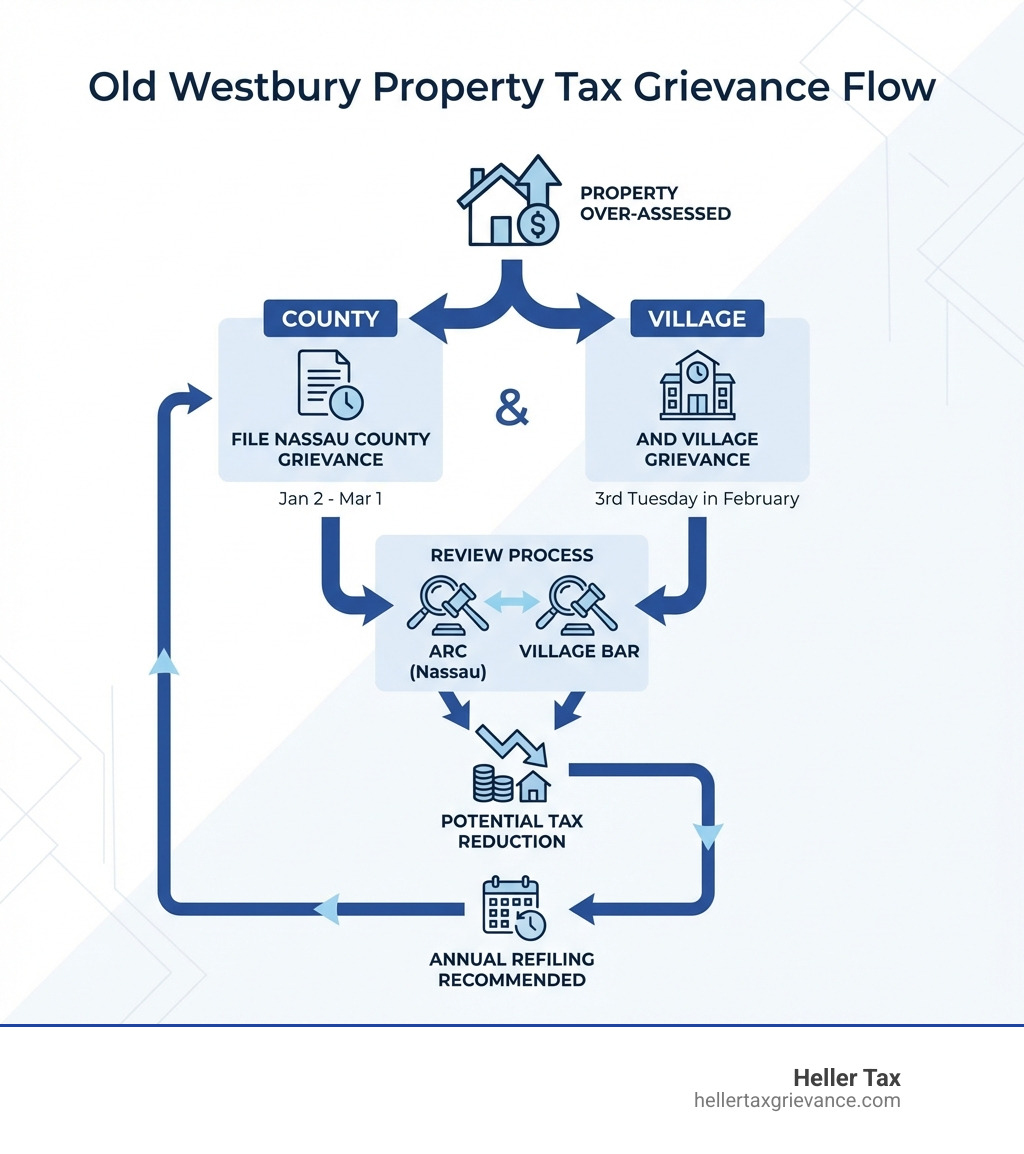
- When to file: Nassau County grievances run January 2 – March 1; Village grievances are due the 3rd Tuesday in February
- Who can file: Property owners, their authorized agents, or tenants required to pay taxes
- Cost: No fee if unsuccessful; professional services typically charge 35-50% of tax savings
- Risk: Your taxes cannot increase from filing a grievance—only decrease or stay the same
- Key fact: Nassau County can raise your assessment up to 6% per year or 20% over five years, making annual filing essential
If you’re an Old Westbury homeowner, there’s a good chance you’re paying more than your fair share. In 2007, Business Week dubbed Old Westbury New York’s most expensive suburb, and Nassau County homeowners consistently face some of the highest property taxes in the entire United States. Yet many residents don’t realize their property may be over-assessed compared to similar homes in their community.
Filing a grievance isn’t about dodging taxes—it’s about ensuring you only pay what’s fair. The process exists because the mass appraisal system Nassau County uses to value properties can’t account for individual characteristics like your home’s condition, location quirks, or recent damage. When comparable homes are assessed lower than yours, you have a valid case for reduction.
Old Westbury presents a unique situation. Unlike most Nassau County villages, Old Westbury is an “assessing unit” that sets its own property values for village taxes. This means you face two separate tax bills—one from Nassau County (covering county, town, and school district taxes) and one from the Village. To maximize your savings, you must file two separate grievances with different authorities on different timelines.
The stakes are high. A successful grievance can save you thousands of dollars annually, and in Nassau County, if you win a reduction one year, you can refile the next year to maintain fair assessments. Heller Tax Grievance has helped thousands of Long Island homeowners steer this process, including achieving the record for the largest property tax reduction in Nassau County at $73,000 per year.
I’m Adam Heller, and since founding Heller & Consultants Tax Grievance in 2006, I’ve specialized in helping homeowners file successful Old Westbury property tax grievances through both the Nassau County and Village systems. After working with over 50,000 clients and establishing relationships with assessors and review commissions across Long Island, I’ve seen how the dual grievance process in Old Westbury confuses homeowners—and how much money they leave on the table by not filing both applications.
Understanding the Old Westbury Property Tax Grievance Process
A property tax grievance is essentially a formal complaint challenging the assessed value of your home, which directly impacts your property tax bill. It’s your right as a homeowner to ensure that the value placed on your property by the assessing authority is fair and accurate. In Old Westbury, this process is a bit more nuanced than in other parts of Nassau County because of the village’s unique assessment status.
While most of Nassau County follows a unified assessment system, Old Westbury operates as an “assessing unit” for its own village taxes. This means that when we talk about an Old Westbury property tax grievance, we’re often addressing two distinct but equally important processes: one for your county, town, and school taxes (handled by Nassau County), and another specifically for your village taxes (handled by the Village of Old Westbury itself).
This dual system can be confusing, but understanding it is key to maximizing your potential tax savings. If you only grieve your county assessment, you’re missing out on potential reductions on your village tax bill, and vice versa. It’s like leaving money on the table!

Any person who pays property taxes can grieve an assessment. This includes property owners, purchasers, and even tenants who are required to pay property taxes as part of their lease or written agreement. For a comprehensive overview of grievance procedures in New York State, you can always refer to the New York State Department of Taxation and Finance’s official Grievance procedures – Department of Taxation and Finance – NY.Gov.
The Nassau County Grievance: For County, Town, and School Taxes
The primary avenue for challenging your county, town, and school taxes in Old Westbury is through the Nassau County Assessment Review Commission (ARC). The ARC is the administrative review body responsible for handling all property tax grievances for properties under the county’s assessment roll.
The filing period for the Nassau County grievance is typically from January 2nd to March 1st each year. This is a crucial window, and missing it means you’ll have to wait until the next year to file. We always recommend marking these dates on your calendar!
Eligibility for filing with ARC is broad: generally, if you’re the homeowner (or authorized agent) of a one, two, or three-family home used exclusively for residential purposes, you can file. Nassau County is known for its annual recalculations and adjustments to property assessments. This means your property’s assessed value can change every year, and not always in your favor. In fact, Nassau County can increase your assessment up to 6% per year, or as much as 20% over a five-year period! This aggressive reassessment schedule is precisely why filing a Old Westbury property tax grievance annually is so vital. It’s your best defense against ever-increasing tax bills.
The Nassau County ARC manages the full grievance process, from the initial application to submitting supporting documents and conducting any required appearances. You can find more information about their operations at the Nassau County Assessment Review Commission (ARC) website.
The Village of Old Westbury Grievance: For Village Taxes
Here’s where the Old Westbury situation gets specific. Because the Village of Old Westbury is an “assessing unit,” it maintains its own assessment roll for village tax purposes. This means you need to file a separate grievance directly with the Village of Old Westbury’s Board of Assessment Review (BAR) to challenge your village tax assessment.
For assessing villages like Old Westbury, the grievance month is February, and the petition month is April. The deadline for filing your village grievance is specifically the 3rd Tuesday of February. This is distinct from the county deadline and requires its own paperwork and attention.
Filing both the Nassau County grievance and the Village of Old Westbury grievance is paramount. Neglecting one means you’re only addressing half of your property tax burden. We’ve seen many homeowners make this mistake, and we want to help you avoid it. By tackling both, you ensure a comprehensive review of your entire property tax liability.
Your Step-by-Step Checklist for a Successful Grievance
Filing a successful Old Westbury property tax grievance might seem daunting, but by breaking it down into manageable steps, we can steer the process effectively.

Step 1: Determine if You’re Over-Assessed
The first and most critical step is figuring out if your property is indeed over-assessed. This isn’t always obvious, especially with the complexities of mass appraisal systems used by Nassau County. These systems, while efficient, can often overlook individual property characteristics or fail to keep pace with market fluctuations in specific neighborhoods.
Common reasons for over-assessment include:
- Mass Appraisal System Inaccuracies: The county’s system often uses broad strokes, missing unique features of your home, like a recent renovation, an outdated kitchen, or even a less desirable location within your specific block.
- Unequal Assessment: This occurs when your property is assessed at a higher percentage of its market value than other comparable properties in your municipality. You might be assessed fairly compared to your home’s actual market value, but unfairly compared to your neighbors.
- Market Value Changes: Property values fluctuate. If the market value in Old Westbury has declined since your last assessment, or if your property has specific conditions impacting its value (e.g., proximity to noise, lack of desirable amenities), your assessment might not reflect its true worth.
Checking Your Assessment Roll: You can find your property’s current assessed value on the annual assessment roll. If your municipality assesses at 100% of market value, your assessment and the assessor’s estimate will be identical. Otherwise, you can calculate the assessor’s estimate by dividing your assessment by the level of assessment.
Gathering Evidence: This is where you build your case. We need to demonstrate that your property’s assessed value is higher than its fair market value, or higher than comparable properties. Key pieces of evidence include:
- Comparable Property Sales: Look for recent sales of similar homes in Old Westbury, particularly those that sold for less than your assessed value. These should be properties of similar size, age, condition, and location.
- Photos of Property Condition: Document any issues that might negatively impact your home’s value, such as an aging roof, outdated interiors, or necessary repairs.
- Professional Appraisal: While not always necessary, a recent appraisal can be powerful evidence.
- Income/Expense Statements: For income-generating properties, these can show a lower market value.
The New York State Department of Taxation and Finance offers helpful resources on determining if your assessment is fair. You can check out their video: Is your assessment fair?.
Step 2: Prepare and File Your Application
Once you’ve determined you have a strong case, it’s time to prepare the necessary forms. You’ll likely be dealing with two separate applications for your Old Westbury property tax grievance:
- Nassau County AR1 Form: This is for your county, town, and school taxes. You can obtain this form from the Nassau County Assessment Review Commission or online.
- Village RP-524 Form: This is for your village taxes. The RP-524 form is the standard “Complaint on Real Property Assessment” form used in most of New York State.
Information Needed for Forms: Both forms will require similar basic information:
- Your name and contact information
- Property location and identification (Section, Block, Lot)
- Current assessed value (land and total)
- Your estimate of the property’s market value
- The amount of assessment reduction you are requesting
Grounds for Complaint: This is where you explain why you believe your assessment is incorrect. The forms typically list several legal grounds:
- Excessive Assessment: Your property’s assessed value is simply too high, meaning it exceeds its fair market value. This is the most common ground. You’ll use comparable sales data to prove this.
- Unequal Assessment: Your property is assessed at a higher percentage of market value than the average for comparable properties in Old Westbury. You might be assessed at 100% of market value, but other similar homes are only assessed at 80%, making your assessment unequal.
- Unlawful Assessment: This applies if your property is entirely exempt, outside the assessing unit’s boundaries, or assessed by an unauthorized person.
- Misclassification: This is relevant in municipalities with homestead and non-homestead tax rates, where your property might be incorrectly classified (e.g., a residential property being classified as commercial).
Carefully completing these forms is crucial. We handle all the paperwork for our clients, ensuring accuracy and proper submission. For detailed guidance on filling out the RP-524 form, you can consult the New York State Department of Taxation and Finance’s guide: Completing the grievance form.
Step 3: Navigating the Process After You File Your Old Westbury property tax grievance
Once your Old Westbury property tax grievance applications are filed, the waiting game begins.
Review by ARC/BAR:
- Nassau County ARC: The Assessment Review Commission will review your application and the evidence provided. They may request additional information or schedule a conference.
- Village of Old Westbury BAR: The Village’s Board of Assessment Review will conduct a similar review process for your village grievance. They also have the right to request further evidence or your appearance.
Receiving the Determination Notice: After their review, both the ARC and the Village BAR will issue a formal determination notice. This document will state whether your grievance was successful, partially successful, or denied, and what, if any, reduction was granted.
Understanding the Decision: It’s important to carefully read and understand the determination notice. It will outline the new assessed value (if reduced) and any next steps or appeal rights.
What to do if your grievance is denied: Don’t despair! A denial at the administrative level is not the end of the road. You have further options, which we’ll discuss in the next section. Our team at Heller Tax Grievance monitors these outcomes closely and advises clients on the best course of action.
What Happens If Your Grievance Is Denied?
If your Old Westbury property tax grievance is denied by either the Nassau County ARC or the Village BAR, you still have avenues for appeal. This is where professional guidance becomes even more critical.
The most common next step for residential property owners is to pursue a Small Claims Assessment Review (SCAR) proceeding. SCAR is a low-cost option available through the New York State Unified Court System. It’s designed for homeowners of one, two, or three-family dwellings used exclusively for residential purposes, or owners of vacant land not large enough for such a dwelling. There is a $30 filing fee for SCAR.
To initiate a SCAR proceeding, you must file within 30 days of the filing of the final assessment roll or notice of such filing, whichever is later. This deadline is strict, so prompt action is essential. While you can represent yourself in SCAR, having an experienced professional who understands the nuances of property valuation and court procedures can significantly improve your chances of success.
For more complex cases, or for commercial properties, a tax certiorari proceeding in State Supreme Court may be necessary. This is a more formal legal process and typically requires the assistance of an attorney.
At Heller Tax Grievance, we pride ourselves on managing the entire process for you. This includes handling any required appearances before the ARC or Village BAR, and if necessary, guiding you through the SCAR process. We have a track record of achieving significant reductions for homeowners, even if they’ve been denied previously. Our goal is to ensure you don’t overpay, and we’ll explore every available option to achieve that.
Frequently Asked Questions about the Old Westbury property tax grievance
We hear a lot of questions from homeowners in Old Westbury and across Long Island about the grievance process. Let’s tackle some of the most common ones.
Can filing a property tax grievance increase my taxes?
This is a very common concern, and we’re happy to tell you: No, your taxes can never be increased because you filed a grievance. New York State law explicitly protects homeowners from this. The worst that can happen is your assessment stays the same. So, you truly have nothing to lose by filing. Your assessment can only be lowered or remain unchanged.
What are the costs involved in filing a grievance?
The costs can vary depending on how you choose to file your Old Westbury property tax grievance:
- DIY Filing: If you choose to file yourself, the direct costs are minimal. You won’t pay a fee to the ARC or Village BAR for the initial grievance. However, if you proceed to a Small Claims Assessment Review (SCAR) in court, there’s a $30 filing fee.
- Hiring a Professional: This is where most homeowners find value. Professional grievance services, like Heller Tax Grievance, typically operate on a contingency fee model. This means there are no upfront fees, and you only pay if we successfully achieve a reduction for you. Our “You Don’t Pay Unless You Save” guarantee is a cornerstone of our service. If there’s no reduction, there’s no fee. When a reduction is secured, our fee is a percentage of the tax savings, typically 35-50%. This structure ensures that our interests are aligned with yours – we only get paid if we save you money!
Do I have to file a grievance every year?
While not strictly mandatory, we highly recommend filing an Old Westbury property tax grievance every single year. Here’s why:
- Annual Recalculations: Nassau County recalculates and adjusts assessments annually. Your property’s assessed value can increase by up to 6% per year or 20% over a five-year period. Filing annually is your best defense against these automatic increases.
- One-Year Reductions: A successful grievance typically results in a reduction for that specific tax year only. It doesn’t permanently lower your assessment for future years. To maintain a fair assessment and prevent your taxes from creeping back up, you need to refile each year.
- Changing Market Conditions: Property values are dynamic. What was a fair assessment last year might not be this year due to market shifts, neighborhood developments, or changes to your own property. Annual filing ensures your assessment always reflects current conditions.
Think of it as an annual insurance policy against overpayment. It’s a hassle-free way to ensure you’re not overcharged year after year.
Conclusion: Take Control of Your Old Westbury Property Taxes
Filing an Old Westbury property tax grievance is not just a bureaucratic task; it’s your fundamental right as a homeowner to ensure you’re paying only your fair share. Given that Nassau County homeowners face some of the highest property taxes in the nation, and Old Westbury itself is one of New York’s most expensive suburbs, proactively managing your assessment is crucial to protecting your financial well-being.
We’ve seen how the dual grievance process in Old Westbury—requiring separate filings for county and village taxes—can be confusing. But understanding this dual approach is the key to maximizing your potential tax savings. Neglecting one means leaving money on the table.
Filing a grievance is a risk-free endeavor. Your taxes cannot increase as a result of filing; they can only decrease or stay the same. With Nassau County’s annual assessment increases (up to 6% per year or 20% over five years), filing annually is not just recommended, maintaining a fair assessment.
At Heller Tax Grievance, we understand the complexities of the Nassau County and Village of Old Westbury assessment systems. Our “You Don’t Pay Unless You Save” guarantee means you have nothing to lose and potentially significant savings to gain. We handle all the paperwork, track deadlines, and represent your interests, making the process simple and stress-free for you. We’ve helped thousands of Long Island homeowners achieve substantial tax reductions, including historic records. Let us put our expertise to work for you.
Don’t let over-assessment cost you another dollar. Take control of your property taxes today.