
When Can You Deduct Property Taxes on Federal Returns?
Yes, you can deduct property taxes on your federal income tax return if you itemize deductions on Schedule A instead of taking the standard deduction, up to the federal state and local tax (SALT) cap. To qualify for a federal tax write-off, real estate taxes must meet specific IRS criteria: they must be assessed uniformly across all property in the community, based on the assessed value of the property (known as ad valorem), and dedicated to general public welfare rather than private benefits.
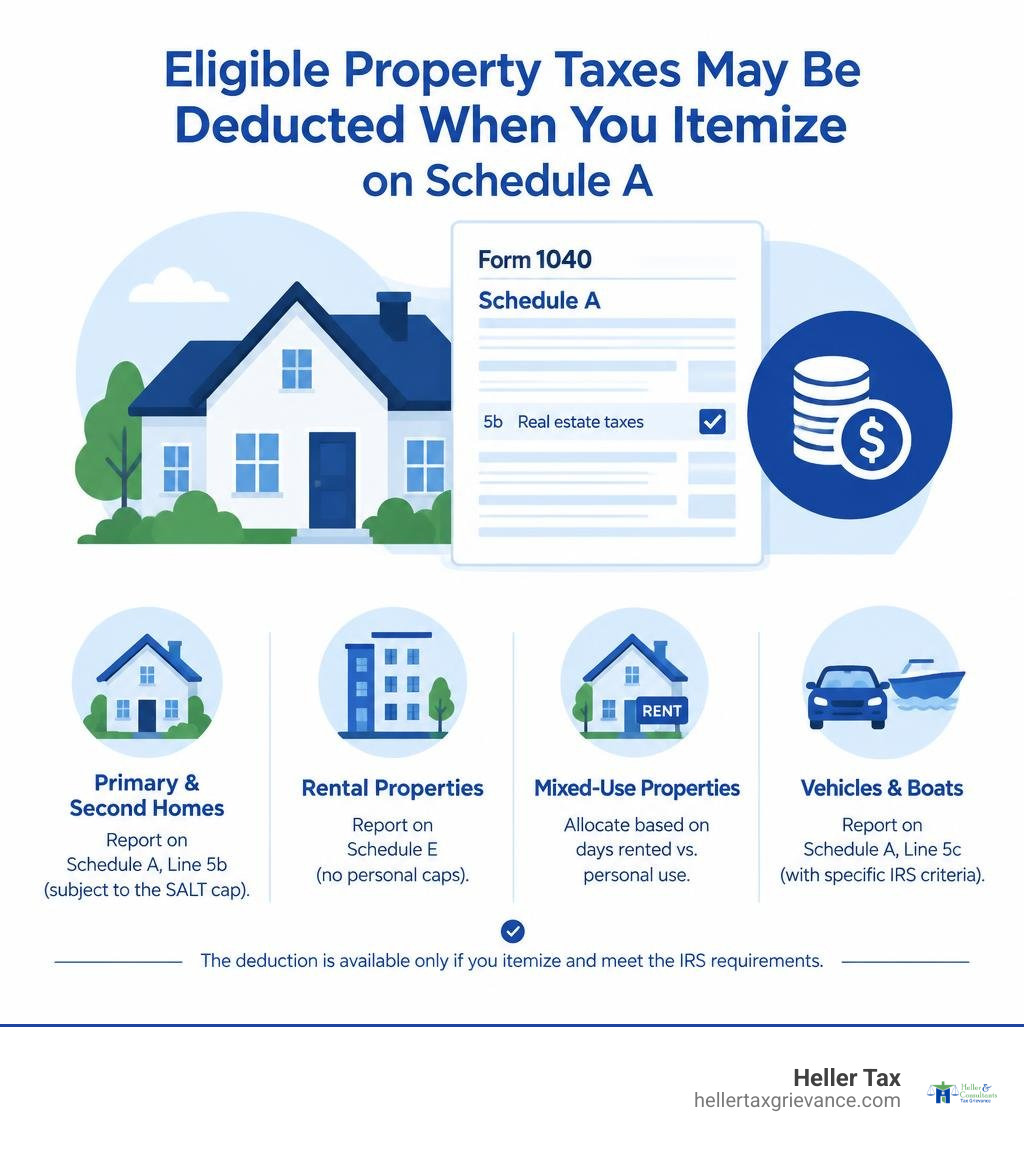
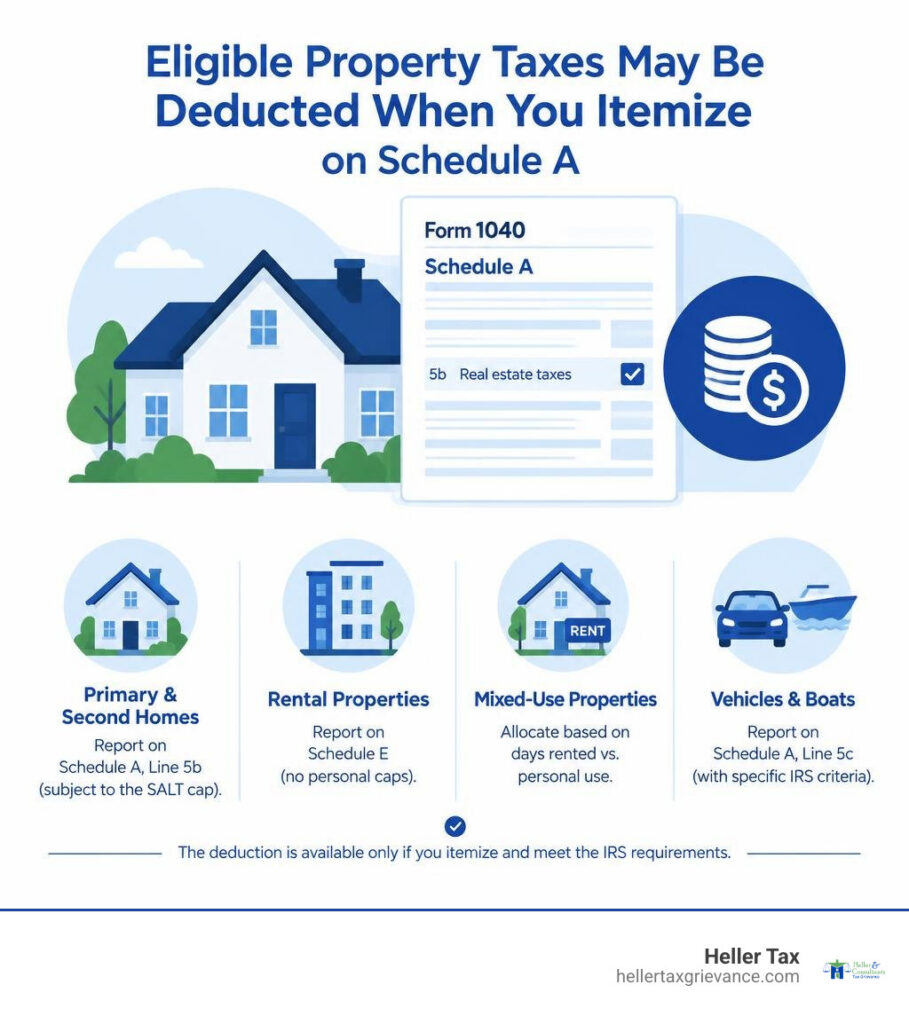
When preparing your return, claiming a property tax deduction on your federal tax filing requires filing IRS Form 1040 along with Schedule A. The official 2025 Instructions for Schedule A (Form 1040) outline that you can only deduct taxes that were legally imposed on you and actually paid during the tax year.
Where on Form 1040 Can You Deduct Property Taxes?
State and local real estate taxes are reported directly on Schedule A (Form 1040), Line 5b.
Because individual taxpayers operate on a cash basis of accounting, the deduction applies strictly in the calendar year the money left your hands (or was disbursed by your mortgage company) to the local taxing authority. For example, if you paid a winter property tax bill on December 30, 2025, it counts on your 2025 federal return, even if the town does not process the check until early January 2026.
Can You Deduct Property Taxes on Second Homes and Rental Properties?
Yes, but the tax rules vary depending on how the property is used:
- Second Homes and Vacation Properties: Real estate taxes on personal vacation homes or secondary residences are treated just like those on your primary residence. You report them on Schedule A Line 5b, subject to the overall federal cap.
- Rental Properties: If you rent out a property to tenants, the taxes are treated as an ordinary business expense rather than a personal itemized deduction. You report these taxes on Schedule E (Form 1040). Crucially, rental property tax deductions on Schedule E are not limited by personal caps.
- Mixed-Use Properties: If you divide time between personal use and renting the home to guests, you must calculate a proportional allocation based on the number of days rented versus personal days, as detailed in the ins and outs of property tax deduction.
Personal Property Taxes on Vehicles and Boats
Beyond real estate, you can also deduct personal property taxes on movable assets such as cars, RVs, and boats on Schedule A, Line 5c.
To qualify for Line 5c, the tax must satisfy three IRS requirements:
- It must be based strictly on the value of the personal property (ad valorem).
- It must be assessed on an annual basis.
- It must be levied directly on personal property you own.
Flat vehicle registration fees or weight-based assessments do not qualify. However, if your state or county charges an annual excise tax calculated as a percentage of your vehicle’s assessed market value, that specific portion is fully deductible.
Understanding the Federal SALT Deduction Limit and Itemization Rules
The federal State and Local Tax (SALT) deduction lets taxpayers deduct a combination of local property taxes and either state/local income taxes or sales taxes.
For the 2025 tax year (returns filed in 2026), the maximum SALT deduction is $40,000 for single filers, heads of household, and married couples filing jointly (and $20,000 for married individuals filing separately). For higher earners, this deduction begins phasing down once Modified Adjusted Gross Income (MAGI) exceeds $500,000 ($250,000 for married filing separately), down to a floor of $10,000 ($5,000 MFS). For 2026 tax returns, the limit is projected at $40,400.
Even with these figures, state and local taxes SALT deduction problems remain because property taxes in high-tax areas often exceed the allowable thresholds. Furthermore, claiming the deduction is only beneficial if your total itemized deductions exceed your standard deduction.
| Filing Status | 2025 Standard Deduction | 2026 Standard Deduction |
|---|---|---|
| Single | $15,750 | $16,100 |
| Married Filing Jointly | $31,500 | $32,200 |
| Head of Household | $23,625 | $24,150 |
| Married Filing Separately | $15,750 | $16,100 |
For state returns, check local rules such as Itemized deductions (2025) – Tax.NY.gov to ensure compliance with state-level filing schedules.
Deductible vs. Non-Deductible Real Estate Charges
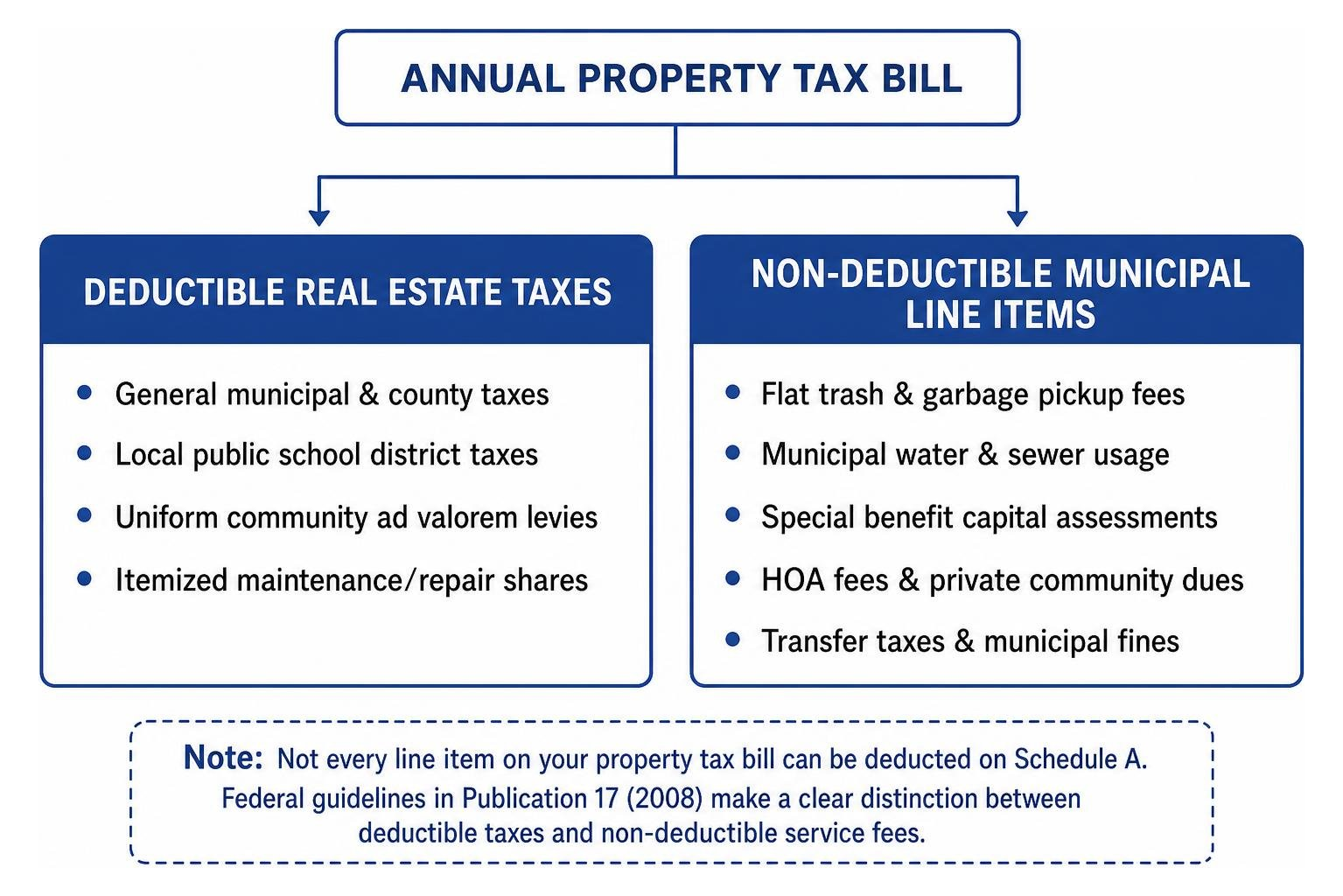
Not every line item on your property tax bill can be deducted on Schedule A. A tax bill frequently combines general municipal taxes with specific local utility charges and user fees.
Federal guidelines in Publication 17 (2008), Your Federal Income Tax make a clear distinction between deductible taxes and non-deductible service fees. Exploring 7 big tax breaks for homeowners will help you identify other legal ways to lower your taxable burden.
Common Non-Deductible Charges
- Flat municipal service fees: Line items for trash collection, water, sewer, or municipal electric services.
- Special assessments for capital improvements: Levies for constructing permanent neighborhood infrastructure (such as new sidewalks, street paving, or water mains) that increase the market value of your property. (Note: Portions assessed strictly for ongoing repairs or maintenance can be deducted if itemized).
- Homeowners Association (HOA) fees: Dues paid to private associations are personal expenses and cannot be deducted.
- Transfer taxes and stamp fees: Taxes paid when buying or selling real estate cannot be written off as taxes, though they adjust the cost basis of the home.
- Fines and late penalties: Penalties for code violations or late tax payments are non-deductible.
Special Rules for Escrow Accounts and Home Sales During the Year
Property transactions and escrow accounts introduce specific timing and reporting rules that require careful review of year-end paperwork.

Buyer vs. Seller Proration at Closing
When real estate is bought or sold during the year, the IRS requires property taxes to be prorated based on the exact number of days each party owned the property:
- The seller deducts taxes up to the day before the closing date.
- The buyer deducts taxes starting from the closing date through the rest of the tax year.
This division applies regardless of how the parties agreed to split the costs on the settlement statement or Closing Disclosure. Additionally, if a buyer pays delinquent prior-year property taxes owed by the seller at closing, those back taxes cannot be deducted on Schedule A; instead, they must be added to the property’s cost basis.
Mortgage Escrow Timing and Disbursement Rules
If you pay your property taxes through a lender’s mortgage escrow account, the date your monthly mortgage payment is made does not determine the tax deduction.
Instead, you can only deduct the property taxes that the loan servicer actually disbursed to the taxing municipality during that tax calendar year. Mortgage servicers report this figure on Form 1098, Box 10. Always review your lender’s annual escrow analysis statement to confirm the disbursement dates and amounts.
State Relief Programs: Property Tax Deductions vs. Tax Credits
Understanding the difference between a property tax deduction and a property tax credit helps ensure you do not leave money on the table:
- Tax Deduction: Lowers your taxable income. The actual cash savings equal the deduction multiplied by your marginal tax bracket rate.
- Tax Credit: Directly reduces your final tax liability dollar-for-dollar. Refundable credits can provide cash back even if your tax bill is zero.
Various states provide specific property tax relief programs. You can discover how to qualify for property tax exemptions and breaks to reduce your underlying tax bill.
In New York, programs such as the School Tax Relief (STAR) credit provide direct relief checks or exemptions for primary residences, alongside specific exemptions for senior citizens and veterans.
Lowering Your Property Taxes in Long Island: Nassau and Suffolk County
While federal deductions provide tax-time relief, they only reduce a portion of what you spend. Lowering your underlying property assessment reduces the total tax bill you owe year after year.
On Long Island, Nassau County and Suffolk County follow distinct property tax grievance calendars and procedures.
- Nassau County: The annual grievance filing period runs from January 2 through March 1 (unless extended by county officials). Grievances are submitted to the Nassau County Assessment Review Commission (ARC).
- Suffolk County: Grievances are handled at the town level (e.g., Brookhaven, Islip, Babylon, Huntington, Smithtown) and must be filed by Grievance Day, which is held annually on the third Tuesday in May.
Challenging an excessive property assessment through an official grievance never increases your property taxes, but it can secure permanent reductions in your annual tax burden.
Frequently Asked Questions About Property Tax Deductions
Do you need to itemize deductions to claim property taxes?
Yes. To claim real estate taxes on your personal home, you must file Schedule A (Form 1040) and itemize deductions instead of claiming the standard deduction. If your standard deduction is higher than your combined itemized expenses, taking the standard deduction will provide the larger tax benefit. For rental properties, property taxes are deducted on Schedule E as a rental expense without needing to itemize personal deductions.
Can you deduct property taxes if you pay through an escrow account?
Yes. You can deduct property taxes paid through an escrow account, but you must base your deduction on the actual disbursement amount the mortgage servicer sent to the tax collector during the calendar year, not the total monthly escrow payments you made. This disbursed total is reported in Box 10 of your annual Form 1098.
What is the maximum property tax deduction under the SALT cap?
Under current federal rules for the 2025 tax year, the total SALT deduction—which includes property taxes plus either state and local income taxes or general sales taxes—is capped at $40,000 for single filers, heads of household, and married couples filing jointly ($20,000 for married filing separately). A phase-down applies to taxpayers with MAGI above $500,000.
Conclusion
Writing off real estate taxes on your federal return can provide meaningful tax relief, provided you itemize on Schedule A and stay within the federal SALT limits. However, deducting property taxes only returns a percentage of what you spent.
At Heller Tax Grievance, we believe homeowners should never pay more than their fair share. We help Long Island homeowners across Nassau and Suffolk counties substantially lower their property tax assessments. With our “You Don’t Pay Unless You Save” guarantee and over $160 million saved for our clients, we make securing your property tax reduction simple and risk-free.
Take control of your real estate taxes today. Apply for your assessment reduction with our property tax grievance service and start saving on your property taxes year after year.