

Why Commercial Tax Grievance on Long Island Can Save You Thousands
Commercial tax grievance on Long Island is the formal process of challenging your property’s assessed value — and for many commercial property owners, it’s one of the most powerful tools available to protect their bottom line.
Quick answer: A commercial tax grievance challenges the assessed value assigned to your property by the local assessor — not the tax rate itself. If your property is overassessed, you can file a grievance to lower that value and reduce your annual tax bill. Here’s what you need to know at a glance:
| Key Factor | Details |
|---|---|
| What it is | A formal complaint challenging your property’s assessed value |
| Who can file | Property owners and, in most cases, tenants responsible for taxes |
| Nassau County deadline | March 1 (filed with the Assessment Review Commission) |
| Suffolk County deadline | Third Tuesday in May (filed with the town’s Board of Assessment Review) |
| Cost to file | No upfront cost; most firms work on contingency |
| Potential savings | Thousands to hundreds of thousands of dollars per year |
| Refunds available? | Yes — most commercial filings can result in back-year refunds |
Long Island has some of the highest property taxes in the country. For commercial property owners — whether you own an office building, retail center, warehouse, or apartment complex — taxes are often one of the single largest fixed expenses you carry every year. And unlike residential properties, commercial assessments are especially prone to error, often based on income assumptions that don’t reflect what your property actually earns.
Yet most commercial owners never challenge their assessment.
I’m Adam Heller, founder of Heller & Consultants Tax Grievance. With a background in Long Island real estate dating back to 1999 and nearly two decades focused exclusively on commercial tax grievance on Long Island, I’ve helped thousands of property owners across Nassau and Suffolk Counties recover what they were overpaying. This guide walks you through exactly how the process works — step by step.
Understanding Commercial Property Tax Grievances on Long Island
To successfully navigate a commercial tax challenge, we must first clear up a very common point of confusion: the difference between your property’s assessment and its tax rate.
When you file a tax grievance—legally known as a tax certiorari proceeding—you are not arguing with the school board, the town, or the county about their budget or the tax rates they set. Those entities determine how much revenue they need to raise. Instead, you are challenging the municipal assessor’s opinion of what your property is actually worth.
Your tax bill is calculated by multiplying your property’s assessed value by the local tax rate. Since we cannot change the tax rate, our only avenue for relief is to prove that the assessor has overvalued the property. If we can legally lower that assessment, your tax bill drops proportionally.
An overassessment occurs when the municipality’s designated market value for your commercial property exceeds its actual current market value. On Long Island, because the commercial real estate landscape is incredibly diverse and constantly shifting, these overassessments happen far more often than you might think.
Why File a Commercial Tax Grievance On Long Island? What Property Owners Should Know
Why are commercial assessments so frequently inflated? The answer lies in the methodology assessors use to value commercial real estate.
Unlike residential assessors who primarily look at recent neighborhood home sales, commercial assessors rely heavily on the income capitalization approach. They estimate your property’s value based on its “income potential.” Unfortunately, this means they often make broad, idealized assumptions about your property, including:
- Assuming your property enjoys 100% occupancy year-round.
- Assuming you are collecting peak market rents, even if your actual tenants are on older, below-market leases.
- Utilizing aggressive, outdated capitalization rates (cap rates) that do not reflect current economic conditions, interest rates, or risk profiles in May 2027.
If you own an office building in Syosset with empty suites, a retail strip in Massapequa with tenant concessions, or a warehouse in Deer Park facing soaring maintenance costs, the assessor’s “idealized” model does not match your financial reality. By filing a grievance, we present your actual, documented income and expenses to replace the town’s guesswork with hard facts. To explore this further, read more about Commercial Real Estate Property Taxes.
Eligibility: Who Can File a Grievance?
A common misconception is that only the deed-holding owner of a commercial property has the legal right to file a tax grievance. In reality, New York State law allows any “aggrieved party” who is obligated to pay the property taxes to file a challenge.
This eligibility extends to:
- Sole and Joint Property Owners: Anyone holding the title to the commercial real estate.
- Contract Buyers: Individuals or entities under contract to purchase the property, provided the contract permits or obligates them to manage tax challenges.
- Commercial Tenants: If you lease a commercial space under a net lease (such as a triple-net or NNN lease) where you are contractually obligated to pay the real estate taxes directly to the municipality or reimburse the landlord, you generally have the legal standing to file a grievance.
For tenants, filing a grievance can be a lifeline. When property taxes climb, they directly erode your operating income and business cash flow. Proactively seeking relief is a standard smart business practice. For actionable strategies on lowering these overhead costs, see How to Get Some Much-Needed Commercial Property Tax Relief.
Nassau County vs. Suffolk County: Deadlines and Calendars
While Nassau and Suffolk are neighbors, their property tax administration systems are entirely different worlds. Nassau County features a highly centralized system, whereas Suffolk County’s process is decentralized across its ten individual towns (such as Babylon, Huntington, Islip, and Brookhaven). Note that we focus exclusively on these county and town-level systems, as village-level tax grievance processes are excluded from our services in favor of the primary county and town jurisdictions.
To ensure you never miss a critical date, let’s compare their structures:
| Feature | Nassau County | Suffolk County |
|---|---|---|
| Primary Assessing Body | Nassau County Department of Assessment | Individual Local Towns |
| Grievance Review Board | Assessment Review Commission (ARC) | Town-specific Boards of Assessment Review (BAR) |
| Tentative Roll Publication | January 2 / January 4 | May 1 |
| Filing Deadline | March 1 | Third Tuesday in May (Grievance Day) |
| Refiling Rules | Annual filing permitted and recommended | Allows annual filing, but successful reductions can be held for 3 years |
| Disputed Funds | Disputed Assessment Fund (DAF) system | Traditional escrow/refund system |
Nassau County Tax Grievance Calendar
In Nassau County, the commercial tax grievance calendar is strictly defined. The tentative assessment roll is typically published at the start of January. Property owners then have until the March 1 deadline to file an administrative complaint with the Nassau County Assessment Review Commission (ARC).
Because Nassau County handles assessments at the county level, the filing process is centralized online. However, commercial cases in Nassau are subject to unique rules, such as the Disputed Assessment Fund (DAF). The DAF requires a portion of commercial tax payments to be held in a specialized escrow account while appeals are pending, which helps expedite refunds once a reduction is finalized. To get a complete breakdown of Nassau’s specific procedures, view our Property Tax Grievance Nassau Complete Guide.
Suffolk County Tax Grievance Calendar
Suffolk County operates on a completely different timeline. The tentative assessment rolls for Suffolk towns are published on May 1. The deadline to file a commercial tax grievance is Grievance Day, which falls on the third Tuesday in May across most Suffolk jurisdictions.
Because each town in Suffolk (such as Babylon, Huntington, Islip, or Brookhaven) has its own Board of Assessment Review (BAR), you must file your grievance directly with the specific town where the property is located. We do not address or pursue separate village-level grievances, focusing our efforts entirely on these primary town assessments. One major benefit of the Suffolk system is the stability it offers: once we successfully secure an assessment reduction through a formal settlement, the town will typically hold that reduced rate in place for three years, protecting your business from sudden reassessment spikes. To review the underlying state rules governing these boards, visit the Grievance procedures – Department of Taxation and Finance – NY.Gov.
Navigating the Commercial Tax Grievance Long Island Process
Successfully reducing a commercial property tax assessment requires an evidence-based approach. Municipalities do not lower assessments out of goodwill; they do so when presented with undeniable valuation data.

How to Initiate Your Commercial Tax Grievance Long Island Case
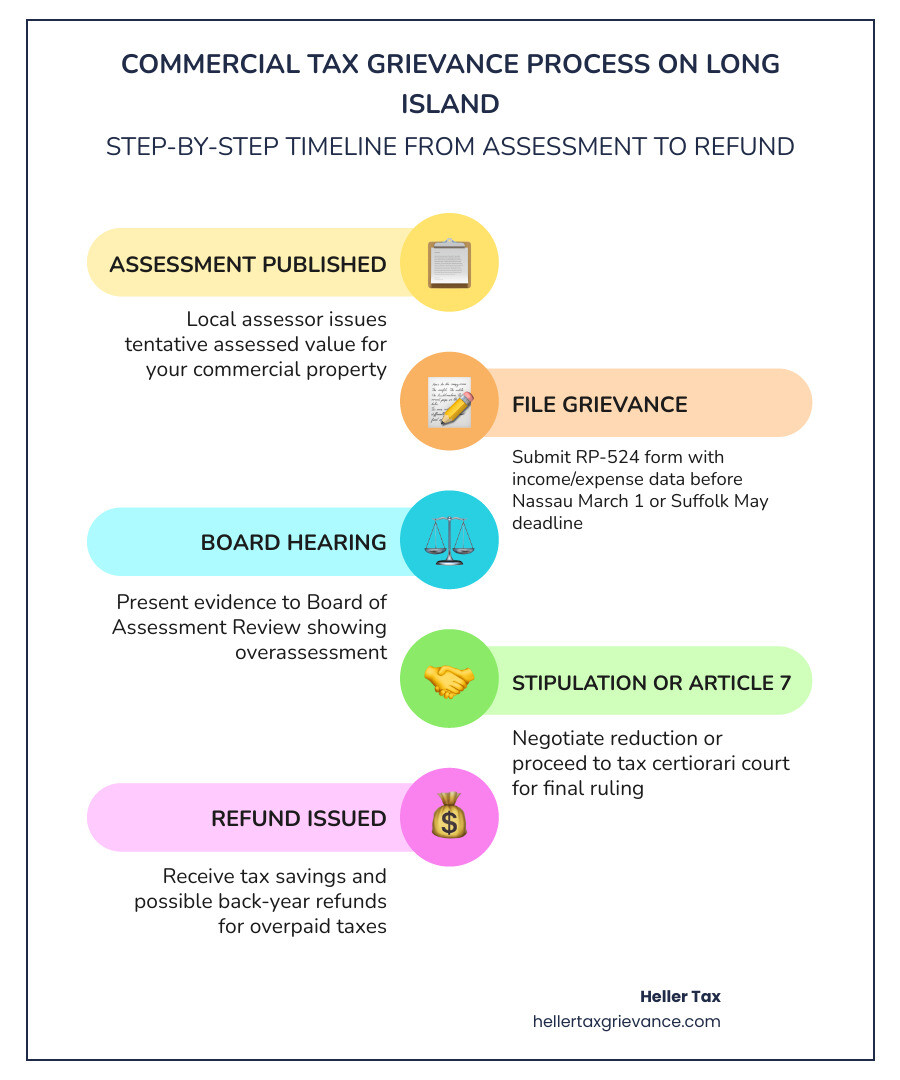
The official process begins by filing Form RP-524 (Complaint on Real Property Assessment) with the appropriate board before the county or town deadline. However, simply filling out the form is not enough. To build a winning case, we must gather and analyze a comprehensive suite of financial and property records:
- Certified Income and Expense Statements: Providing three years of actual historical financial performance to counter the assessor’s idealized assumptions.
- Current Rent Rolls: Detailing actual lease rates, tenant terms, and vacancy rates.
- Local Market Surveys: Presenting data on comparable commercial properties, local lease rates, and actual transaction cap rates on Long Island.
- Proof of Obsolescence or Property Conditions: Documenting physical, functional, or economic depreciation (such as structural damage, outdated layouts, or neighborhood economic decline) that limits the property’s utility and market value.
By compiling this data, we construct a precise valuation model that proves your property’s real-world value is lower than the town’s estimate. For a deeper look at how to structure your property’s defense, check out the Top 5 Ways Can Use Pay Fewer Commercial Property Taxes.
What Happens After Filing: Hearings, Stipulations, and Article 7
Once your commercial grievance is filed, the case proceeds through three potential phases:
- Administrative Review and Stipulations: The Assessment Review Commission (in Nassau) or the Board of Assessment Review (in Suffolk) reviews the submitted evidence. In many cases, we can negotiate a “stipulation”—a mutually agreed-upon assessment reduction—directly with the assessor or board staff without needing a formal hearing.
- Board of Assessment Review Hearings: If a stipulation cannot be reached, the case is scheduled for an administrative hearing where we present oral arguments and documentation to support the reduction.
- Article 7 Certiorari Proceedings: If the board denies the grievance or offers an insufficient reduction, we escalate the case by filing an Article 7 petition in the New York State Supreme Court. This initiates a formal judicial review.

Don’t let the word “court” intimidate you. The vast majority of Article 7 commercial tax certiorari cases on Long Island are settled through pre-trial settlement conferences with county or town attorneys, resulting in substantial tax reductions and retroactive tax refund checks for prior years.
Frequently Asked Questions About Long Island Commercial Tax Grievances
Will filing a commercial tax grievance trigger an audit or property inspection?
This is the single most common fear we encounter, and we want to put it to rest: No, filing a tax grievance will not trigger a retaliatory audit, nor will it result in an automatic physical inspection of your property.
Under New York State law, the Board of Assessment Review cannot increase your property assessment simply because you filed a grievance. Your assessment can only go down or stay the same as a result of your challenge. Filing a grievance is a standard, legally protected administrative right. It is treated by municipalities as a routine financial proceeding, not a hostile act.
How often should commercial property owners file a grievance?
Commercial property owners should treat tax grievances as an annual financial checkup. Because market conditions, vacancy rates, and your property’s net operating income (NOI) fluctuate constantly, your assessment should be reviewed every single year.
Filing annually is the only way to ensure your property taxes remain aligned with your actual financial performance. If you skip a year, you risk overpaying on your taxes for that entire cycle, which directly damages your cash flow and property valuation. To stay updated on shifting local tax rates and trends, review the Tag Commercial Grievance Rates page.
How do contingency fee structures work for commercial grievances?
At Heller Tax Grievance, we believe that seeking tax fairness should not be a risky financial gamble. That is why we operate on a strict contingency fee model.
Under this structure:
- There are no upfront fees or retainer costs to begin your case.
- We handle the entire process—including analysis, document preparation, filings, negotiations, and court representation—at our own expense.
- You do not pay us a single penny unless we successfully secure a reduction in your property taxes.
- If we win your case, our fee is a pre-agreed percentage of the actual tax savings we achieve for you.
This model aligns our goals directly with yours: we only succeed when we save you money. To learn more about the advantages of working with dedicated specialists, read the 5 Reasons Hire Firm File LI Tax Grievance.
Conclusion
Carrying an inflated commercial property tax assessment is an unnecessary drain on your business’s profitability, property value, and peace of mind.
At Heller Tax Grievance, we have saved Long Island property owners over $160 million in property taxes. We hold record commercial tax reductions of $1,000,000 per year in Nassau County and $130,000 per year in Suffolk County, with average commercial savings of $80,000 in Nassau County and $300,000 in Suffolk County.
Backed by our “You Don’t Pay Unless You Save” guarantee, we manage the entire process from start to finish, allowing you to focus on running your business while we fight to lower your overhead.
Don’t let another tax cycle pass by while overpaying. Get started with your free commercial property analysis today, and let us help you secure the tax relief you deserve.