
What Are the Property Classification Codes Used on Long Island?
To understand how your commercial property is taxed, we must look at how New York State categorizes real estate. The state uses a standardized system of three-digit numeric codes to classify every parcel of land, ensuring local assessors categorize properties consistently based on actual use.
According to the state’s guidelines on Property type classification codes, these codes are structured hierarchically into three levels:
- Category: Indicated by the first digit (100 to 900). It represents the broad, primary use of the land.
- Division: Indicated by the second digit. It narrows down the property type within that category.
- Subdivision: Indicated by the third digit. It provides the most specific identification of the property’s daily use.
For example, in the “Recreation and Entertainment” category (the 500 series):
- A broad, unclassified recreation facility is coded as 500.
- An amusement facility is coded as 530.
- A fairground specifically is assigned the subdivision code 531.
While New York State provides this uniform framework, local towns and counties across Nassau and Suffolk Counties sometimes utilize additional local coding schemes to meet specific assessment needs.
State guidelines specify that the property class code itself should not directly dictate the dollar amount of your assessment. However, in practice, the code assigned to your property determines its “Tax Class.” On Long Island, your tax class directly dictates the assessment ratio and tax rate applied to your property. If an assessor incorrectly codes your property, you could find yourself paying commercial rates on a property that should qualify for residential tax limits.
The Nine Main NYS Property Class Categories
The New York State uniform system divides all real property into nine primary categories:
- 100 – Agricultural: Land used for agricultural production.
- 200 – Residential: One, two, and three-family residences, including seasonal homes and condominiums.
- 300 – Vacant Land: Property without permanent improvements or buildings.
- 400 – Commercial: Properties used for the sale of goods and services, including retail, offices, restaurants, and apartments.
- 500 – Recreation and Entertainment: Fairgrounds, amusement parks, theaters, and sports facilities.
- 600 – Community Services: Properties used for public or governmental services, including schools, libraries, and places of worship.
- 700 – Industrial: Properties used for manufacturing, processing, and industrial waste disposal.
- 800 – Public Services: Properties owned by public service corporations, including water, gas, electric, and communication utilities.
- 900 – Wild, Forested, Conservation Lands and Public Parks: Reforested lands, state parks, and conservation areas.
For commercial property owners on Long Island, the most critical categories to watch are Code 400 (Commercial) and Code 700 (Industrial). If your property in Farmingdale, Deer Park, or Syosset is assigned a code in either of these categories, it will be assessed using commercial valuation methods, which carry a significantly higher tax burden.
Why Living Accommodations Fall Under Commercial Class 400
A common point of confusion for multi-family property owners on Long Island is why their residential rental buildings are taxed as commercial entities. Under the New York State classification system, living accommodations designed for temporary occupancy or high-density rental use—such as hotels, motels, and apartment buildings with four or more units—are classified under the Commercial (400) category rather than the Residential (200) category.
For example, a standard apartment building is assigned code 411. Because it falls under the 400 series, local tax jurisdictions treat the property as a commercial business. This classification strips the property of the protective assessment growth caps enjoyed by Class 1 residential homeowners (which limit annual assessment increases to 6% per year or 20% over five years).
Instead, these multi-family properties are subjected to commercial tax rates and valuation methods. This classification has massive tax rate implications, often resulting in effective tax rates that are three to four times higher than those applied to single-family homes.
How Do Nassau and Suffolk Counties Differ in Property Classification and Assessment?
Long Island does not have a single, unified property tax system. Instead, Nassau County and Suffolk County operate under entirely different assessment structures.
Nassau County (along with New York City) is designated as a “Special Assessing Unit” under New York State Real Property Tax Law. This means Nassau County uses a strict, mandated four-class property tax system where properties are divided into four distinct classes, each with its own assessment ratio and tax rate.
Suffolk County, on the other hand, is comprised of non-special assessing units. Suffolk County does not use a county-wide four-class system. Instead, assessment is handled individually by its ten towns (such as Babylon, Brookhaven, Huntington, and Islip). These towns have the option to adopt a “homestead vs. non-homestead” tax rate system to separate residential and commercial properties, but they do so using local town assessment ratios.
| Feature | Nassau County (Special Assessing Unit) | Suffolk County Towns (Non-Special Assessing Unit) |
|---|---|---|
| System Structure | Strict County-wide Four-Class System | Individual Town Assessments; Optional Homestead/Non-Homestead |
| Property Classes | Class 1 (Residential), Class 2 (Co-ops/Condos/Apartments), Class 3 (Utility), Class 4 (Commercial/Industrial) | Homestead (1-3 family residential) vs. Non-Homestead (Commercial/Industrial/Multi-family) |
| Assessment Ratios | Varies dramatically by class (Class 1 is 0.1%, Class 4 is 1.0%) | Varies by town; determined annually by local town assessors |
| Class Shares | Mandated class shares lock in tax revenue proportions by class | No county-wide class shares; town-specific tax levies |
| Grievance Authority | Nassau County Assessment Review Commission (ARC) | Town Board of Assessment Review (BAR) |
This structural difference means a commercial owner in Syosset (Nassau) faces a completely different assessment process than one in Deer Park (Suffolk).
Nassau County’s Four-Class System (Class 1 vs. Class 4)
In Nassau County, the four-class system creates a stark divide in how property values are translated into tax bills:
- Class 1: One- to three-family residential properties.
- Class 2: Residential properties with more than three units, including co-ops, condominiums, and apartment buildings.
- Class 3: Utility company properties.
- Class 4: All other real property, primarily commercial and industrial buildings.
The most critical factor here is the Level of Assessment (LOA), which is the fractional percentage of market value used to calculate your property’s assessed value. In Nassau County, these fractions are heavily weighted against commercial owners.
For Class 1 residential properties, the LOA is set at a mere 0.1%. For Class 4 commercial properties, the LOA is set at 1.0%—ten times higher.
This means if you own a Class 1 home in Massapequa with a market value of $1,000,000, its assessed value is just $1,000. If you own a Class 4 commercial building in Massapequa with the exact same market value of $1,000,000, its assessed value is calculated at $10,000. This structural multiplier is the foundation of the high commercial tax rates on Long Island.
Suffolk County’s Assessment and Homestead Options
In Suffolk County, tax assessment is decentralized. Each town’s assessor is responsible for maintaining the local assessment roll and determining the fractional assessment rate for properties within their jurisdiction.
To protect residential homeowners, several Suffolk County towns utilize a homestead vs. non-homestead tax system. Under this option:
- Homestead properties include 1-3 family residential homes, owner-occupied condominiums, and vacant land zoned for residential use.
- Non-homestead properties encompass all commercial, industrial, utility, and larger multi-family residential properties.
When a town adopts this system, it splits its tax levy into two separate pools. Because local school districts and town or county services require substantial funding, and because residential voters are protected by local tax caps, town boards frequently allocate a disproportionate share of the tax levy to the non-homestead pool. As a result, commercial property owners in Suffolk towns like Brookhaven, Islip, or Babylon face significantly higher tax rates per dollar of assessed value than their residential neighbors.
How Fractional Assessments and Class Shares Create Tax Inequities
Fractional assessments and “class shares” often shift a disproportionate tax burden onto commercial property owners.
In Nassau, residential properties (Class 1) are protected by strict statutory growth caps. As their market values rise, their share of the tax burden does not keep pace. To meet budget demands, the tax burden shifts to Class 4 commercial properties, which lack assessment caps. This explains why commercial properties face effective tax rates several times higher than single-family homes.
What Are the Tax Implications of Vacant Land Classification on Long Island?
Many assume vacant, non-income-producing land has minimal property taxes. On Long Island, this is a misconception. Under New York State Real Property Tax Law (RPTL) §1802, vacant land classification is highly contested and financially impactful.
In Nassau County, vacant land must be classified as either Class 1 (residential) or Class 4 (commercial). The Department of Assessment is solely responsible for assigning these classifications, and they do so without consulting the property owner. If they see a vacant parcel, they will default to Class 4 unless strict, specific criteria are met to prove the land belongs in Class 1.
The tax implications of this classification are massive, as detailed by real estate tax experts in publications like the Know your zone: The tax implications of vacant land in New York City and Nassau County – by Jeremy May : NYREJ.
The Contiguity Rule and Zoning Requirements
To secure a Class 1 designation for a vacant parcel in Nassau County, the property must meet strict legal requirements:
- Zoning: The vacant land must be zoned exclusively for residential use. If the land is zoned for commercial, industrial, or mixed-use, it will automatically be classified as Class 4 commercial land.
- The Contiguity Rule: If a vacant parcel is not zoned residential, it can still qualify for Class 1 status if it is physically contiguous (sharing a property line) to a 1-3 family residential home owned by the exact same individual or entity.
- The “Materially Beneficial Use” Rule: Even if a parcel is zoned residential or is contiguous to a home, it cannot be used for any purpose that provides a “materially beneficial use” of a non-residential nature.
In the Richmond Country Club case, vacant land adjacent to residential property used for tennis courts was ruled to have an active, materially beneficial recreational use. It was classified as commercial, resulting in a massive tax increase.
The 900% Assessment Jump: Class 1 vs. Class 4 Vacant Land
To see just how devastating a misclassification can be, let’s look at a real-world mathematical comparison using the East Meadow School District tax rates.
Imagine you own a vacant parcel of land with an estimated market value of $1,000,000.
If that property is properly classified as Class 1 (Residential):
- The Nassau County Class 1 Level of Assessment (LOA) is 0.1%.
- Assessed Value = $1,000,000 × 0.001 = $1,000.
- Applying the Class 1 tax rate for this area (approximately $2,727.51 per $100 of assessed value), your annual tax bill would be $27,280.
If the Department of Assessment classifies that exact same vacant parcel as Class 4 (Commercial):
- The Class 4 Level of Assessment (LOA) is 1.0%.
- Assessed Value = $1,000,000 × 0.01 = $10,000 (a 1,000% increase in assessed value).
- Applying the Class 4 tax rate for this area (approximately $919.887 per $100 of assessed value), your annual tax bill would be $92,000.
By simply changing the classification code from Class 1 to Class 4, your annual tax liability jumps from $27,280 to $92,000—an increase of nearly $65,000 every single year on the exact same piece of dirt. This is why verifying your vacant land’s classification is one of the most critical steps in protecting your commercial real estate investment.
How Do Income Data and Submarket Valuations Affect Commercial Assessments?
Unlike residential properties, which are valued almost exclusively using the comparable sales method, Class 4 commercial properties are valued primarily using the income capitalization approach. This method calculates a property’s market value based on the income it generates, balanced against its operating expenses.
Because commercial valuations are tied directly to the economic performance of the property, the data used by local assessors must be highly accurate. If you want to understand the details of this process, we recommend reading our guides on Commercial Real Estate Property Taxes and our dedicated Commercial Info portal.
When assessors use outdated income data, incorrect occupancy assumptions, or generalized market averages, commercial properties end up severely over-assessed, leading to inflated tax bills that cut directly into your bottom line.
The Role of RPIE and ASIE Income Filings
To gather the financial data necessary to perform income-based valuations, taxing jurisdictions require commercial property owners to submit annual financial disclosures:
- Nassau County: Requires owners of income-producing commercial properties to file the Annual Survey of Income and Expenses (ASIE).
- New York City / Bordering Jurisdictions: Require the Real Property Income and Expense (RPIE) filing.
These filings require you to submit detailed rent rolls, security deposits, and itemized operating expenses. Assessors review this data to calculate your property’s Net Operating Income (NOI). They then apply a capitalization rate (cap rate) to convert that NOI into an assessed market value.
Market Value = Net Operating Income (NOI) / Capitalization Rate (Cap Rate)
If you fail to file your ASIE or RPIE, or if you submit incomplete data, the consequences are severe. Assessors will apply a penalty and default to “standardized” market assumptions. They will assume your building is 100% occupied at peak market rents and has minimal operating expenses. This artificial calculation can easily double your property’s assessed value, leaving you with an inflated tax bill.
Why Submarket Analysis Matters for Class A vs. Class B Properties
One of the biggest flaws in the commercial assessment process on Long Island is the reliance on broad, generalized market averages. Assessors frequently apply county-wide or town-wide averages for vacancy rates, rental rates, and capitalization rates, ignoring the hyper-local realities of specific submarkets.
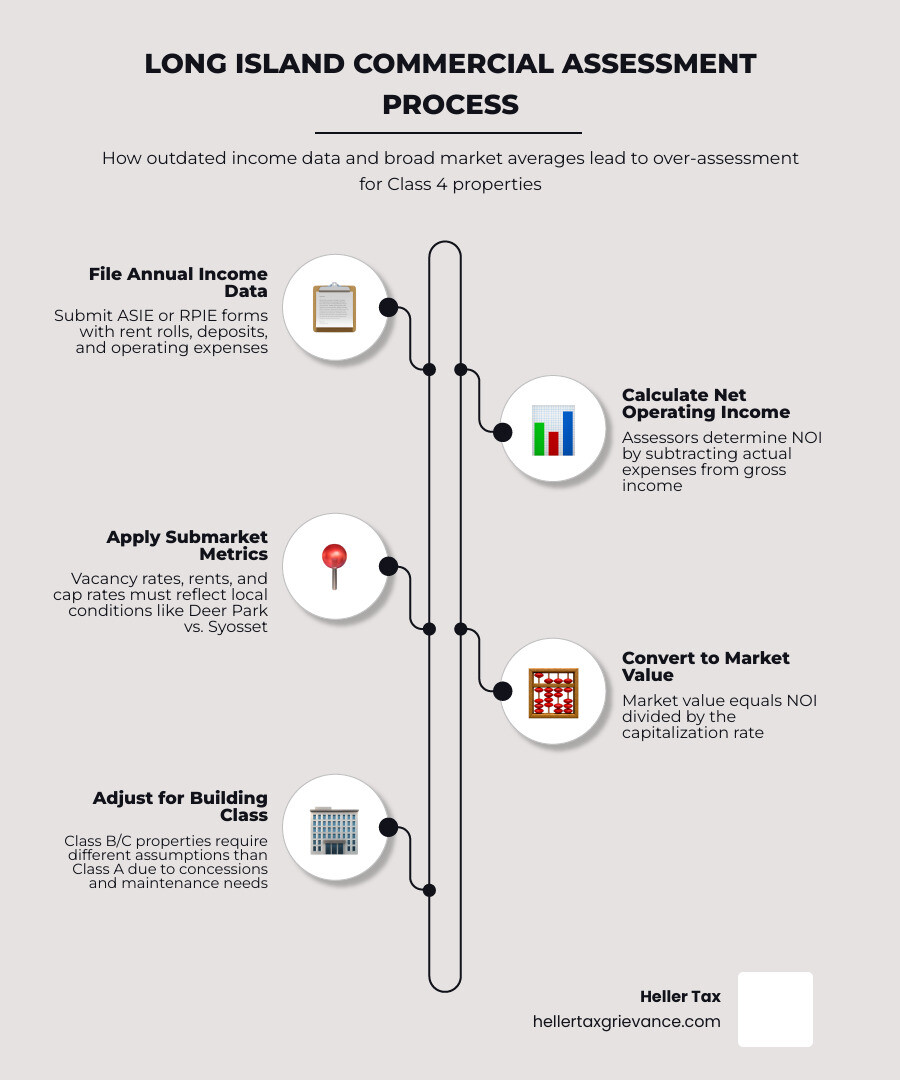
In reality, commercial real estate conditions on Long Island can shift dramatically within just a few miles:
- Vacancy Rates: Submarket vacancy rates for industrial or retail properties in areas like Deer Park or Farmingdale can vary by more than 10% compared to premier markets like Syosset or Melville.
- Building Quality: Valuing a Class B or Class C older commercial building using the same metrics as a newly constructed, high-clearance Class A industrial park materially overstates the older building’s value. Class B and C properties typically require larger tenant concession packages, have higher vacancy rates, and demand significant capital investment for maintenance.
- Capitalization Rates: Properties located in higher-tax jurisdictions or weaker submarkets carry higher investment risk, which warrants a higher capitalization rate. A higher cap rate results in a lower, more accurate assessed value.
When assessors fail to account for these submarket differences, owners of B- and C-class properties end up subsidizing the tax burden of top-tier Class A properties. Successfully challenging your commercial assessment requires presenting detailed, submarket-specific data that reflects the true economic conditions of your property’s immediate area.
How Can Long Island Property Owners Challenge Misclassification and Over-Assessment?
If you believe your commercial property has been misclassified or over-assessed, you do not have to accept your tax bill. You have the legal right to challenge your assessment through the annual property tax grievance process.
Filing a grievance is a formal administrative challenge to the assessed value set by the county or town assessor. It is not an objection to the tax rate itself (which is set by local school boards, counties, and towns), but rather a challenge to the valuation of your property.
To explore how a successful grievance can lower your overhead, review our resources on the general Property Tax Grievance process and our comprehensive guide to Long Island Property Tax Grievance. We also outline key reduction strategies in our articles on the Top 5 Ways Can Use Pay Fewer Commercial Property Taxes and How to Get Some Much-Needed Commercial Property Tax Relief.
Navigating the Nassau and Suffolk County Grievance Calendars
The most critical rule of property tax grievances is that deadlines are absolute. If you miss the filing window for your county or town, you forfeit your right to challenge your assessment for that entire tax year.
Nassau County Grievance Calendar
In Nassau County, the commercial tax grievance process is handled by the Nassau County Assessment Review Commission (ARC).
- Filing Window: Typically opens in January and closes on March 1st of each year for the upcoming tax roll.
- Process: You must file an Administrative Grievance (Form AR-1) with ARC. Because Nassau County operates on a multi-year assessment lag, the grievance you file in early 2027 will impact your tax bills for the 2027/2028 school and town tax years.
- For a detailed walkthrough, see our Nassau County Property Tax Grievance: A Comprehensive Guide.
Suffolk County Grievance Calendar
In Suffolk County, grievances are handled individually by each of the ten towns’ Boards of Assessment Review (BAR).
- Filing Deadline: By state law, Suffolk County town grievances must be filed on or before the third Tuesday in May (which falls on May 19, 2027).
- Process: You must submit your grievance application (Form RP-524) directly to the assessor’s office in the specific town where your property is located (e.g., Babylon, Brookhaven, Islip).
- To understand the town-specific rules, read our guide on Suffolk County Property Tax Grievance.
What Happens During Settlement Season After the Grievance Deadline?
Once the filing deadline passes, the “settlement season” begins. This is the period when administrative hearings, reviews, and negotiations take place between property tax attorneys and county or town representatives.
During this phase, the quality of your economic documentation is everything. To secure a settlement offer from the Nassau ARC or a Suffolk Town BAR, you must provide a complete, verified record of your property’s financial performance. This includes:
- Certified rent rolls showing actual occupancy and rental rates.
- Three years of detailed operating statements (income and expenses).
- Copies of active commercial leases.
- Professional appraisals or submarket vacancy studies.
If your submission is incomplete, the assessor’s office will issue a deficiency notice. It is vital to take these notices seriously and respond before the formal or informal cure period ends. If you fail to provide the requested economic data, your grievance will be summarily denied, and you will be forced to escalate the dispute to a formal Tax Certiorari proceeding in New York State Supreme Court, which is a much longer and more expensive legal process.
How Heller Tax Grievance Can Help Minimize Your Tax Burden
Navigating the complexities of commercial property classification, ASIE/RPIE filings, and submarket capitalization rates is a daunting task for any business owner. That is why commercial property owners across Long Island—from Syosset and Massapequa to Deer Park, Rocky Point, and Stony Brook—partner with us at Heller & Consultants Tax Grievance.
We specialize in commercial tax reduction, offering a highly professional, data-driven approach to challenging unfair assessments. Our unique advantages include:
- Our “You Don’t Pay Unless You Save” Guarantee: We operate entirely on a contingency fee basis. If we do not successfully reduce your property’s assessed value, you owe us absolutely nothing. There are no upfront fees, no retainer costs, and zero financial risk to your business.
- Proven Track Record: We have saved our clients over $160 million in property taxes, securing some of the largest single tax reductions in both Nassau and Suffolk County history.
- Hyper-Local Expertise: With deep roots and local offices serving Rocky Point, Farmingdale, Deer Park, Brookville, Syosset, Upper Brookville, Massapequa, Stony Brook, and Miller Place, we understand the distinct submarket dynamics of every Long Island township. We don’t rely on broad averages; we build a customized, evidence-based case for your specific property.
Frequently Asked Questions About Long Island Property Classification
Does my property classification code directly determine my tax rate?
No, the three-digit New York State property classification code itself does not directly set your tax rate. Instead, the code is an administrative tool used by assessors to identify your property’s primary use.
However, this code dictates the Tax Class (such as Class 1 vs. Class 4 in Nassau County, or Homestead vs. Non-Homestead in Suffolk County) to which your property is assigned. Your Tax Class directly determines the Level of Assessment (the percentage of market value that is taxable) and the specific tax rate applied by local school districts, counties, and towns. Therefore, an incorrect classification code will directly lead to an incorrect, and often highly inflated, tax bill.
Can I change my property classification from Class 4 to Class 1?
Yes, but doing so requires meeting strict legal standards and providing clear physical and zoning evidence. To successfully reclassify a property from Class 4 (Commercial) to Class 1 (Residential) on Long Island, you must typically prove one of the following:
- Zoning Compliance: The property is zoned exclusively for residential use, and any previous commercial activity has ceased.
- Physical Conversion: A multi-family building has been physically modified to contain three or fewer residential units.
- The Contiguity Rule: For vacant land, you must prove the parcel is physically contiguous to your Class 1 residential home, shares the exact same ownership name, and is not being put to any materially beneficial non-residential use.
If the local assessor refuses to update your classification despite meeting these criteria, we can help you pursue formal reclassification litigation through a Tax Certiorari proceeding.
What is the deadline to file a commercial property tax grievance on Long Island?
For the 2027 tax grievance calendar, the deadlines are as follows:
- Nassau County: The annual filing window closes on March 1, 2027.
- Suffolk County: The deadline for all ten Suffolk towns is the third Tuesday in May, which is May 19, 2027.
These deadlines are strict. If your application is not postmarked or electronically submitted by these exact dates, you will lose your right to challenge your assessment for the year.
How Can You Protect Your Commercial Investment on Long Island?
Your property’s classification is not just an administrative label on a county database—it is the single most critical factor determining your commercial property tax burden on Long Island. Whether you own a retail strip in Miller Place, an industrial warehouse in Farmingdale, or a vacant parcel in Massapequa, a misclassification or an over-assessment can cost your business tens of thousands of dollars in unnecessary overhead every year.
With property taxes on Long Island remaining among the highest in the nation, commercial property owners cannot afford to accept their assessments without question. Assessors make mistakes, rely on outdated financial data, and ignore the micro-market realities of local submarkets.
Don’t let unfair property taxes erode your property’s profitability. Partner with Heller & Consultants Tax Grievance to review your assessment. We will analyze your property’s classification, review your income data, and compare your assessment against local submarket realities—completely risk-free. You do not pay us a single penny unless we successfully secure a reduction for you.
Contact us today to schedule your free, no-obligation commercial property tax assessment review.