
Understanding the High Cost of Homeownership in Muttontown
Muttontown property tax bills are among the highest on Long Island, reflecting both the village’s affluent character and New York’s notoriously steep tax rates. If you’re a homeowner or investor in this exclusive Nassau County community, understanding how your taxes are calculated—and how to potentially reduce them—can save you thousands of dollars each year.
Quick Facts About Muttontown Property Taxes:
| Metric | Muttontown | Comparison |
|---|---|---|
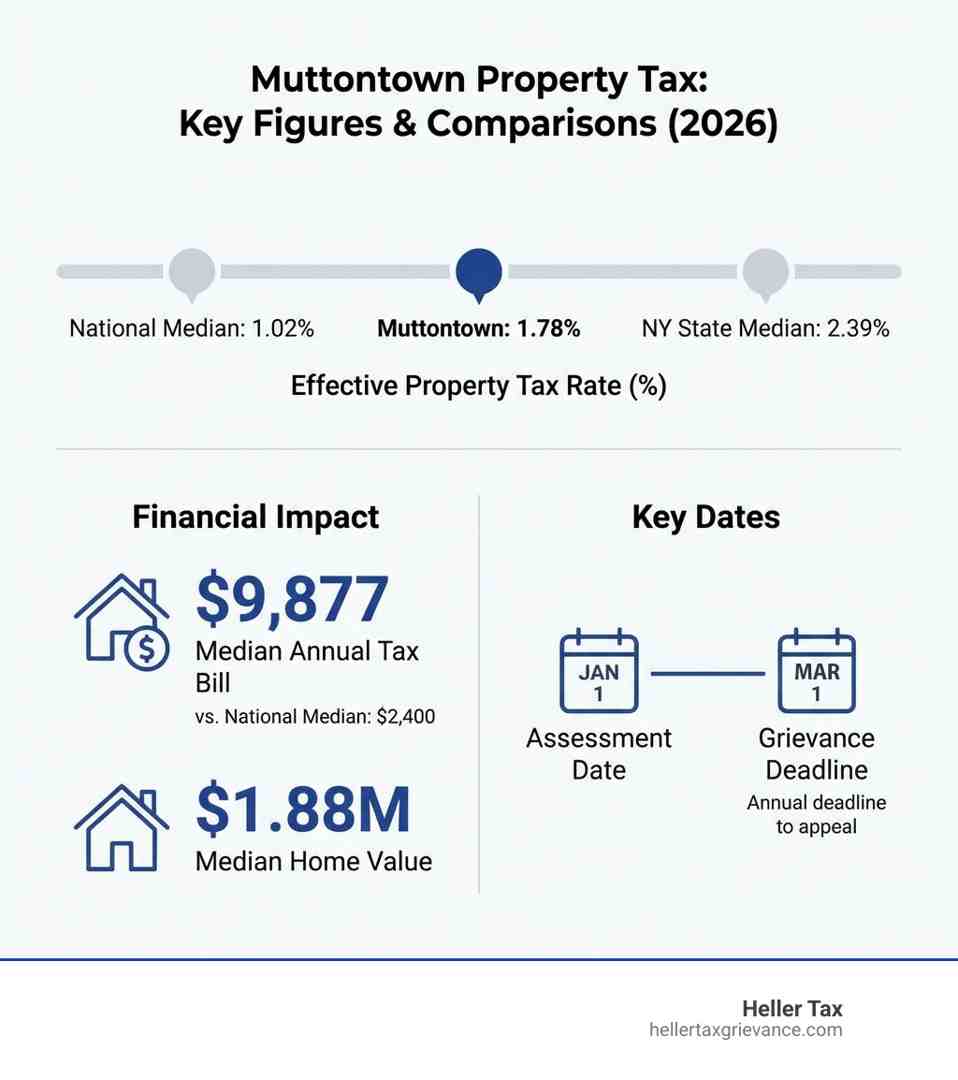
| Median Effective Tax Rate | 1.78% | National median: 1.02%, NY state median: 2.39% |
| Median Annual Tax Bill | $9,877 | $7,477 higher than national median ($2,400) |
| Median Home Value | $1.88M | Significantly above national average |
| Homeownership Rate | 95.9% | Well above national average of 65% |
| Grievance Filing Deadline | March 1 | Annual deadline to appeal assessments |
Muttontown homeowners face a unique tax situation. While the village’s 1.78% effective property tax rate is lower than New York’s state median of 2.39%, it’s still 74% higher than the national median. Combined with the area’s high property values—the median home is worth $1.88M—this translates to substantial annual tax bills that often exceed $9,800.
Your tax bill funds essential services including the Muttontown Police Department, road maintenance, snow plowing, safety inspections, and local zoning boards. Village taxes are collected separately from school district taxes, fire district charges, and Nassau County levies, making your total tax picture more complex than in many other communities.
The difference between market value and assessed value is crucial. Nassau County assesses properties annually as of January 1st, with assessment notices typically sent by mid-April. Your assessed value equals your market value minus any applicable exemptions (such as STAR, senior citizen, or veterans exemptions). Property taxes are then calculated by multiplying your assessed value by the local tax rates set by your school district, village, county, and special districts.
Many Muttontown homeowners don’t realize their properties may be over-assessed or unfairly assessed compared to similar homes. The April 1st deadline to file a property tax grievance is critical—missing it means waiting another full year for relief. With average tax savings in Muttontown reaching $1,102 for successful appeals, reviewing your assessment annually is a smart financial move.
I’m Adam Heller, and I’ve dedicated my career to helping Long Island property owners reduce their Muttontown property tax burden after witnessing how high taxes impact home values during my years in real estate. Since founding Heller & Consultants Tax Grievance in 2006, my team has helped over 50,000 clients achieve significant reductions—including record-breaking savings of $73,000 in Nassau County.
Understanding Your Muttontown Property Tax Bill
Navigating your Muttontown property tax bill can feel like deciphering a cryptic message. But don’t worry, we’re here to break it down. Your annual property tax bill is a mosaic of different levies, each contributing to the services that make Muttontown such a desirable place to live.
In Nassau County, property assessments are handled by the Nassau County Department of Assessment. They determine the market value of your property, which then forms the basis for your assessed value. This assessed value, combined with the tax rates from various taxing jurisdictions, culminates in your final property tax bill.
Muttontown, like many communities on Long Island, is served by multiple jurisdictions. These include:
- School Districts: These are often the largest component of your property tax bill. Muttontown is served by parts of several excellent school districts, including Jericho, Syosset, Oyster Bay-East Norwich, and Locust Valley.
- Village Taxes: The Village of Muttontown is its own assessing unit, meaning it assesses properties annually as of January 1st. These village taxes fund the specific services provided directly by the Village of Muttontown.
- Nassau County Taxes: These cover county-wide services such as social services, health departments, and county road maintenance.
- Special Districts: These include fire districts (Jericho, Syosset, and East Norwich, with some residents in the East Norwich Fire district billed separately for fire services) and water supply (primarily through the Jericho Water District).
To view or pay your property taxes online, you can often find resources directly through the Village of Muttontown’s website: Pay or View Property Taxes Online.
Key Muttontown Property Tax Statistics
Let’s put Muttontown’s property tax situation into perspective with some key statistics. These numbers underscore the significant financial commitment of owning a home in this beautiful village:
- Median Annual Tax Bill: The median annual Muttontown property tax bill is a substantial $9,877. To truly grasp this, consider that it’s $7,477 higher than the national median property tax bill of $2,400. This stark difference highlights why understanding and potentially reducing your taxes is so vital here.
- Median Home Value: The median home value in Muttontown stands at an impressive $1.88 million. This figure reflects the high quality of life, spacious properties, and excellent amenities the village offers. It’s also a significant factor in the higher tax bills, as taxes are based on property value.
- Homeownership Rate: Muttontown boasts a remarkably high homeownership rate of 95.9%, significantly above the national average of 65%. This indicates a stable, invested community where residents take pride in their homes and neighborhood.
- Median Household Income: The median household income in Muttontown is $247,589. This high income level helps residents manage the significant cost of living, including property taxes, but it doesn’t negate the desire to ensure those taxes are fair.
- Population and Demographics: As of 2023, Muttontown has an estimated population of 3,496, with a median age of 44.7. The poverty rate is exceptionally low at 2.86%, far below the national average. About 1,584 residents are employed, contributing to the local economy. These demographic indicators paint a picture of an affluent and well-established community.
Market Value vs. Assessed Value
Understanding the distinction between market value and assessed value is absolutely crucial when it comes to your Muttontown property tax bill. These two terms are often confused, but they play very different roles in determining how much you pay.
- Market Value: This is what your property would likely sell for on the open market. It’s an estimate of its worth based on recent sales of comparable properties, current market conditions, and the property’s unique features. In Nassau County, the Department of Assessment is responsible for determining this market value for every property.
- Assessed Value: This is the value that your local government uses to calculate your property taxes. In Muttontown (and Nassau County), your assessed value is typically the market value minus any applicable property tax exemptions. The assessed value is often lower than the actual market value, precisely because of these exemptions, such as the homestead or senior exemption.
Here’s a simplified table to illustrate the relationship:
| Component | Example Value | Description |
|---|---|---|
| Market Value | $1,800,000 | What your home would sell for today. |
| Exemptions | -$75,000 | Reductions based on eligibility (e.g., STAR, Veterans). |
| Assessed Value | $1,725,000 | The value used to calculate your property taxes. |
The Nassau County Department of Assessment sends out assessment notices typically by mid-April each year. These notices detail your property’s market value, assessed value, and an estimated tax bill. Reviewing this document carefully is your first step in ensuring your assessment is fair. If we believe your property’s market value or assessed value is too high, we can challenge it.
How Tax Rates Are Calculated
Ever wondered how that tax rate magically appears on your bill? It’s not magic, but rather a deliberate process driven by the budgetary needs of various local government entities. In Muttontown, your property taxes are a collection of rates set by:
- School Districts: As the largest component, school districts (Jericho, Syosset, Oyster Bay-East Norwich, and Locust Valley) determine their annual budget based on educational needs, operational costs, and projected enrollment. They then calculate the amount of money they need to raise from property taxes – this is called the tax levy. The tax levy is then divided by the total assessed value of all taxable properties within the district to arrive at the school tax rate.
- Village of Muttontown: The Village Board approves an annual budget to fund village-specific services such as police, road maintenance, snow plowing, and zoning administration. Similar to school districts, they establish a tax levy to cover these expenses, which is then translated into the village tax rate based on the total assessed value of properties within the village.
- Nassau County: The county government also sets a budget for county-wide services. This generates another tax levy and corresponding tax rate that applies to properties throughout Nassau County, including Muttontown.
- Special Districts: Fire districts, water districts, and other special service districts also have their own budgets and levies, which contribute smaller, but still significant, components to your overall property tax bill.
The formula is: Tax Rate = (Total Budgeted Expenses – Other Revenues) / Total Assessed Value of Taxable Property. Each taxing entity applies its unique rate to your property’s assessed value (after exemptions) to determine its portion of your property tax bill. This layered system means that your total Muttontown property tax is the sum of these individual components.
Lowering Your Bill: Exemptions and Tax Grievances
Facing a hefty Muttontown property tax bill can be daunting, but you’re not powerless. There are established avenues for reducing your property tax burden, primarily through exemptions and the tax grievance process. Many homeowners are paying more than their fair share due to over-assessment or unequal assessment, and we’re here to help you identify those opportunities for savings.
The April 1st deadline to file a property tax grievance is critically important. Missing it means you’ll have to wait another year to challenge your assessment. This annual window is your best opportunity to potentially save thousands on your property taxes. Our team has extensive experience helping homeowners in Muttontown and throughout Nassau County steer this process successfully.
For more detailed information on how we can assist with your Muttontown tax grievance, please visit: More info about Muttontown tax grievance.
Common Property Tax Exemptions
Property tax exemptions are a homeowner’s best friend, as they directly reduce your property’s assessed value, and therefore, your tax bill. In Muttontown and across Nassau County, several common exemptions are available:
- STAR Program (School Tax Relief): This is New York State’s largest property tax relief program.
- Basic STAR: Available to homeowners regardless of age, provided their household income is below a certain threshold. It provides a partial exemption from school taxes.
- Improved STAR: Offers a greater exemption for senior citizens (age 65 and older) whose income meets specific criteria.
Both Basic and Improved STAR exemptions apply only to school taxes, not to county or village taxes.
- Senior Citizen Exemption: This exemption offers significant savings for qualifying seniors. To be eligible, homeowners generally must be 65 or older, meet specific income requirements, and the property must be their primary residence. This exemption applies to both school and general (county) taxes, but typically not to special district levies.
- Veterans Exemption: Available to eligible veterans who served during specific periods of war or conflict. The amount of the exemption depends on the veteran’s service and disability status. Importantly, Veterans Exemptions may apply only to some levies on the General Tax Bill and may also reduce school taxes if the school district opts in. It’s crucial to check with your specific school district.
How Exemptions Reduce Assessed Value: When you qualify for an exemption, the exempted amount is subtracted from your property’s assessed value before the tax rate is applied. This means you’re taxed on a lower value, resulting in a lower tax bill.
Application Process: To apply for these exemptions, you typically need to file an application with the Nassau County Department of Assessment by a specific deadline, usually in January. We always encourage homeowners to explore all available exemptions, as they can lead to significant and ongoing savings on your Muttontown property tax.
How to Challenge Your Muttontown Property Tax Assessment
If you suspect your Muttontown property tax assessment is too high, you have the right to challenge it through the grievance process. This is where we shine, helping homeowners steer what can be a complex system.
The core of the grievance process is proving that your property has been over-assessed (its assessed value is higher than its market value) or unequally assessed (its assessment is higher than comparable properties in your neighborhood).
- The Annual Grievance Deadline: This is the single most important date to remember: April 1st. This is the deadline to file your property tax grievance with the Assessment Review Commission (ARC) in Nassau County. If you miss this date, you cannot challenge your assessment for that tax year. Nassau County typically sends out assessment notices by mid-April, which means you have a short window to review and act.
- Filing with the Assessment Review Commission (ARC): This is the first administrative step. You’ll need to submit a formal grievance application. This application requires specific information about your property and, most importantly, evidence to support your claim of over-assessment or unequal assessment.
- Required Evidence: The most compelling evidence includes:
- Recent Sales: Sales of comparable properties in your neighborhood that sold for less than your property’s assessed market value.
- Property Condition: Documentation of any significant issues or damage to your property that might negatively impact its value but isn’t reflected in the assessment.
- Professional Appraisal: While not always required, a professional appraisal can provide strong support for your claim.
We handle the collection and presentation of this evidence, building the strongest possible case for your grievance.
- Small Claims Assessment Review (SCAR): If you are dissatisfied with ARC’s determination, you have the option to appeal to the Small Claims Assessment Review (SCAR) part of the New York State Supreme Court. This is a judicial review of ARC’s decision. We can represent you through this stage as well, ensuring your case is presented effectively.
Our expertise lies in analyzing your assessment, identifying discrepancies, and carefully preparing and filing your grievance. We understand the nuances of Nassau County’s assessment system and are committed to helping you secure a fair Muttontown property tax assessment.
Key Considerations for Real Estate Closings
For anyone involved in a real estate closing in Muttontown, particularly buyers and sellers, understanding property tax-related considerations is paramount. A smooth closing depends on anticipating and addressing these potential issues:
- Restored Taxes: This is a common pitfall. If a property with an exemption (like a Senior Citizen or STAR exemption) is sold to a new owner who is not entitled to that exemption, the Department of Assessment will remove the exemption. What often happens next is that “restored” taxes, prorated back to the closing date, will be added to a future tax roll. This process can take up to two years for these exemptions to be fully removed and the restored taxes to appear on tax bills. Buyers need to be aware of this potential future liability.
- Duplicate Bill Fees ($10.00): When payments are made by parties other than the owner (such as banks, title companies, or attorneys), a mandatory $10.00 duplicate bill fee is required for each payment. This fee must often be submitted as a separate check. Payments that are incomplete or lack this fee will be deemed incomplete and returned, potentially leading to delays and penalties.
- Notifying the Receiver of Taxes: New homeowners have a critical responsibility to notify the Town of Oyster Bay’s Receiver of Taxes and their individual village (Muttontown) of any change in billing address, in writing. This ensures you receive your tax bills and important notifications promptly.
- Postage Requirements: When mailing your property tax payment, the postmark date is crucial for determining if your payment is on time. A non-U.S. Postal Service Postage Meter postmark is not considered legal proof of the date of mailing. The date of receipt at the collecting officer’s facility is considered the payment date. To avoid late penalties, ensure your mailing envelope has a U.S. Postal Service cancellation mark on or before the due date. Hand-delivering payments to the Receiver of Taxes office is another way to ensure timely processing.
- The Role of the Receiver of Taxes: The Receiver of Taxes for the Town of Oyster Bay is the primary entity responsible for collecting general, school, and special district taxes. While the Village of Muttontown collects its own village taxes, the Receiver of Taxes plays a central role in the broader property tax collection process for properties within Oyster Bay, which includes Muttontown. They are also the contact point for many of these closing-related inquiries.
Being proactive and informed about these details can prevent unexpected costs and complications during your real estate transaction in Muttontown.
What Your Muttontown Taxes Fund
Ever wonder where your substantial Muttontown property tax payments actually go? It’s a fair question, and the answer is that they fund the very fabric of the community you call home. From keeping our streets safe to ensuring our children receive a top-tier education, your taxes contribute to a wide array of village services, community amenities, and the overall high quality of life we enjoy here.
The Village of Muttontown prides itself on its self-governance and the comprehensive services it provides to its residents. We coordinate our activities with neighboring governmental agencies and cooperate with state, county, town, and special district authorities to deliver these essential services. For more information about the services provided by the village, you can always visit the official village website: Information on Village Services.
Village of Muttontown Services
As its own assessing unit, the Village of Muttontown directly funds and manages a variety of services that improve daily life for its residents:
- Police Department: The Muttontown Police Department ensures the safety and security of our community. In emergencies, residents should always call 911. For non-essential messages or inquiries, the MPD maintains a separate number that is checked periodically.
- Road Maintenance: The village is responsible for the upkeep and repair of public roads within its jurisdiction. This includes routine maintenance, pothole repairs, and ensuring our roadways are in good condition. For private roads, residents or their homeowners’ associations (HOAs) typically bear the responsibility for maintenance and repairs.
- Snow Plowing: When winter arrives, the village ensures that public roads are plowed and made safe for travel, a crucial service in our Long Island winters. Again, snow removal on private roads generally falls to residents or their HOAs.
- Safety Inspections: The village conducts safety inspections of properties to ensure compliance with local building codes and zoning ordinances, contributing to the overall safety and aesthetic appeal of the community.
- Zoning Boards: Muttontown has various boards that oversee development and land use, including the Board of Appeals, Planning Board, and Site and Architectural Review Board. These bodies ensure that development aligns with the village’s character and comprehensive plan.
- Village Administration: Beyond these direct services, your taxes also support the day-to-day operations of the village, including village leadership, processing forms and permits, maintaining village code and zoning regulations, managing online tax payments, financial oversight, and disseminating important announcements and alerts. The village also manages a Stormwater Management Program to protect our natural environment.
These services are funded through your village taxes, allowing Muttontown to maintain its unique charm and high standards.
Local and County Services
Beyond the direct services provided by the Village of Muttontown, your property taxes also contribute to a broader network of local and county services that benefit residents:
- School Districts: As mentioned, a significant portion of your property tax bill goes to funding our excellent public schools. Muttontown residents are served by parts of four distinct school districts, each with its own budget and educational programs:
- Jericho School District
- Syosset School District
- Oyster Bay-East Norwich Central School District
- Locust Valley Central School District
These districts are vital to the community, providing quality education that contributes to property values and the long-term success of our children.
- Fire Districts: Fire protection is a critical service, and Muttontown is covered by three fire districts:
- Jericho Fire District
- Syosset Fire District
- East Norwich Fire District
It’s worth noting that some residents in the East Norwich Fire district are billed separately for their fire services, a detail important to understand for your overall tax picture.
- Water Supply: Access to clean, reliable water is essential. The Jericho Water District provides water to the district, ensuring residents have this fundamental utility.
- Nassau County Services: Your county taxes support a vast array of services at the county level. This includes the Nassau County Department of Assessment (which handles your property assessments), county police services (complementing village police), public health initiatives, social services, parks, and maintenance of county roads that run through or near Muttontown. The county also handles matters related to deeds and property records.
Together, these layers of government and service providers ensure that Muttontown residents benefit from a comprehensive and well-funded infrastructure, from local roads and schools to county-wide health and safety programs.
Conclusion: Taking Control of Your Muttontown Property Taxes
Owning a home in Muttontown offers an unparalleled quality of life, but it comes with the reality of high property values and a complex tax system. We’ve explored how your Muttontown property tax is calculated, the various jurisdictions that contribute to your bill, and the essential services those taxes fund. Understanding these intricacies is the first step toward becoming a more informed and empowered homeowner.
The good news is that you don’t have to steer this complex landscape alone. The opportunity for significant savings often lies in carefully reviewing your property assessment and, if necessary, challenging it. Many homeowners in Muttontown are over-assessed, meaning they are paying more in taxes than they legally should. Identifying and rectifying these discrepancies can lead to substantial reductions in your annual tax bill.
At Heller Tax Grievance, we are experts in this field. We’ve dedicated ourselves to helping Long Island homeowners, including those in Muttontown, reduce their property taxes. Our “You Don’t Pay Unless You Save” guarantee means there’s no risk to you – we only get paid if we successfully lower your taxes. With over $160 million saved for our clients and a track record of achieving some of the largest tax reductions in Nassau and Suffolk counties, we are confident in our ability to help you.
Don’t let the complexity of property taxes deter you from seeking fairness. Take control of your Muttontown property tax burden today.