

What Your Nassau County Tax Assessed Value Means
For most Nassau County homes, assessed value is not the home’s sale price. The county estimates its market value, then applies the Class One Level of Assessment of 0.10%. A home valued at $800,000 would generally start with an assessed value of $800, though assessment limits may affect the figure shown on the roll. To check yours, search the Nassau County Land Records Viewer and compare the property’s details and value with your records.
That small assessed value does not mean a small tax bill. Your bill also depends on local tax rates and any exemptions you receive. If the county’s value or property details look wrong, you may be able to challenge the assessment.
I’m Adam Heller. After working in Long Island real estate, I founded Heller Tax to help property owners review their Nassau County tax assessed value and seek a fair reduction when the evidence supports one.
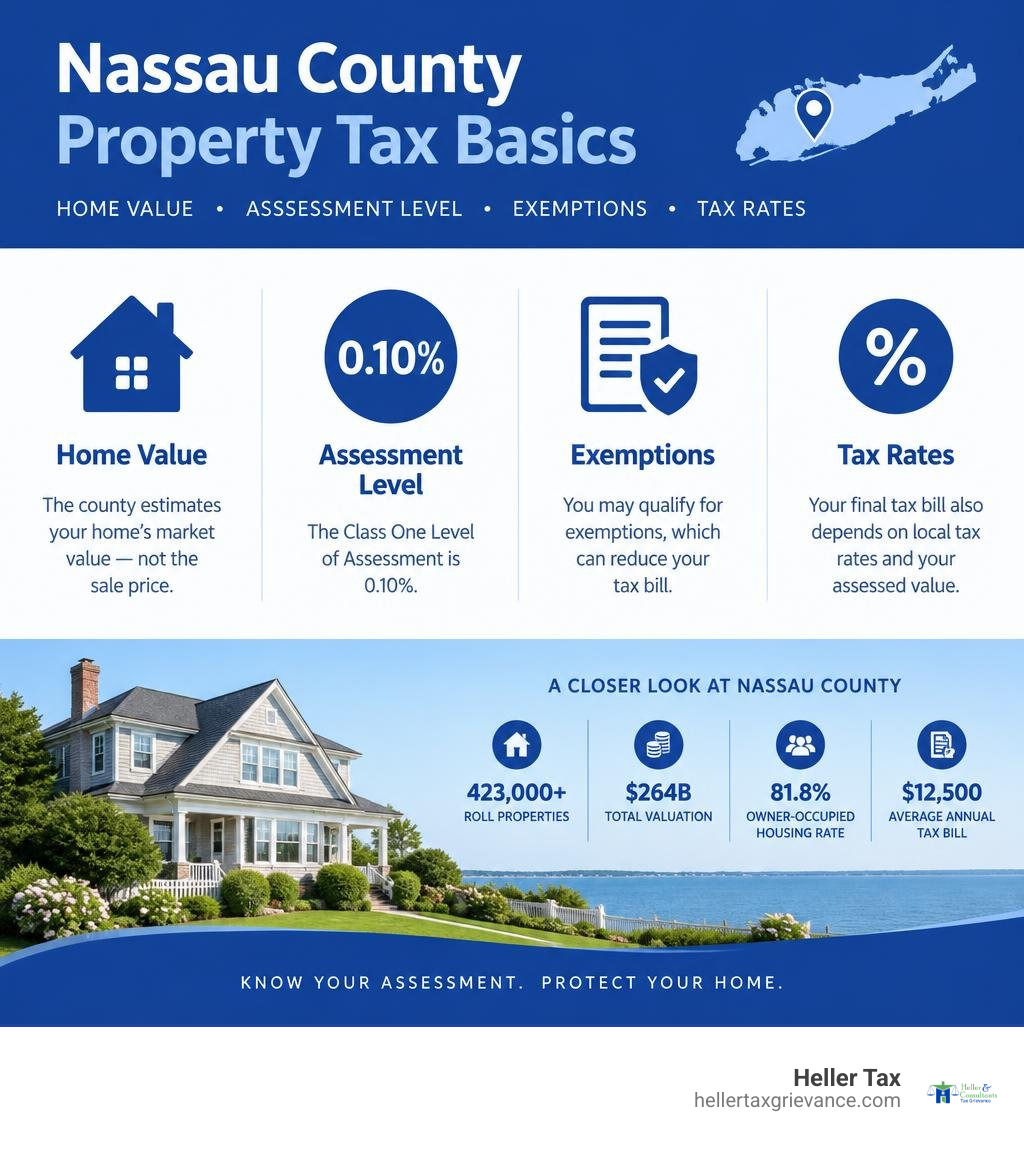
Nassau County’s Department of Assessment manages over 423,000 roll properties carrying a total valuation of roughly $264 billion. That makes our home county the second largest assessing entity in the entire State of New York, trailing only New York City. With an owner-occupied housing rate of 81.8% and an average annual property tax bill sitting around $12,500, property taxes are one of the single largest recurring expenses Long Island families face.
Understanding how your local assessment translates into thousands of dollars in real estate levies is the first step toward making sure you never pay a penny more than your fair share.
Understanding Your Nassau County Tax Assessed Value and How It Is Calculated
At first glance, your tax assessment can look like a bizarre accounting error. If your property is worth $700,000, seeing an assessed value of just $700 on your official county statement feels like you stumbled into an alternate universe.
Nassau County operates on a fractional assessment system. Rather than taxing homes at 100% of their fair market worth, the county converts market value into an assessed figure using a standardized municipal ratio.
| Valuation Step | Example Home A | Example Home B | Example Home C |
|---|---|---|---|
| Full Market Value (FMV) | $600,000 | $850,000 | $1,200,000 |
| Level of Assessment (LOA) | 0.10% | 0.10% | 0.10% |
| Tentative Assessed Value (TAV) | $600 | $850 | $1,200 |
| Applicable Exemptions (e.g., Basic STAR) | -$30 | -$30 | $0 |
| Final Taxable Value | $570 | $820 | $1,200 |
Every year, the Department of Assessment updates its figures through annual property assessment roll updates, reviewing residential and commercial parcels across every town and school district.
Full Market Value, Level of Assessment, and Taxable Value
To understand your tax bill, you need to recognize the three distinct values that define your property:
- Full Market Value (FMV): This is the Department of Assessment’s estimate of what your home would sell for on the open market as of a specific valuation date (set roughly two years prior to the actual tax year).
- Level of Assessment (LOA): For Class One residential properties (one-, two-, and three-family homes), the Level of Assessment has been fixed at 0.10% since the completion of the 2020 countywide reassessment.
- Taxable Value: This is your final assessed value after applying statutory caps and eligible property tax exemptions.
To calculate your base assessed value, the county uses a simple formula:
Full Market Value × Level of Assessment (0.10%) = Tentative Assessed Value
For instance, if the county values your home at $900,000: $900,000 × 0.0010 = $900
New York State Real Property Tax Law (RPTL) Section 1805 also imposes statutory caps to protect Class One homeowners from sudden assessment spikes. These rules limit assessment increases to no more than 6% in a single year or 20% over any five-year period, barring physical structural additions.
Following major reassessment adjustments, transitional smoothing rules phase in significant market movements over five years. Navigating these Nassau County assessment procedures is critical when understanding how reassessment affects taxes across changing real estate cycles.
Finding Your Nassau County Tax Assessed Value Online
You do not need to wait for a physical notice to arrive in your mailbox to check your valuation. Nassau County maintains a public database where you can review your complete inventory sheet and current assessment figures.
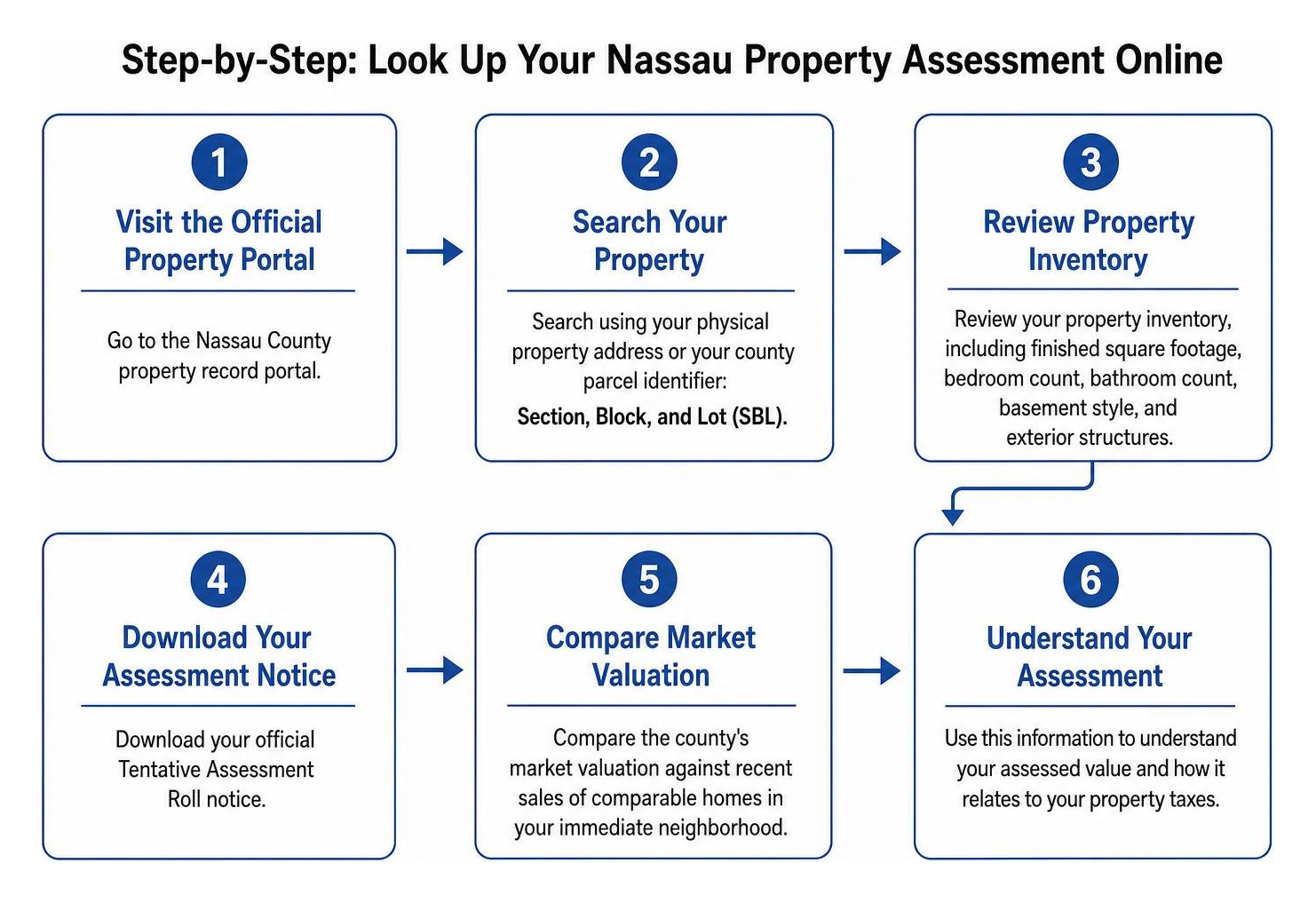
To look up your property online:
- Visit the official Nassau County property record portal.
- Search using your physical property address or your county parcel identifier: Section, Block, and Lot (SBL).
- Review your property inventory, including finished square footage, bedroom count, bathroom count, basement style, and exterior structures.
- Download your official Tentative Assessment Roll notice and compare the county’s market valuation against recent sales of comparable homes in your immediate neighborhood.
If you recently received an official notice from Mineola, deciphering your assessment disclosure notice will help you identify whether the county is overestimating your market value.
The Anatomy of Your Property Tax Bill in Nassau County
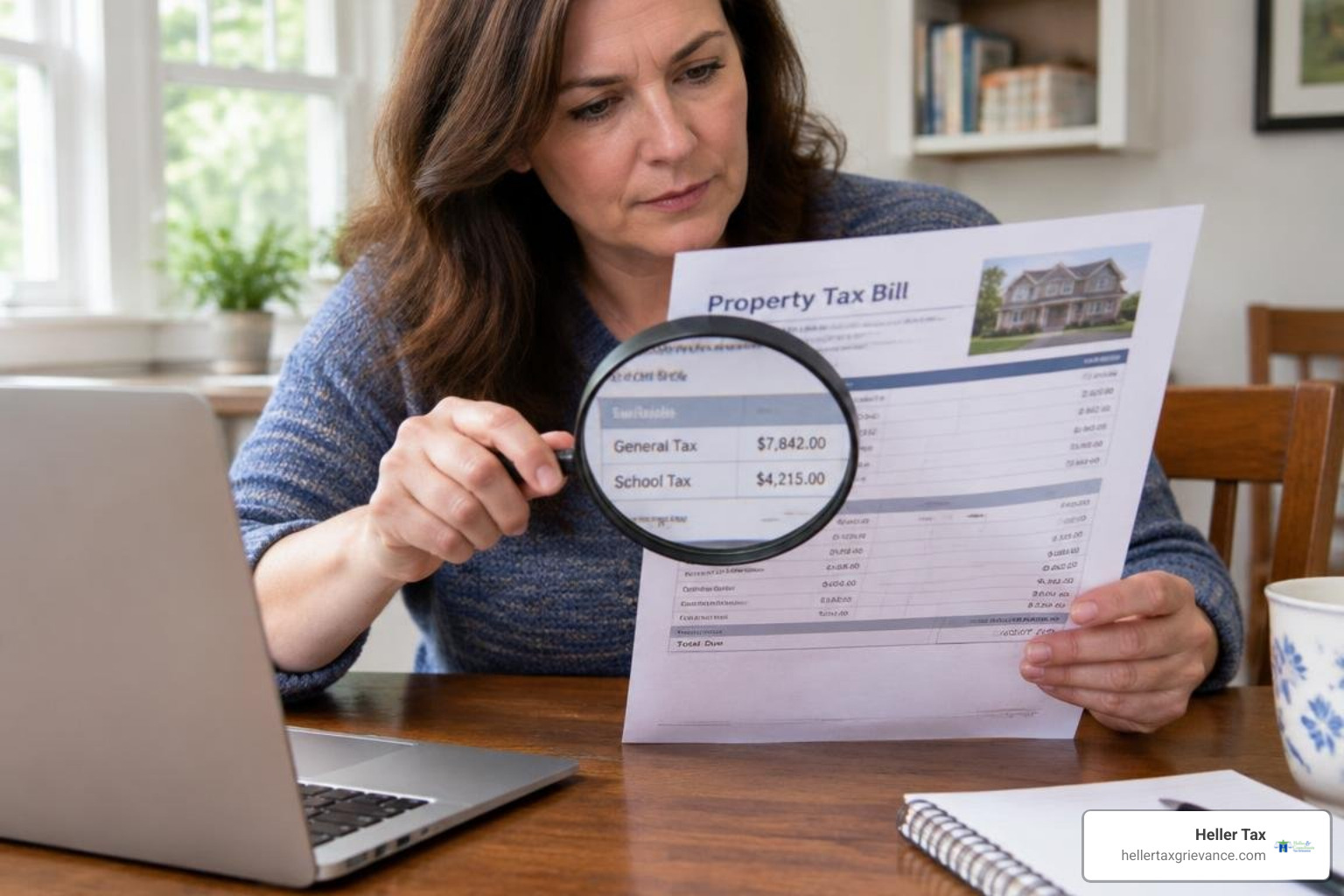
Many homeowners ask: If my assessed value is only $800, why is my tax bill $14,000?
The answer lies in local tax rates. Because assessed values are scaled down to one-thousandth of market value, tax rates per $100 of assessed value look unusually large.
The effective property tax rate across Nassau County sits at approximately 1.64% of true market value—notably higher than both the New York State median (1.02%) and the national baseline. With a median Nassau home value of $633,800 and median real estate taxes topping $10,000+, these rates add up quickly across your school, town, and county statements.
How School Districts, Towns, and General Levies Compound
Your annual property tax obligation is split across two primary bills:
- School District Tax Bill: Typically issued in October and paid in two halves (October and April).
- General Tax Bill (County, Town, and Special Districts): Issued in January and paid in two halves (January and July).
School taxes make up the vast majority of your annual burden, routinely accounting for 65% to 70% of your total bill. In communities with high operational budgets and limited commercial tax bases, school districts rely heavily on local residential funding. For example, analysis of local school district tax levies indicates that over 91% of the Manhasset Union Free School District’s revenue is generated directly from local residential property taxes.
Your general bill also includes local town taxes (Hempstead, North Hempstead, or Oyster Bay) and specialized district fees for fire protection, refuse collection, water authority operations, and local libraries. In some cases, direct municipal charges for unpaid local services or sidewalk maintenance are added directly to the line-item ledger.
The Impact of New York’s 2% Property Tax Cap
New York State’s Property Tax Cap limits annual growth in a taxing district’s overall tax levy to 2% or the rate of inflation, whichever is lower (unless a local school board or municipality formally votes to override the threshold by a supermajority).
However, a common misconception is that the 2% cap prevents an individual homeowner’s taxes from rising more than 2%.
The cap applies to the aggregate levy collected across the entire municipality, not your individual bill. If school district spending increases by 2%, but your home is reassessed at a higher rate relative to your neighbors—or if neighboring properties successfully grieve and lower their assessments—your individual share of the overall tax pie expands, causing your personal bill to jump well past 2%.
Factors That Alter Your Assessment and Available Property Tax Exemptions
Your assessed value is not permanently locked in place. The Department of Assessment adjusts assessments annually based on physical modifications, permit records, neighborhood sales analysis, and countywide modeling updates.

Why Your Property Assessment Changes Year to Year
Several distinct events can trigger a sudden change in your tentative assessment:
- Building Permits & Renovations: When you pull a permit for an extension, finished basement, second-story addition, or in-ground pool, town building departments send those records to the county. The Department of Assessment revalues the property to reflect the new square footage and amenities.
- Physical Field Inspections: County field assessors conduct neighborhood visual inspections to update property inventory data. Homeowners can also request an inspection directly by emailing or writing to 240 Old Country Road in Mineola if they believe structural records contain errors.
- Market Trend Adjustments: The county continuously analyzes arms-length real estate transactions to update algorithmic valuations across entire zip codes and neighborhoods.
If your property assessment increases without any physical alterations to your home, evaluating your property tax impact notice helps you pinpoint whether the change was driven by neighborhood appreciation or clerical errors.
How Do Property Tax Exemptions Reduce Nassau County Tax Assessed Value?
Property tax exemptions lower your bottom-line bill by subtracting value directly from your total assessed figure before tax rates are applied.
Common New York and Nassau County exemptions include:
- Basic STAR (School Tax Relief): Available for primary residences where the owners’ combined annual income is $500,000 or less. New applicants receive this relief as a direct state check (STAR Credit), while longtime enrolled owners may retain it as a taxable value deduction.
- Enhanced STAR: Provides expanded school tax relief for qualifying senior citizens aged 65 and older with limited annual household incomes.
- Alternative Veterans Exemption: Grants structured reductions (under RPTL Section 458-a) of 15% for wartime service, an additional 10% for combat zone deployment, and further proportional reductions for service-connected disability ratings.
- Senior Citizen & Disability Relief: Tiered, income-based assessment deductions for qualified seniors or residents with documented physical disabilities.
- Volunteer Firefighter & Ambulance Worker Exemptions: Local tax roll credits honoring dedicated first responders serving their communities.
Reviewing Nassau property tax exemption guidelines ensures you take advantage of every eligible deduction. Most exemption applications must be filed with the county by January 2 to take effect for the following tax cycle.
How to Challenge Your Assessment with the Assessment Review Commission (ARC)
If your county assessment indicates a market value higher than what your home is realistically worth, you have the legal right to challenge it.
Challenging your assessment—commonly known as filing a tax grievance—is an administrative appeal submitted to the Nassau County Assessment Review Commission (ARC).
When reviewing appeals, ARC evaluates market evidence to decide whether your property is overassessed. Following a comprehensive guide to filing a Nassau County tax grievance ensures you present strong comparable sales data that supports a lower valuation.
Filing Deadlines and the Step-by-Step Grievance Process
The county runs on a forward-looking tax calendar. An assessment grievance filed in early 2026 applies to the 2027–2028 tax year (affecting the October 2027 school bill and the January 2028 general tax bill).
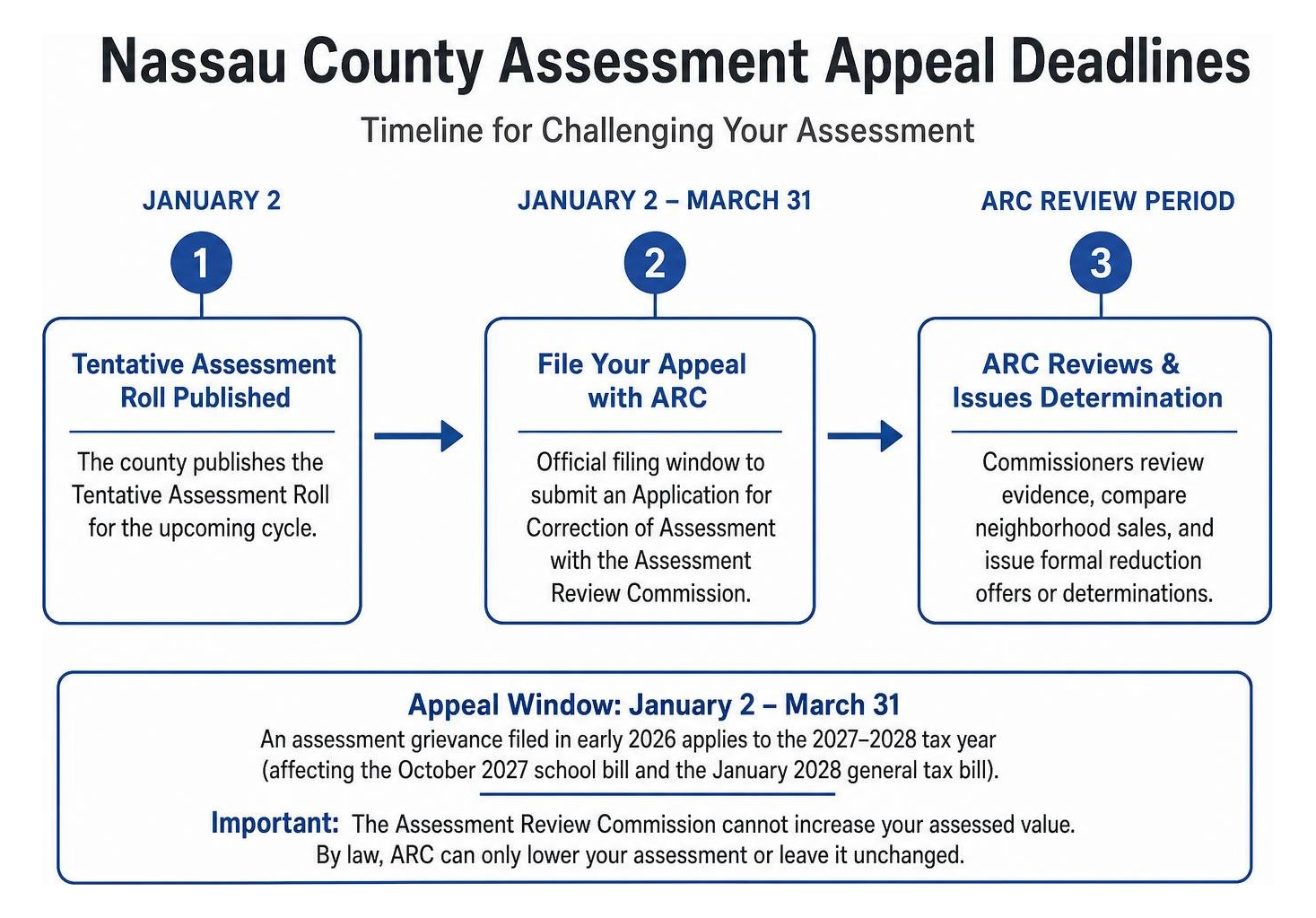
- January 2: The county publishes the Tentative Assessment Roll for the upcoming cycle.
- January 2 – March 31: The official filing window opens to submit an Application for Correction of Assessment with the Assessment Review Commission.
- ARC Review Period: Commissioners review evidence, compare neighborhood sales, and issue formal reduction offers or determinations.
Crucially, the Assessment Review Commission cannot increase your assessed value. By law, ARC can only lower your assessment or leave it unchanged. There is zero risk of your assessment going up as a result of filing an administrative grievance.
To protect your rights, make sure you submit your petition before meeting the annual tax grievance deadline and follow standard step-by-step grievance filing procedures.
Pursuing a Small Claims Assessment Review (SCAR) After an ARC Determination
If ARC denies your grievance or offers an inadequate reduction, you can take your appeal to the next level by filing for a Small Claims Assessment Review (SCAR) in New York State Supreme Court.
- Eligibility: SCAR is available to owner-occupants of one-, two-, or three-family residential properties who filed a timely administrative grievance with ARC.
- Filing Fee: The petition requires a modest $30 filing fee paid to the Nassau County Clerk. If your appeal is successful, this fee is refunded by the county.
- Hearing Process: An impartial, state-appointed judicial hearing officer reviews the evidence presented by you (or your representative) alongside the county’s assessor and renders a binding determination.
For commercial parcels or complex residential estates, property owners can pursue formal Article 7 tax certiorari judicial proceedings. Understanding these legal avenues is essential when navigating tax appeals and valuation disputes.
Frequently Asked Questions About Nassau County Property Assessments
Can the Assessment Review Commission increase my assessed value if I file a grievance?
No. Under New York State and Nassau County administrative rules, the Assessment Review Commission is legally prohibited from raising your property’s tentative assessed value during a grievance proceeding. The commission can only reduce your assessment or sustain the current figure.
Why is my assessed value only a tiny fraction of what my home is worth?
Nassau County uses a fractional assessment system with a Class One Level of Assessment set at 0.10%. Multiplying your home’s estimated market value by 0.0010 produces your assessed figure (for example, a $750,000 market valuation yields a $750 assessed value). Taxing entities then set higher tax rates per $100 of taxable value to generate their required budget levies.
When does Nassau County publish the tentative assessment roll?
The Department of Assessment releases the Tentative Assessment Roll annually on January 2. Homeowners can look up their updated property valuations, inventory details, and assessment notices online via the Nassau County Land Records Viewer starting that day.
Conclusion
Your property assessment directly dictates your share of local school, town, and county taxes. With Nassau County property taxes averaging around $12,500 per year, leaving an inflated property valuation unaddressed can cost you thousands of dollars in unnecessary tax payments over time.
At Heller Tax Grievance, we believe no Long Island homeowner should shoulder an unfair tax burden. Serving families across Nassau and Suffolk counties—including Massapequa, Syosset, Farmingdale, and Brookville—our team has secured over $160 million in tax savings with our ironclad “You Don’t Pay Unless You Save” guarantee. If we don’t reduce your property assessment, you don’t owe us a single dollar.
Review our ultimate guide to handling Nassau County property taxes to learn more about the grievance process, check your property records, and let our experienced team help you secure the tax reduction you deserve.