
Basics and Common Reasons for a Grievance
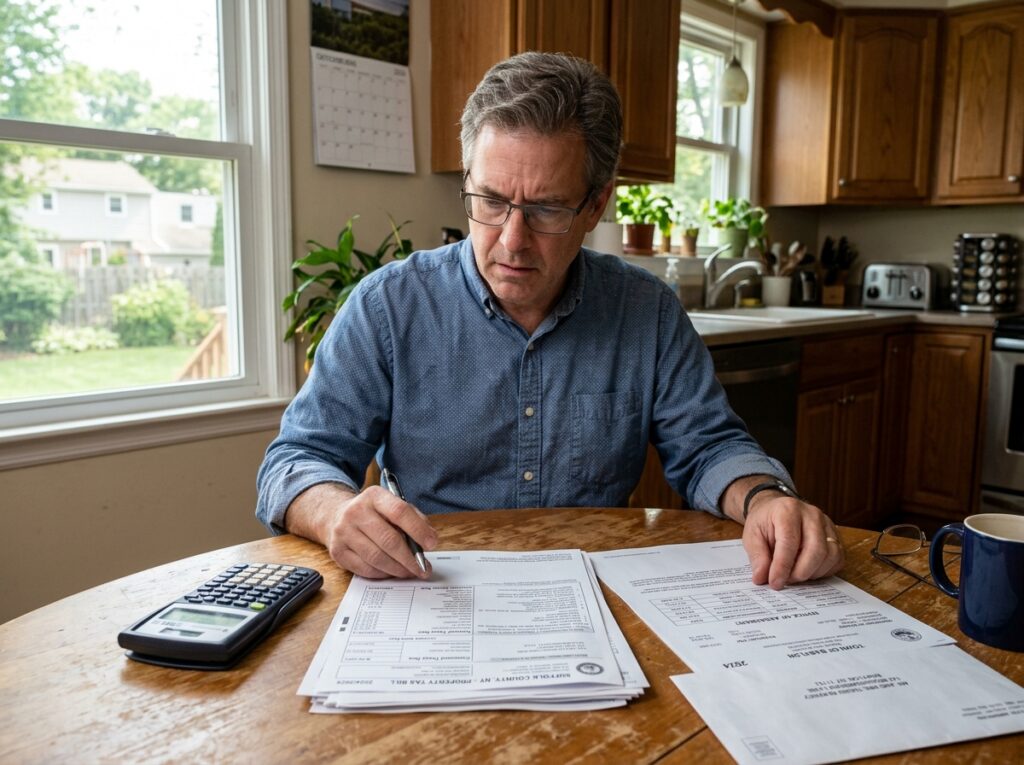
To understand property tax grievance faqs, we first need to distinguish between your tax bill and your property assessment. Your assessment is the value the local assessor places on your home for taxing purposes. If that value is higher than the actual market value (what you could sell your home for in today’s market), you are likely overpaying.
A property tax grievance is not a complaint about high tax rates; it is a formal challenge to the value assigned to your home. When we file a grievance, we are asking the municipality to contest your assessment because it doesn’t accurately reflect the property’s worth. Many homeowners worry that their taxes are “locked in,” but the truth is that the assessment roll is tentative every year, providing a window for corrections. For a deeper dive into how these values are calculated, you can check out our Property Tax Reassessment FAQ.
Who is eligible to file property tax grievance faqs?
We often hear from people who aren’t sure if they have the “standing” to file. According to New York State grievance procedures, eligibility is broader than you might think. You can file a grievance if you fall into any of these categories:
- Property Owners: The most common filers. If you own the deed, you have the right to grieve.
- Purchasers: If you have signed a contract to buy a home but haven’t closed yet, you are still eligible to file, provided you have a stake in the upcoming tax year.
- Tenants: In some commercial or specific residential cases, if your lease explicitly requires you to pay the property taxes, you have the legal right to challenge the assessment.
- Representatives: You don’t have to go it alone. You can authorize a representative (like our team at Heller Tax Grievance) to handle the entire process for you.
Common reasons to trigger property tax grievance faqs
Why do assessments get “wrong” in the first place? Assessors are tasked with valuing thousands of homes, often using mass appraisal techniques that don’t account for the unique quirks of your specific property. Common grounds for a grievance include:
- Unequal Assessment: This occurs when your property is assessed at a higher percentage of its full market value than all other properties on the assessment roll. If your neighbors with identical homes are assessed at $10,000 and you are at $15,000, that is unequal.
- Excessive Assessment: This is the most frequent reason. It simply means the assessor’s estimate of your home’s market value is higher than what the house is actually worth. If the town thinks your home is worth $800,000, but similar homes are selling for $700,000, your assessment is excessive.
- Inventory Errors: Sometimes the data is just plain wrong. Perhaps the town records show you have a finished basement or a fourth bedroom that doesn’t actually exist. A 100-square-foot error in living space can inflate your value by $15,000 or more in some Long Island zip codes.
- Unlawful Assessment: This applies if the property should be exempt (like a church or government building) but was taxed anyway, or if the property is located outside the boundaries of the taxing unit.
If any of these sound familiar, you likely have a strong case. You can find more specific examples in our general FAQs.
The Long Island Tax Calendar and Deadlines
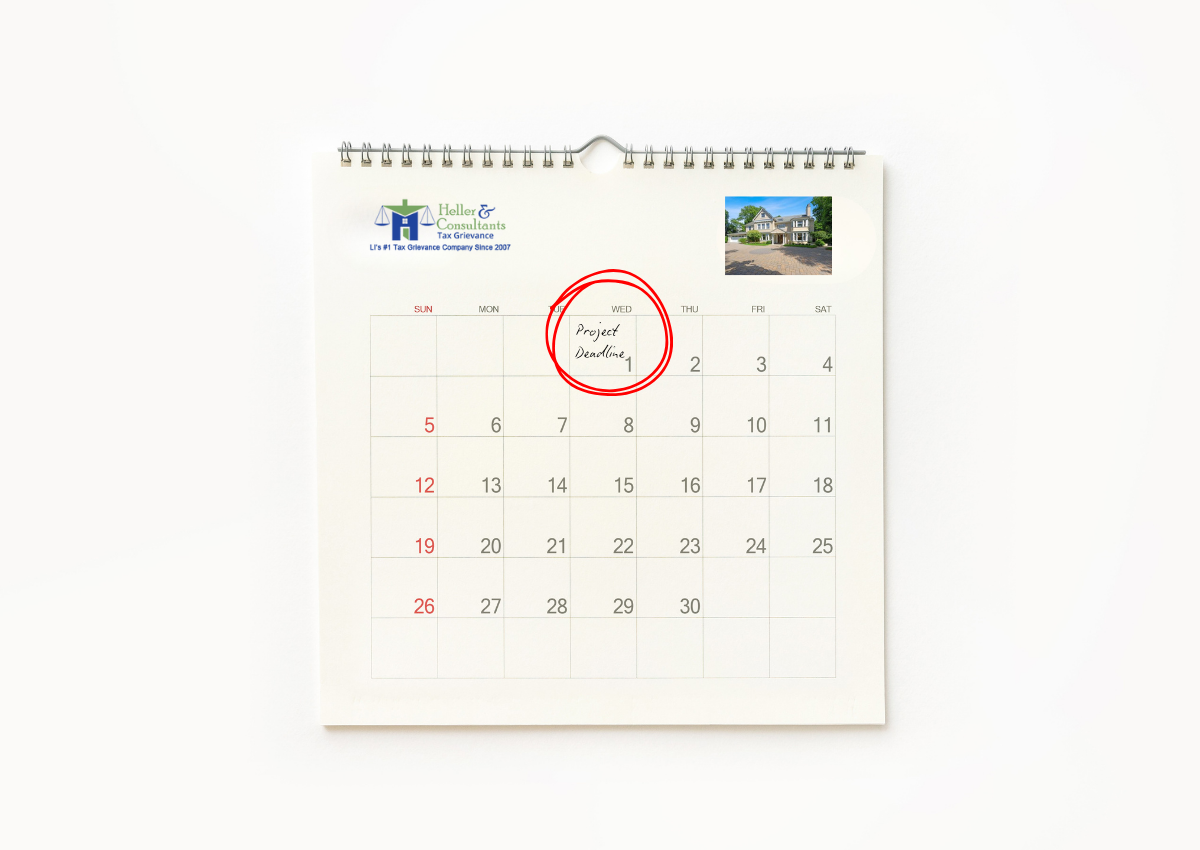
Timing is everything. In property tax grievance faqs, missing a deadline by a single day means waiting an entire year to try again. New York State law is very strict: if the application is not received by the deadline, the Board of Assessment Review (BAR) or the Assessment Review Commission (ARC) cannot legally hear your case.
It is also important to remember that you are grieving the current tentative assessment roll. You cannot go back and “fix” taxes you paid three years ago. The grievance process is strictly forward-looking. To stay updated on where your specific case stands during these windows, we provide tools for FAQs / Case Status.
Nassau vs. Suffolk filing timelines
The two counties operate on completely different schedules. Here is what you need to know for 2024 and beyond:
- Nassau County: The filing period typically runs from January 1st through March 1st. Nassau uses the Assessment Review Commission (ARC) to handle these initial filings. Because Nassau works so far in advance, the grievance you file in early 2027 actually impacts the 2028/2029 tax year.
- Suffolk County: The deadline is always the third Tuesday in May (known as Grievance Day). For most Suffolk townships (like Brookhaven, Islip, or Huntington), the filing window opens around May 1st.
For a comprehensive look at these dates across the state, the New York State grievance booklet is an excellent resource.
Navigating the Property Tax Grievance FAQs Process
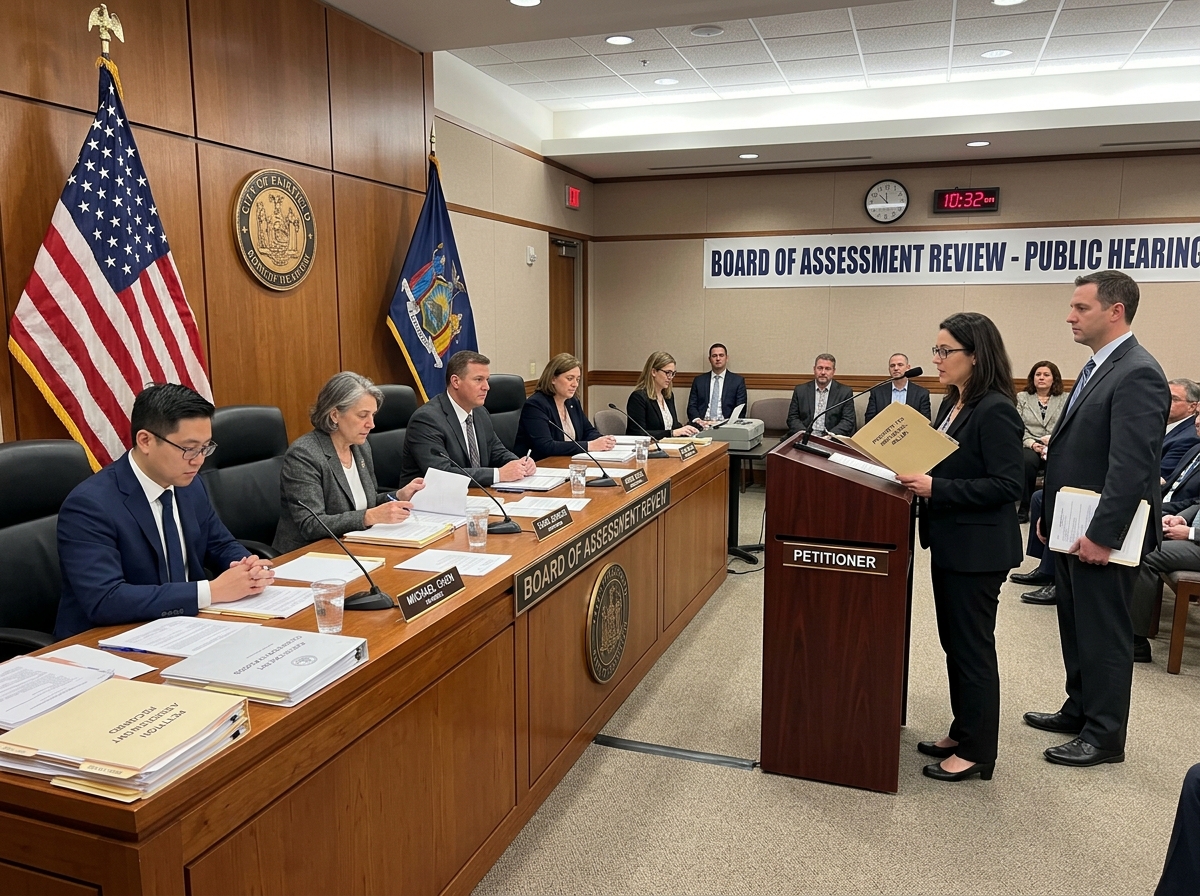
Once you file Form RP-524 (the standard “Complaint on Real Property Assessment”), the administrative review begins. This is the stage where the Board of Assessment Review (BAR) in Suffolk or the ARC in Nassau reviews your evidence.
The process is notoriously slow. From the moment we file your application to the moment you see a reduction, it can take up to 18 months. Why so long?
- Volume: Thousands of homeowners file every year.
- Deliberation: The BAR members (usually 3 to 5 appointed citizens) must review every piece of evidence.
- Hearings: On Grievance Day, boards often hold sessions lasting 10 hours (9 a.m. to 8 p.m.) to hear from residents.
- Presentation: If you choose to attend in person, you are typically given only 3 minutes to present your case. This is why having a professional file a comprehensive, data-backed evidence package is often more effective than a brief in-person plea.
We answer more questions about the day-to-day timeline in our FAQs / Case Status / FAQs.
What happens if my grievance is denied?
Don’t panic. A denial at the board level is common and is often just a stepping stone to a successful outcome. If the BAR or ARC does not grant a reduction, the next step is Small Claims Assessment Review (SCAR).
SCAR is a judicial review where an independent hearing officer—not a town employee—looks at the case.
- The Cost: There is a $30 state-imposed filing fee to move to SCAR.
- Suffolk Specifics: In Suffolk County, you may also face a $75 fee for a “Certified Market Analysis” if you don’t provide a professional appraisal.
- The Win: SCAR is where many of our largest reductions are won. If the hearing officer rules in your favor, the savings are retroactive to the start of the tax year for which you filed. If you already paid your bill at the higher rate, the municipality will eventually issue you a refund check.
Additional Property Tax Grievance FAQs
There is often confusion between a tax grievance and a tax exemption. While both can lower your bill, they work very differently.
| Feature | Tax Grievance | Tax Exemption (e.g., STAR) |
|---|---|---|
| What it does | Challenges the home’s value | Removes a portion of value from taxation |
| Frequency | Can be filed every year | Usually filed once (unless income changes) |
| Basis | Market value and comparable sales | Eligibility (Age, Residency, Military Service) |
| Deadline | March 1 (Nassau) / May (Suffolk) | March 1 (Statewide) |
Do I still have to pay taxes while a grievance is pending?
Yes. This is a critical point in property tax grievance faqs. Filing a grievance does not pause your tax obligation. You must continue to pay your property taxes by the standard due dates (usually December and May in Suffolk; varying dates in Nassau).
If you stop paying, you will incur heavy late penalties and interest from the Receiver of Taxes. If your grievance is successful later, you will receive a refund check for the overpayment. If you have an escrow account, your mortgage company will continue to pay based on the current bill. Once the reduction is official, your escrow will be re-analyzed, often resulting in a lower monthly mortgage payment and a surplus check from your bank.
Can my assessment go up because I filed a grievance?
This is the number one fear that keeps homeowners from filing, and we want to put it to rest: No, your property taxes cannot be raised because you filed a grievance.
New York State law protects homeowners in this process. The Board of Assessment Review only has the power to maintain your assessment or lower it; they cannot legally use your grievance as an excuse to “punish” you with a higher value. It is a one-way street—the only possible outcomes are that your taxes stay the same or they go down. This makes grieving your taxes a virtually risk-free endeavor.
Conclusion
Navigating the maze of property tax grievance faqs can feel overwhelming, but it is the most effective tool you have to control your cost of homeownership on Long Island. Whether you are in Farmingdale, Miller Place, or Syosset, the math remains the same: if your assessment is too high, you are subsidizing the rest of the town.
At Heller Tax Grievance, we’ve spent years perfecting the art of the reduction. We’ve saved Long Island homeowners over $160 million, securing some of the largest tax reductions in Nassau and Suffolk counties. Our “You Don’t Pay Unless You Save” guarantee means that if we don’t successfully lower your property taxes, you don’t owe us a penny. There is no upfront cost and no risk to your current assessment.
Don’t let another tax season pass you by while paying more than your fair share. For a deep dive into every step of the process, read our Complete Guide for Property Tax Grievances and let us help you start saving today.