
Why Your Commercial Property Tax Bill Is Probably Too High
Commercial tax grievance is the formal process of challenging your property’s assessed value to lower your tax bill — and on Long Island, it’s one of the most powerful financial tools available to commercial property owners.
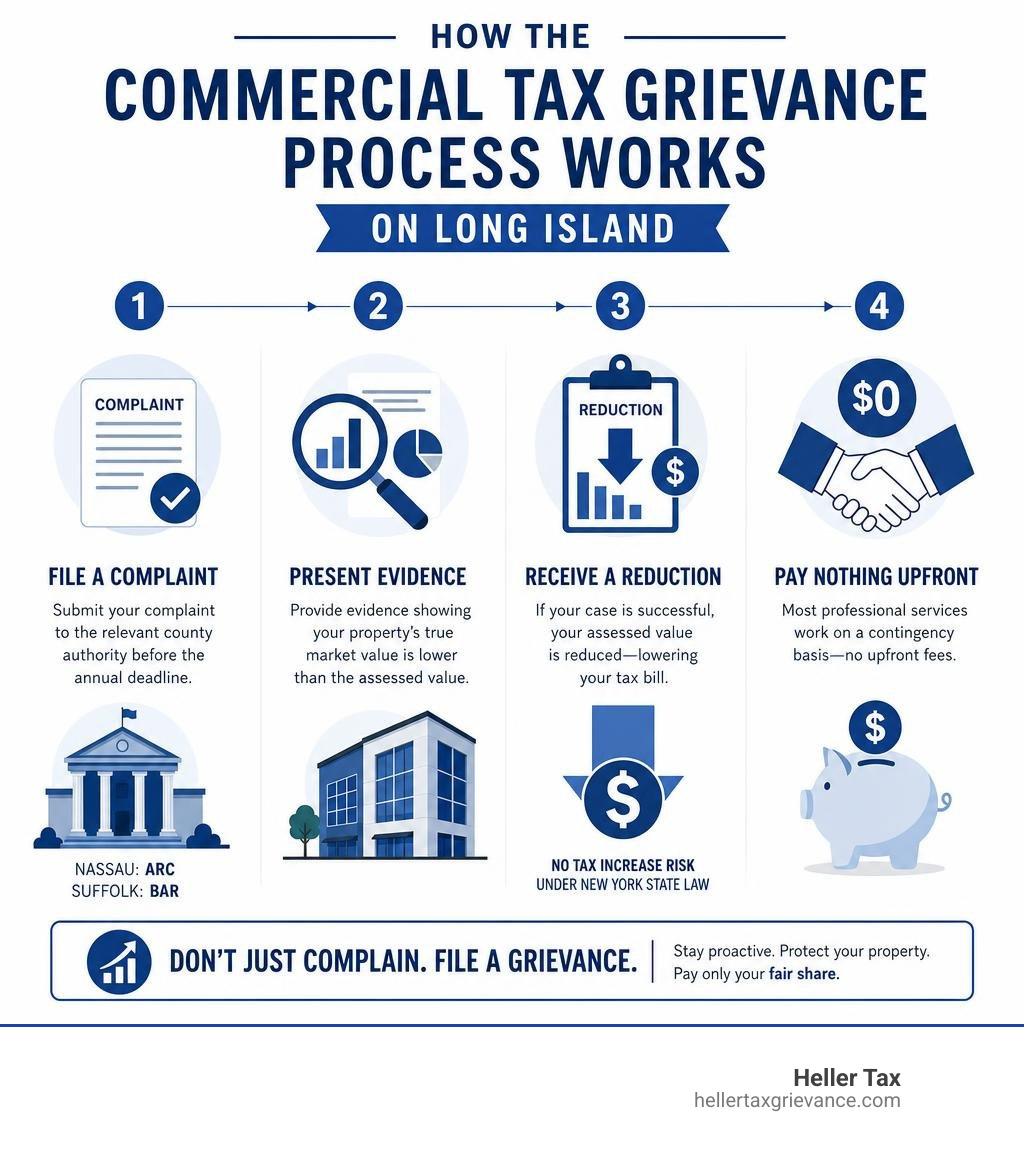
Here’s a quick summary of how it works:
- File a complaint with your municipality (Nassau’s ARC or Suffolk’s BAR) before the annual deadline
- Present evidence showing your property’s true market value is lower than the assessed value
- Receive a reduction if your case is successful — with no tax increase risk under New York State law
- Pay nothing upfront — most professional services work on a contingency basis
New York State ranks #47 out of 50 for worst property taxes in the country. Nassau County regularly holds the #1 or #2 spot for highest property taxes of any county in the entire nation. If you own commercial real estate here — whether it’s a retail strip, office building, warehouse, or apartment complex — there’s a strong chance your assessed value is higher than it should be.
And here’s the hard truth: if you don’t file, your taxes will almost certainly go up on their own.
Property taxes on Long Island typically increase around 10% per year. Staying silent isn’t neutral — it’s expensive.
I’m Adam Heller, founder of Heller Tax Grievance, and I’ve spent nearly two decades focused exclusively on commercial tax grievance and residential property tax reduction on Long Island after selling my real estate firm to Douglas Elliman in 2006. In that time, our team has helped thousands of Long Island property owners — commercial and residential — pay only their fair share in taxes, holding the record for the largest single-year reductions in both Nassau and Suffolk counties.
Commercial tax grievance helpful reading:
Why You Should File a Commercial Tax Grievance on Long Island
If you own commercial real estate in Nassau County or Suffolk County, property taxes are likely one of your single largest annual operating expenses. Unlike residential properties, where tax increases hurt but are relatively predictable, commercial property tax hikes can completely devastate your bottom line.
Over-assessment is incredibly common across Long Island’s commercial hubs—from Syosset and Farmingdale to Massapequa and Deer Park. Municipalities use broad, generalized algorithms to determine property valuations, often ignoring the hyper-local market realities that affect individual commercial spaces.
When your property is over-assessed, you are effectively paying a premium on an imaginary valuation. By filing a commercial tax grievance, you force the municipality to reconcile its generic formulas with the actual financial and physical reality of your property. To understand the legal framework of this process, you can review the official Grievance procedures – Department of Taxation and Finance – NY.Gov.
Filing a grievance is not an act of aggression; it is a routine, highly strategic business practice. To learn more about how these taxes impact your business, explore our guide on More info about commercial real estate property taxes.
What is a Commercial Tax Grievance and How Does It Differ from Residential?
While both residential and commercial tax grievances aim to lower assessed property values, the underlying assessment methodologies, legal frameworks, and financial stakes are vastly different.
For a residential property (such as a single-family home in Stony Brook or Miller Place), assessors look primarily at comparable sales—what did the house next door sell for? It is a relatively straightforward valuation based on market transactions of highly similar properties.
Commercial property valuation, however, is significantly more complex. Assessors look beyond physical brick-and-mortar sales and focus heavily on the property’s income-producing capability. Because of this, the commercial grievance process requires a deep dive into financial accounting, capitalization rates, vacancy trends, and commercial lease agreements.
| Feature | Residential Tax Grievance | Commercial Tax Grievance |
|---|---|---|
| Primary Valuation Method | Comparable Sales Method | Income Capitalization Method |
| Key Documentation | Recent sales of nearby homes | Rent rolls, profit & loss statements, leases |
| Financial Impact | Lowers monthly mortgage/holding costs | Directly increases Net Operating Income (NOI) and property resale value |
| Filing Complexity | Simple form; homeowner can often file | Highly technical; requires professional/legal representation |
| County Filing Requirements | Standardized residential forms | Specialized income/expense filings (e.g., ASIE in Nassau) |
Why Commercial Property Assessments Are Frequently Inflated
Why do commercial assessments miss the mark so often? The answer lies in the assumptions made by county assessors.
Assessors typically value commercial properties using the Income Capitalization Approach. This method converts a property’s potential income into an estimate of market value. However, because assessors do not have the time to analyze every business individually, they build their models on idealized, “perfect-world” assumptions:
- 100% Occupancy Assumptions: Assessors often calculate your property’s value assuming every storefront, office suite, or warehouse bay is fully leased. In reality, you might be dealing with persistent vacancies.
- Aggressive Capitalization (Cap) Rates: The cap rate is the rate of return on a real estate investment property. Assessors frequently use compressed, aggressive cap rates that artificially inflate your property’s calculated value.
- Inflated Market Rents: Assessors may assume your tenants are paying top-of-market rental rates, completely ignoring the below-market leases you signed years ago that are still legally binding.
- Underestimated Operating Expenses: General models rarely account for the soaring costs of property maintenance, localized utility spikes, or unexpected structural repairs.
When the county assumes you have zero vacancies, maximum rental rates, and minimal expenses, your assessment skyrockets. A commercial tax grievance is your opportunity to correct these assumptions with hard data. For actionable strategies on tackling these inflated bills, read our article on How to Get Some Much-Needed Commercial Property Tax Relief.
Eligible Property Types and Key Evidence Required
Almost any income-producing or business-use property on Long Island is eligible for a commercial tax grievance. Whether you own a local retail strip in Rocky Point or a large office complex in Brookville, you have the legal right to challenge an unfair assessment.

Eligible property types include:
- Retail Spaces: Strip malls, standalone retail buildings, shopping centers, and car dealerships.
- Office Buildings: Medical offices, corporate headquarters, and multi-tenant professional buildings.
- Industrial & Flex Warehouses: Manufacturing facilities, distribution centers, and self-storage properties.
- Multifamily Properties: Apartment buildings, co-ops, and large residential complexes (typically four or more units).
- Specialty Properties: Hotels, motels, mixed-use developments, and vacant commercial land.
To explore how different property types can optimize their tax strategies, see our breakdown of the Top 5 Ways Can Use Pay Fewer Commercial Property Taxes.
Essential Documentation for Your Commercial Tax Grievance
Filing a successful commercial grievance is entirely about the strength of your evidence. You cannot simply argue that your taxes “feel” too high; you must prove that the county’s valuation of your property is mathematically incorrect.
To build an airtight case, you generally need to compile the following documentation:
- Income and Expense (I&E) Statements: At least three years of detailed profit and loss statements showing the actual cash flow of the property.
- Certified Rent Rolls: Up-to-date lists of all tenants, their occupied square footage, lease start and end dates, and actual monthly rental payments.
- Lease Agreements: Copies of current commercial leases, especially if they show you are locked into below-market rates.
- Proof of Vacancy: Documentation showing structural vacancies, such as marketing materials for unleased spaces or utility bills showing inactive units.
- Property Condition Reports: Evidence of deferred maintenance, structural issues, outdated HVAC systems, or environmental concerns that lower the property’s market value.
- Independent Appraisals: A recent, certified commercial appraisal reflecting the true market value of the property.
In Nassau County, commercial property owners must submit these financial details through formal portals. You can learn more about how the county handles these submissions directly from the Assessment Review Commission – NassauCountyNY.gov.
The Long Island Tax Grievance Calendar and Deadlines
In property tax reduction, deadlines are absolute. If you miss a filing window by even a single minute, you lose your right to challenge your assessment for that entire tax year.
Because Nassau and Suffolk Counties operate on entirely different tax calendars, commercial property owners must stay highly organized.
To navigate these timelines successfully, consult our comprehensive Commercial Tax Grievance Long Island Step-by-Step Guide.
Nassau County Deadlines and the ASIE Filing
Nassau County commercial properties (classified as Class 4 properties) face a rigorous, two-part filing process.
- The ASIE Deadline (April 1, 2027): Commercial property owners in Nassau County must file an annual Annual Survey of Income and Expense (ASIE). For the 2025/2027 cycle, the ASIE-2025 must be submitted electronically before April 1, 2027. Failing to file this form on time carries heavy financial penalties and can result in the automatic denial of your tax grievance.
- The ARC Grievance Deadline (March 31, 2027): The formal grievance petition must be submitted to the Nassau County Assessment Review Commission (ARC) by March 31, 2027, for the corresponding tax year.
Because these dates require meticulous preparation of complex financial spreadsheets, commercial owners must begin gathering their data months in advance.
Suffolk County Deadlines and Grievance Day
Suffolk County operates on a town-by-town assessment system, but coordinates its primary deadlines to a single, crucial day.
- Suffolk County Grievance Day (May 19, 2027): In Suffolk County, commercial tax grievances must be filed with the local town’s Board of Assessment Review (BAR) on or before the third Tuesday in May—which fell on May 19, 2027, for the current tax cycle.
- Town-Specific Deadlines: All major Suffolk towns (such as Babylon, Brookhaven, Huntington, Islip, and Smithtown) adhere strictly to this county-wide May deadline. Commercial property owners must ensure their documentation is submitted directly to the appropriate town assessor’s office on or before Grievance Day to protect their right to challenge.
Frequently Asked Questions about Commercial Tax Grievances
Will filing a grievance trigger a property inspection or increase my assessment?
This is the single most common fear among commercial property owners, and we want to put it to rest immediately: No, filing a tax grievance will not trigger a physical property inspection, and it cannot increase your property assessment.
Under New York State law, the Board of Assessment Review and the Assessment Review Commission are authorized only to maintain or lower your assessment during a grievance proceeding. They do not have the legal authority to increase your taxes as a penalty for filing a complaint.
Furthermore, the grievance process is an administrative and legal review of your financial documentation. County assessors do not have the staff or the legal right to randomly audit or inspect your building simply because you requested a fair valuation. It is a completely risk-free financial review.
How does a successful grievance affect my property’s NOI and resale value?
Lowering your commercial property taxes has a massive, compounding effect on your property’s overall financial health.
Because commercial property values are calculated directly from their cash flow using capitalization rates, every dollar you save on property taxes is a dollar added directly to your Net Operating Income (NOI).
Let’s look at the math: Imagine you own a retail strip in Syosset. Through a successful commercial tax grievance, we secure an annual tax reduction of $20,000.
If your property is valued at an 8% capitalization rate, that $20,000 reduction in expenses instantly increases your property’s market resale value by $250,000 ($20,000 divided by 0.08).
${Increase in Resale Value} = frac{Annual Tax Savings}{Capitalization Rate}}$$
By reducing your fixed expenses, you make your property significantly more attractive to potential buyers and lenders alike. To explore how tax reductions translate to higher yields, check out our insights on Tag Commercial Grievance Rates.
What is the typical fee structure for commercial grievance services?
At Heller Tax Grievance, we believe that property owners should never have to take a financial gamble to secure tax fairness. That is why we operate on a strict, contingency-fee basis.
- No Reduction, No Fee: If we do not successfully lower your commercial property taxes, you owe us absolutely nothing. There are no upfront consulting fees, no hourly charges, and no hidden administrative costs.
- Success-Based Pricing: Our fee is a percentage of the actual, verified tax savings achieved during the first year of your reduction.
- Disbursements: In some complex commercial cases, minimal third-party costs (such as court filing fees or specialized commercial appraisal fees) may apply, but these are always discussed and approved by you in advance.
This fee structure aligns our incentives perfectly with yours: we only win when you win.
Conclusion
Managing a commercial property on Long Island is challenging enough without overpaying on your property taxes. With New York’s tax rates remaining some of the highest in the country, failing to challenge your assessment is essentially leaving money on the table.
Because market conditions fluctuate, tenants move, and operating costs rise, smart commercial property owners treat tax grievances as an annual financial checkup. Filing annually ensures that your property’s assessment always reflects its true, real-world value—protecting your cash flow, your NOI, and your long-term investment.
At Heller Tax Grievance, we bring over 30 years of combined experience to the table. We handle the entire process for you—from analyzing your rent rolls and preparing the complex financial models to representing your interests before the county boards.
Don’t let inflated county assumptions drain your business’s profitability. Let us do the heavy lifting while you focus on running your business.
Get started with commercial tax reduction services today and discover how much you could save.