
Understanding Your Right to Challenge Your Nassau County Property Tax Assessment
A Nassau County property tax grievance is your formal right to challenge your property’s assessed value if you believe it’s too high. Here’s what you need to know:
Quick Facts:
- Filing Period: January 2 – March 1 annually
- Who Can File: Property owners, purchasers, or tenants responsible for paying property taxes
- Cost: No fee to file with the Assessment Review Commission (ARC)
- Your Protection: ARC cannot increase your assessment—only reduce it or leave it unchanged
- Where to File: Online via Nassau County ARC’s AROW portal, by mail, or in person at 240 Old Country Road, Mineola, NY 11501
Common Grounds for Filing:
- Your property is assessed higher than similar homes in your area.
- Your assessment exceeds the actual market value.
- Your property tax class is incorrect.
- You were denied an exemption you qualify for.
Many Nassau County homeowners pay more in property taxes than they should. The county reassessed all properties in 2018, and values are updated annually based on market conditions, often resulting in inflated assessments.
The Assessment Review Commission (ARC) handles thousands of applications annually. Filing on your own is free but requires gathering comparable sales data and evidence to support a lower valuation. If ARC denies your grievance, you can file a Small Claims Assessment Review (SCAR) for a $30 fee.
I’m Adam Heller, and since 2007, I’ve helped over 50,000 Long Island property owners steer the Nassau County property tax grievance process, securing over $75 million in tax reductions. Our firm holds the record for the largest single-year reductions in both Nassau County ($73,000) and Suffolk County ($17,000).
Understanding Your Assessment and Grievance Rights
Your property’s assessed value, set annually by the Nassau County Department of Assessment, is based on its market value—what it would likely sell for. These values are updated yearly and can often be higher than your home’s true market value or comparable properties. For Class 1 residential properties (most one- to three-family homes), assessment increases are capped at 6% per year and 20% over five years, excluding new construction. A jump beyond this cap is a red flag.
Understanding your tax class is also important, as it affects your tax rate. State law divides properties into four classes:
- Class 1: Most residential properties (one- to three-family homes, smaller condos). These have the lowest tax rates.
- Class 2: Larger residential properties like rental apartments and co-ops.
- Class 3: Utility company property.
- Class 4: All other properties, including commercial and industrial.
Nassau County, not your local town, handles these assessments. However, incorporated villages have their own assessment rolls, which require a separate filing. You have the right to appeal your county assessment to the independent Assessment Review Commission (ARC). For more details, visit the official Nassau County page: How to Appeal Your Assessment (Nassau County).
Who is Eligible to File a Grievance?
Eligibility isn’t limited to the owner:
- Property Owners: Anyone listed on the deed.
- Purchasers: Anyone with a written contract to buy the property.
- Tenants: If your lease requires you to pay property taxes.
- Estate Representatives: An executor or someone with power of attorney for a deceased owner’s property.
- Condominium Owners: Individual unit owners can file but should check if the board is filing for everyone.
- Cooperative Boards: Only the co-op’s board of directors can file for the entire building.
- Business Entities: An officer, partner, or member of the owning entity.
Common Grounds for a Nassau County Property Tax Grievance
When filing a Nassau County property tax grievance, you claim the assessment is incorrect for specific reasons. Common grounds include:
- Excessive Assessment: Your property’s assessed value is higher than its actual market value. This is the most common reason. For example, your home is assessed at $600,000, but similar homes sell for $500,000.
- Unequal Assessment: Your property is assessed at a higher percentage of its value than comparable properties.
- Misclassification: Your property is in the wrong tax class (e.g., a home classified as commercial), resulting in a higher tax rate.
- Unlawful Assessment: The assessment violates the law, such as taxing an exempt property or containing a clerical error.
Key Deadlines and The Grievance Period
Meeting deadlines is the most critical part of the Nassau County property tax grievance process. If you miss the deadline, you lose your right to challenge your assessment for that tax year.
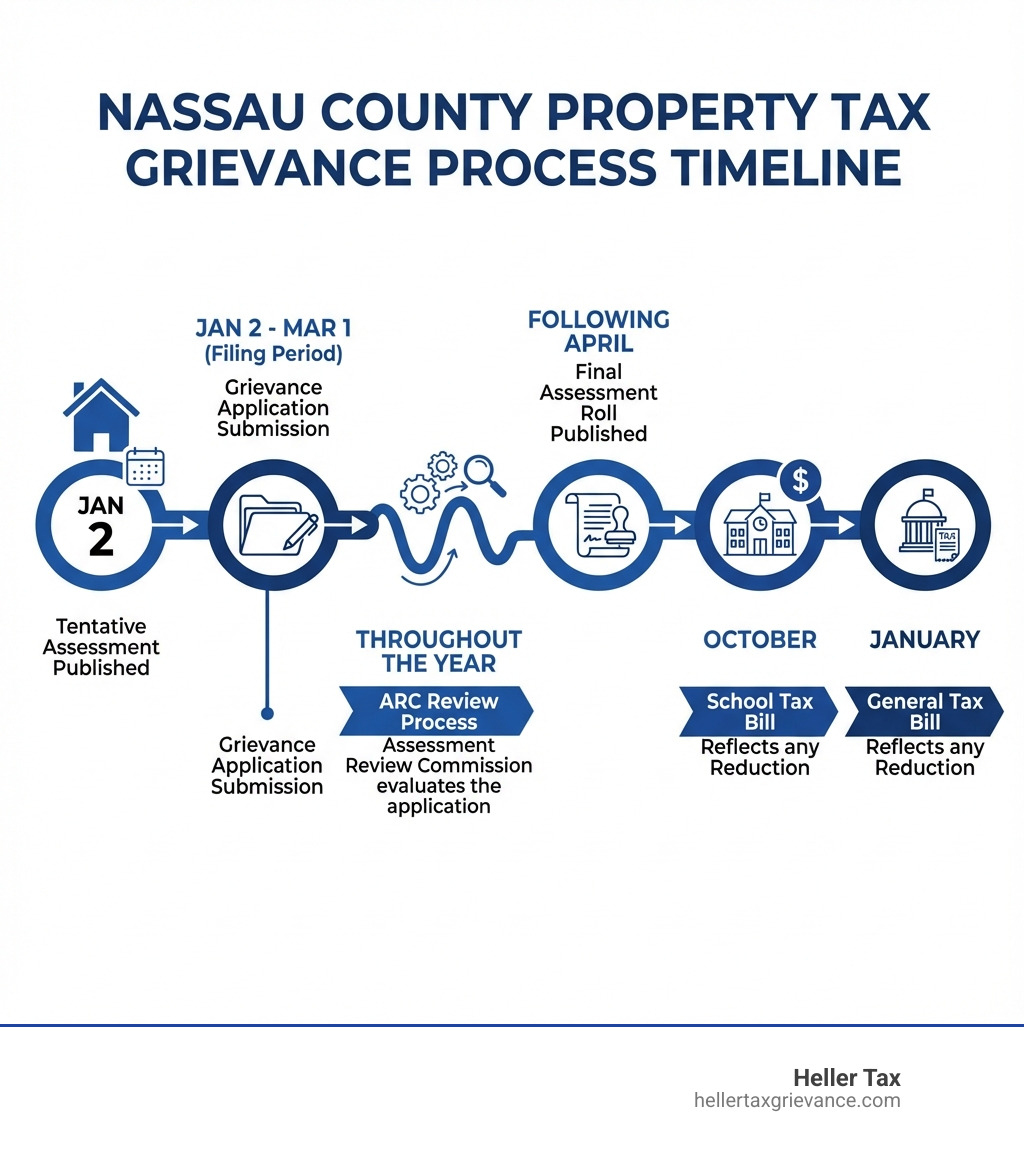
The official grievance period in Nassau County is January 2nd to March 1st annually. This window for submitting your application to the Nassau County Assessment Review Commission (ARC) is strictly enforced. The Department of Assessment publishes the tentative assessment roll in January, which contains the new values you will be challenging.
Filing annually is crucial because assessments change every year. Even if you received a reduction last year, your assessment can increase again based on new market values. An annual grievance protects you from rising tax rates and inflated assessments.
For more information, you can visit the official Nassau County ARC website.
Important Dates for the Tax Grievance Calendar
Here are the key dates you need to know in Nassau County:
- January 2nd (Annually): The tentative assessment roll is published, and the grievance filing period opens.
- March 1st (Annually, or extended date): The traditional deadline for filing your Nassau County property tax grievance with the ARC. For the 2027-2028 tax year, the appeal period is January 2, 2026, to March 2, 2026.
- Throughout the Year (Up to 15 months): The ARC reviews all applications.
- March 31st (of the year following filing): Final determinations on appeals are issued by this date.
- First Business Day in April (of the year following filing): The final assessment roll is published, incorporating any successful grievance changes.
- October (of the year following final roll): Savings from a successful grievance are first reflected on your School Tax bill.
- January (of the second year following final roll): Reductions are then reflected in your General Tax bill.
Though the process can be long, any reduction is retroactive to the beginning of the tax year for which you filed. This makes filing on time essential.
The Step-by-Step Guide to Filing Your Nassau County Property Tax Grievance
Filing a Nassau County property tax grievance with the Assessment Review Commission (ARC) is a clear process with no filing fee. The goal is to prove your assessment is excessive or unequal using evidence like comparable sales data. While you can file on your own, many homeowners find gathering evidence and building a strong case challenging, which is where professional services can help.
How to File a Nassau County Property Tax Grievance
You can file your grievance in several ways:
- Filing Online (AROW): This is the recommended method. The AROW (Assessment Review on the Web) portal provides immediate confirmation and lets you track your application’s status. You can access the portal and a tutorial here: Click here File online throughAROW (Assessment Review on the Web)for immediate confirmation.Click herefor a video tutorial.

- Filing on Paper: Request a paper application by calling ARC at (516) 571-3214 or obtain one from your local town office.
- Filing In Person: File your application at the ARC office: 240 Old Country Road, Mineola, NY 11501.
When filing, use the correct form: AR1 for most residential properties, AR2 for other property types, and AR3 for non-value issues like tax class or exemptions. You can find official forms and instructions on the Nassau County ARC website and in the Nassau County ARC Brochure – “How to Appeal Your Assessment”.
Gathering Your Evidence and Information
A strong grievance requires solid evidence:
- Property Identification: Your parcel number, lot, and block.
- Market Value Estimate: Your estimate of your property’s value as of the valuation date (January 2nd).
- Comparable Sales Data: This is vital. Find recent sales of similar properties that sold for less than your assessed value.
- Photos of Property Condition: Document any issues that negatively impact value (e.g., structural problems, deferred maintenance).
- Exemption Information: Documentation to support eligibility for any denied exemptions (STAR, Senior, etc.).
- Other Supporting Documents: Appraisals, purchase agreements, or other relevant information.
Here’s a look at why many homeowners choose to work with a professional grievance service like ours:
| Benefit Category | Filing Yourself | Using a Professional Grievance Service (like Heller & Consultants Tax Grievance) |
|---|---|---|
| Expertise | Requires learning assessment laws, market analysis, and procedures. | We have specialized knowledge of Nassau County’s assessment practices and appeal process. |
| Time Savings | Involves significant time for research, evidence gathering, and paperwork. | We handle all research, paperwork, and communication with ARC, saving you time. |
| Evidence Gathering | Finding and analyzing truly comparable sales can be difficult. | We use advanced data analytics and comprehensive sales databases to build a robust case. |
| Risk of Errors | Mistakes on forms or in calculations can lead to denial. | Our team ensures all forms and evidence are correctly prepared and presented. |
| Success Rate | May not achieve the maximum possible reduction without specific expertise. | Our track record proves our ability to secure significant reductions. We know what ARC looks for. |
| Cost | No ARC fee, but your time has value, and a missed reduction is a hidden cost. | We work on a “You Don’t Pay Unless You Save” basis. There is no fee unless we get you a reduction. |
| Stress/Hassle | The process can be complex and frustrating for those unfamiliar with it. | We simplify the process, taking the burden off your shoulders. |
| Appeals | If denied, you must steer the SCAR process on your own and attend a court appearance. | We make all SCAR court appearances, protecting your rights at every stage & maximizing your savings. |
What Happens After You File? The Review and Appeals Process
After you file your Nassau County property tax grievance, the Assessment Review Commission (ARC) begins its review. Professional appraisers examine your evidence. The process can take up to 15 months, with final determinations issued by March 31st of the year following your filing. If you file via the AROW system, you can track your appeal’s status online.
During the review, ARC may offer a settlement to reduce your assessment. If you accept, you typically waive your right to further appeal for that tax year. If you reject the offer or none is made, you can proceed to the next step.
A crucial point for homeowners: the Assessment Review Commission (ARC) will never increase your assessment when you file an application. They can only reduce your assessment or leave it unchanged. There are no penalties for filing a grievance.
Small Claims Assessment Review (SCAR)
If you are not satisfied with ARC’s decision (and did not accept a settlement), you can file for a Small Claims Assessment Review (SCAR).
- What is SCAR? An optional, simpler form of judicial review through the NYS Unified Court System for homeowners.
- Eligibility: You must own and live in a one, two, or three-family home or a Class 1 condo used exclusively for residential purposes. You must have filed with ARC first.
- Filing Fee: A $30 filing fee, which may be reimbursed by the county if your appeal is successful.
- Process: Petitions are filed with the Nassau County Clerk’s Office, starting on the first business day in April. More information is available from the New York State Unified Court System.
Frequently Asked Questions about the Nassau County Tax Grievance
We understand that the property tax grievance process can raise a lot of questions. Here, we address some of the most common concerns.
Can filing a grievance cause my assessment to increase?
No. Filing a grievance with the Nassau County Assessment Review Commission (ARC) cannot cause your assessment to increase. The ARC can only reduce your assessment or leave it unchanged. There is no risk or penalty for filing.
Do I need a professional service to file?
No, you are not required to use a professional service to file a Nassau County property tax grievance. You can file on your own for free.
However, the process requires in-depth market research, understanding complex tax laws, and presenting a compelling case. A professional service offers:
- Expertise: Years of experience with Nassau County’s specific processes. Former Nassau County assessors on staff.
- Time Savings: We handle all the research, paperwork, and communication.
- Better Results: Our resources often lead to a greater chance of success and larger reductions.
- No Risk: Our “You Don’t Pay Unless You Save” guarantee means you only pay if we successfully reduce your taxes.
If you hire a representative, ARC will communicate directly with them, simplifying the process for you. Remember to only sign one authorization form, as duplicates can cause a denial.
How often should I file a property tax grievance?
We strongly recommend filing a Nassau County property tax grievance every year. Here’s why:
- Annual Reassessment: Nassau County assesses properties annually, so your value can change each year.
- Rising Tax Rates: School and general tax rates often increase. Challenging your assessment helps offset these increases.
- Separate Determinations: A successful grievance one year doesn’t guarantee a lower assessment the next. Each year is a new case.
Filing annually is the best way to manage your homeownership costs and avoid over-taxation.
Can I appeal my village or city tax assessment separately?
Yes. If you live in an incorporated village within Nassau County (such as Rockville Centre or Garden City), you must appeal your village tax assessment separately. Filing with Nassau County ARC only covers your county assessment. Contact your village clerk for their specific forms, deadlines, and procedures, as they are different from the county’s.
What are the implications of a reassessment on my property taxes?
A reassessment updates property values to current market conditions, which can significantly change your tax bill. It can lead to an increase or decrease in your assessed value and can shift the tax burden among properties. Since the county continues to adjust values annually even after a major reassessment, it’s crucial to review your assessment each year. The Nassau County property tax grievance process exists to ensure your individual assessment is fair and accurate.
Conclusion
Navigating the Nassau County property tax grievance process can seem daunting, but it’s your fundamental right as a homeowner to challenge an assessment you believe is unfair. We’ve walked through what a grievance entails, who is eligible, the common grounds for filing, and the critical deadlines you must meet. We’ve also highlighted the step-by-step process, from filing your application with the Assessment Review Commission (ARC) to pursuing a Small Claims Assessment Review (SCAR) if necessary.
Filing a grievance with ARC costs you nothing, and ARC can never increase your assessment – only reduce it or leave it unchanged. The key to a successful grievance lies in providing solid evidence, particularly comparable sales data, to support your claim.
At Heller Tax Grievance, we pride ourselves on helping Long Island homeowners secure the tax reductions they deserve. With over $160 million saved for our clients and a “You Don’t Pay Unless You Save” guarantee, we make the process simple and risk-free. We handle all the complexities, from gathering evidence to representing you, ensuring your property is assessed fairly.
Don’t let an inflated assessment cost you more than you should be paying. Take control of your property taxes today.