

Why Nassau County Homeowners Can’t Afford to Skip the Tax Grievance Process
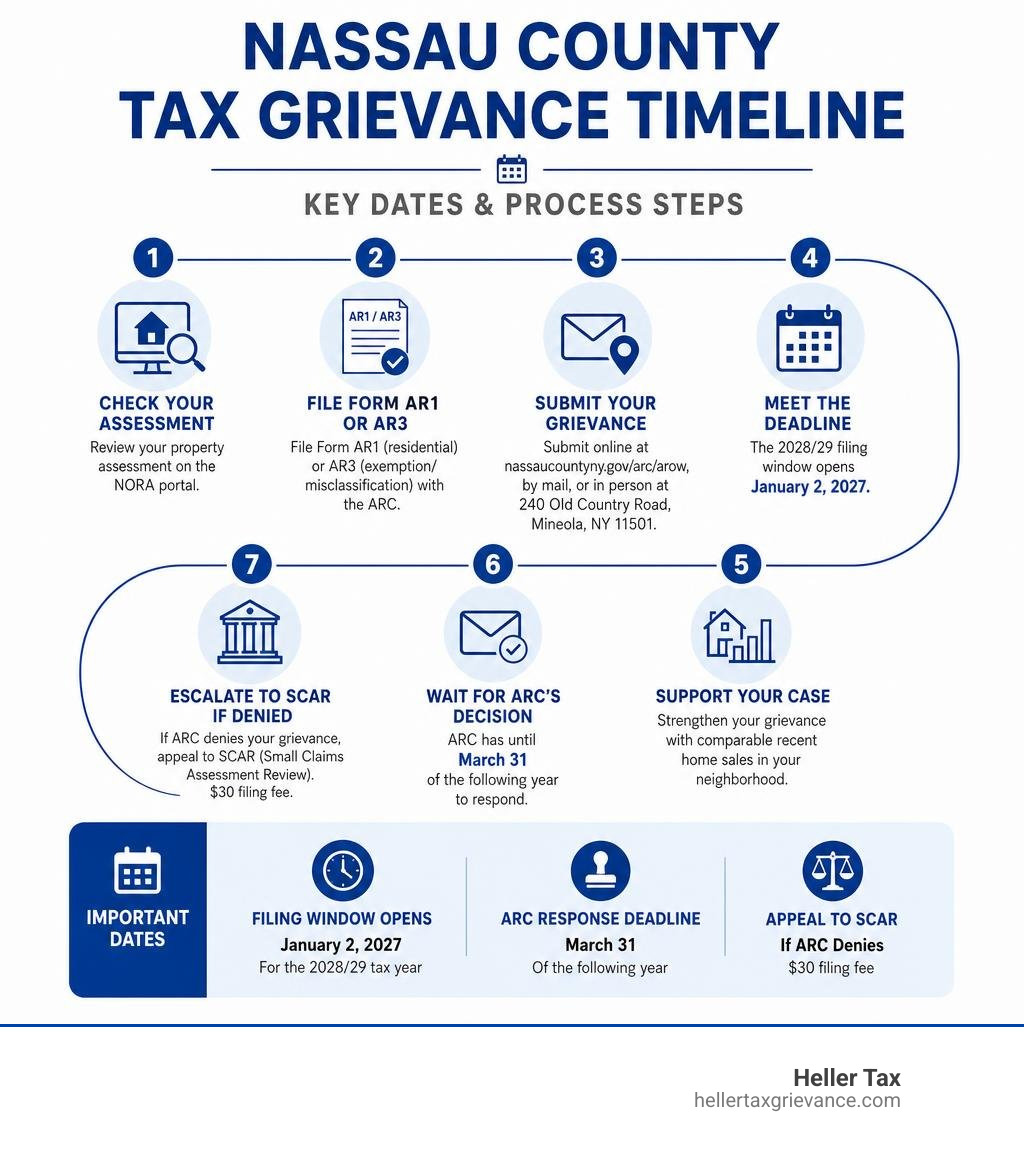
If you’re looking to file a Nassau County tax grievance, here’s the quick answer:
- Check your assessment on the Nassau County NORA portal
- File Form AR1 (residential) or AR3 (exemption/misclassification) with the Assessment Review Commission (ARC)
- Submit online at nassaucountyny.gov/arc/arow, by mail, or in person at 240 Old Country Road, Mineola, NY 11501
- Meet the deadline — the 2028/29 filing window opens January 2, 2027
- Support your case with comparable recent home sales in your neighborhood
- Wait for ARC’s decision — they have until March 31 of the following year to respond
- Escalate to SCAR if ARC denies your grievance (Small Claims Assessment Review, $30 filing fee)
Nassau County homeowners carry one of the heaviest property tax burdens in the country. The median effective property tax rate here is 2.10% — nearly double the national average of 1.02%. On a $650,000 home, that’s over $13,000 a year in property taxes alone.
Yet 39% of Long Island homeowners have never filed a tax grievance — even though the process is free, carries zero risk of a tax increase, and can reduce what you owe year after year.
The good news? You don’t have to be a real estate attorney or financial expert to challenge your assessment. The process is more straightforward than most homeowners expect — and the potential savings are real.
I’m Adam Heller. I’ve spent nearly two decades helping Long Island homeowners file Nassau County tax grievances and keep more money in their pockets — our firm has helped over 50,000 clients and holds the record for the single largest property tax reductions in both Nassau and Suffolk counties. In this guide, I’ll walk you through exactly how the process works, what deadlines matter, and how to build a strong case for your grievance.
What is a Nassau County Property Tax Grievance?
A property tax grievance is a formal, administrative challenge to your home’s assessed value. When you file a grievance, you are not complaining about the tax rates themselves. Instead, you are challenging the county’s calculation of your home’s market value, which directly dictates how much of the local tax burden falls on your shoulders.
To understand how this works, we have to look at the relationship between your property assessment and your actual tax bill. Every year, the Nassau County Department of Assessment estimates the market value of your property. They use this number to determine your assessed value. Local taxing entities—such as the county legislature, your town board, and your school district—then set tax rates based on their annual budgets.
The Assessment Review Commission | Nassau County, NY (ARC) is an independent, quasi-judicial agency separate from the Department of Assessment. ARC’s job is to review tax grievance applications and determine whether your assessment is fair. If ARC finds that your home has been over-assessed, they will lower your assessed value, resulting in lower school and general property tax bills.
Because local tax rates are so high, even a modest reduction in your assessed value can result in thousands of dollars of annual savings. That is why understanding how to successfully navigate a Nassau County Tax Grievance is one of the most effective ways to protect your household budget.
Who is Eligible to File?
Practically any person or entity obligated to pay property taxes on a parcel in Nassau County is eligible to file a tax grievance. This includes:
- Property Owners: The registered owner of the home or commercial property.
- Contract Purchasers: If you have signed a contract to purchase a home but have not yet closed, you are eligible to file.
- Tenants: Commercial or residential tenants who are legally required to pay the property taxes under their lease terms.
- Estates: The executor or administrator of a deceased homeowner’s estate.
You do not need to be a full-time resident of Nassau County to challenge your assessment. Non-resident owners of vacation homes or investment properties have the exact same rights to appeal. If you are ready to start, learning How to File for Property Tax Grievance in Nassau County is your very first step toward financial relief.
Understanding the Grounds for Complaint
When you file, you must specify the legal grounds for your complaint. Under New York State law, there are four distinct grounds for challenging an assessment:
- Unequal Assessment: This is the most common ground for residential homeowners. It means your property is assessed at a higher percentage of its full market value than other properties on the same assessment roll. For instance, if similar homes in your neighborhood are assessed at 1% of their market value while yours is assessed at 1.5%, your assessment is unequal.
- Excessive Assessment: This occurs when the county’s estimated market value of your home is higher than its actual, real-world market value. If the county claims your home is worth $800,000, but recent comparable sales prove it is only worth $650,000, your assessment is excessive.
- Unlawful Assessment: This ground applies if your property is legally exempt from taxes (such as properties owned by religious or charitable organizations) or if the property is located outside the boundaries of the taxing district.
- Misclassification: This applies if your property has been placed in the wrong tax class. For example, if a strictly residential, one-family home is classified as commercial property, it will be taxed at a significantly higher rate.
For a detailed look at how to fill out these sections on official state paperwork, you can review the guide on Completing the grievance form – Tax.NY.gov.
The Nassau County Tax Grievance Calendar and Deadlines
Timing is everything when it comes to property tax appeals. Nassau County operates on a strict annual tax calendar, and missing a deadline means losing your right to challenge your taxes for an entire year.
The county publishes its tentative assessment roll on January 2 of each year. This roll lists the tentative assessed values for all properties based on their market value as of that date. Homeowners then have a designated window to review this roll and file their grievances. Once the grievance period closes, ARC reviews the applications, and the final assessment roll is published on April 1 of the following year.
Because of this structured timeline, there is a nearly two-year lag between the time you file your grievance and the time you see the savings reflected on your tax bills. To keep track of these windows, you must stay informed about the Nassau County Tax Grievance Deadline so you never miss your chance to save.
Key Dates for the 2027/28 and 2028/29 Tax Years
As of our current date in June 2026, we have passed the filing deadline for the 2027/28 tax year. The Nassau County legislature extended the 2027/28 appeal deadline to March 31, 2026. If you filed during that window, ARC is currently reviewing your application and has until March 31, 2027, to issue a final determination.
The upcoming cycle is for the 2028/29 tax year. The tentative roll for this cycle will be published on January 2, 2027, which also marks the official opening of the 2028/29 grievance filing window. The deadline to file your 2028/29 grievance will close in March 2027.
| Tax Year Cycle | Tentative Roll Published / Filing Opens | Grievance Filing Deadline | ARC Review Period Ends | Affects School Tax Bill | Affects General Tax Bill |
|---|---|---|---|---|---|
| 2027/28 | January 2, 2026 | March 31, 2026 (Passed) | March 31, 2027 | October 2027 | January 2028 |
| 2028/29 | January 2, 2027 | March 2027 (Upcoming) | March 31, 2028 | October 2028 | January 2029 |
Step-by-Step Guide to File Nassau County Tax Grievance
Filing a tax grievance in Nassau County can be completed online or via paper forms. The county provides an online portal called AROW (Assessment Review on the Web) which makes electronic filing the fastest and most reliable method.

Before you begin, you need to determine which form to use. If you are contesting the valuation of an exclusively residential one-, two-, or three-family home or a Class 1 condominium, you will use Form AR1. If you are filing a claim based on exemptions, misclassification, or other non-valuation issues, you must use Form AR3.
To make sure you do not miss any critical requirements, we recommend reading our Property Tax Grievance Nassau Complete Guide.
Step 1: Gather Evidence to File Nassau County Tax Grievance
The success of your grievance depends entirely on the quality of your evidence. ARC will not grant a reduction simply because you feel your taxes are too high; you must prove your property is over-assessed compared to its actual market value.
To build a winning case, you should gather:
- Comparable Sales (Comps): Find three to five homes in your immediate neighborhood that are similar to yours in style, size, age, and condition, and that have sold within the last six to twelve months. Their sale prices will establish the actual market value of properties like yours.
- Property Record Card: Check your home’s details on the Nassau County Land Record Viewer. Ensure the county has accurate information regarding your square footage, number of bedrooms, bathrooms, and property condition. Errors here often lead to over-assessment.
- Recent Appraisal: If you recently purchased your home or refinanced your mortgage, a certified bank appraisal is incredibly strong evidence of your home’s true market value.
For more tips on choosing the right comps, check out the official county instructions on How to Appeal Your Assessment | Nassau County, NY.
Step 2: Complete and Submit the Required Forms to File Nassau County Tax Grievance
Once you have your evidence, it is time to complete Form AR1. Accuracy is critical; incomplete or incorrect forms can result in your application being declared defective.
- Part A (General Information): Enter your contact details, property address, and your Section, Block, and Lot numbers (found on your tax bill).
- Part B (Owner’s Estimate of Market Value): This is the most important part of the form. You must state what you believe your home was actually worth as of the valuation date. Base this number on your gathered comparable sales.
- Part F (Comparable Sales): List the addresses, sale dates, and sale prices of the comparable properties you identified in Step 1.
- Part G (Certification): Sign and date the application to certify that all information provided is true and accurate.
Once completed, you can submit your application online through the AROW portal or mail a physical copy to the Assessment Review Commission at 240 Old Country Road, 5th Floor, Mineola, NY 11501. For a deeper dive into the specific sections of the application, read our comprehensive guide on Nassau County Grievance Filing Property Tax.
What Happens After You File Your Grievance?
After you submit your application, ARC begins its review process. This is a waiting game that takes several months.

During the review period, ARC’s analysts compare your property data with local market trends and the comparable sales you provided. There are three potential outcomes of this review:
- Settlement Offer: If ARC agrees that your home is over-assessed, they will present you with a written settlement offer. This offer will outline a percentage reduction in your assessed value. If you accept the offer, you sign a stipulation of agreement, and your assessment is officially lowered.
- Denial / No Change: If ARC believes your current assessment is accurate, they will deny your grievance or offer no reduction.
- No Response / Pending: Due to the high volume of filings, many applications do not receive a direct decision before the March 31 determination deadline. If ARC does not make an offer, it is treated as a denial, clearing the way for you to appeal in court.
To learn more about how to evaluate a settlement offer, read our insights on Navigating Property Tax Grievance in Nassau County.
Escalating to Small Claims Assessment Review (SCAR)
If ARC denies your grievance or fails to offer a satisfactory reduction, you do not have to accept defeat. Your next step is to file a petition for a Small Claims Assessment Review (SCAR) in the New York State Supreme Court.
SCAR is a low-cost, informal court proceeding designed specifically for owner-occupied residential homeowners. Here is what you need to know about the SCAR process:
- Filing Window: You must file your SCAR petition within 30 days of the publication of the final assessment roll (typically by April 30).
- Filing Fee: There is a $30 court filing fee.
- The Hearing: The hearing is held before a trained, independent hearing officer. It is a highly informal setting where you present your comparable sales evidence, and a representative from the Nassau County Department of Assessment presents theirs.
- The Decision: The hearing officer will review both sides and issue a binding decision, typically within 45 days of the hearing.
To understand the full legal parameters of this escalation, you can review the state’s official Grievance procedures.
DIY vs. Hiring a Professional Tax Grievance Firm
Many Nassau County homeowners wonder whether they should file a tax grievance on their own or hire a professional firm. Both approaches have their merits, and the right choice depends on your comfort level with data analysis and your available time.
Filing on your own is entirely free, and the online AROW portal has made the administrative side of the process easier than ever. However, successfully arguing a case requires solid market research. You must locate accurate comparable sales, calculate assessment ratios, and be prepared to present your case in court at a SCAR hearing if ARC denies your initial application.
Hiring a professional firm like Heller Tax Grievance simplifies the entire process. We handle everything from the initial market analysis and form submission to negotiating with ARC and representing you in court at your SCAR hearing.
We operate on a contingency fee model — meaning there are absolutely no upfront costs, and you only pay us if we successfully secure a reduction in your property taxes. Our fee is a percentage of your first-year tax savings, and if we don’t save you money, you don’t owe us a single penny.
With over $160 million saved for our clients and a track record of achieving the largest tax reductions on Long Island, we take the stress and guesswork out of the grievance process. To explore how we can assist you, check out our Nassau County Tax Appeal: Your Guide to Challenging Your Property Value.
Frequently Asked Questions about Nassau County Tax Grievances
Can my property assessment increase if I file a grievance?
No. This is the single biggest myth that prevents Nassau County homeowners from filing. Under New York State law, filing a property tax grievance carries absolutely zero risk of your assessment being increased.
The Assessment Review Commission only has the authority to do two things: reduce your assessed value or leave it exactly the same. Furthermore, Nassau County has strict assessment caps that limit how much your assessment can increase in a single year (capped at 6% annually and 20% over a five-year period). You have absolutely nothing to lose by filing.
How much money can I save by filing a tax grievance?
Your potential savings depend entirely on how over-assessed your home is relative to its true market value. However, because Nassau County has some of the highest tax rates in the country, even a modest reduction in your assessed value results in substantial real-world savings.
On average, successful tax grievances in Nassau County result in annual savings of $1,538.
- $500,000 Home: A 10% reduction saves approximately $1,050 per year.
- $650,000 Home: A 10% reduction saves approximately $1,365 per year.
- $800,000 Home: A 10% reduction saves approximately $1,680 per year.
- $1,000,000+ Home: A 10% reduction saves $2,100+ per year.
How do town assessments work in Nassau County compared to Suffolk County?
In Nassau County, the Department of Assessment handles the valuation for county, town, and school taxes, meaning a single grievance filed with the ARC covers these major portions of your tax bill. For more information on how town assessments are structured, you can read the guide on how to Challenge & Lower Your Taxes | Hempstead Town, NY.
In contrast, Suffolk County’s process is decentralized, where each individual town (such as Huntington, Babylon, or Islip) maintains its own assessment roll and has its own filing deadline, which is typically the third Tuesday in May. Regardless of which county your property is in, challenging your assessment is the most effective way to lower your annual tax burden.
Conclusion
With property taxes on Long Island continuing to climb, standing still is no longer an option. Failing to challenge your assessment year after year essentially means you are volunteer-paying a larger share of the county’s tax burden than your neighbors who do file.
Filing a tax grievance is a simple, risk-free financial maintenance step that every homeowner should take annually. Whether you choose to tackle the paperwork yourself or partner with our team of experts, the most important thing is that you take action before the upcoming filing window closes.
At Heller Tax Grievance, we are proud to serve homeowners across Long Island—from Farmingdale and Deer Park to Stony Brook and Miller Place. We stand by our “You Don’t Pay Unless You Save” guarantee to ensure you can challenge your taxes with complete peace of mind.
If you are ready to secure your savings, let us handle the hard work for you. Start your journey today by reading our Nassau County Property Tax Grievance: A Comprehensive Guide or contacting us to review your property’s value.