

Why Knowing Your Nassau County Tax Grievance Status Could Save You Thousands
Checking your Nassau County tax grievance status is easier than most homeowners think — and knowing where you stand in the review process can make the difference between capturing your savings or missing a critical deadline.
Here’s how to check your Nassau County tax grievance status quickly:
- Go to the AROW portal at nassaucountyny.gov/arc/arow
- Log in with your registered account
- Select “Appeal Filing/Status/Change” or “Check Appeal Status/Offers”
- Enter your Parcel ID (found on your tax bill) to view your current case status
- Check for any settlement offers from ARC that require a response
Nassau County has some of the highest property taxes in the nation, with a median effective rate of 2.10% — nearly double the national average of 1.02%. On a $650,000 home, even a modest 10% reduction in assessed value saves roughly $1,365 per year. Yet many homeowners who file a grievance aren’t sure what happens next or how to track their case through the Assessment Review Commission (ARC) process.
I’m Adam Heller, founder of Heller Tax Grievance, and I’ve spent nearly two decades helping Long Island homeowners navigate the Nassau County tax grievance status process and secure the reductions they’re entitled to. In that time, I’ve seen how staying on top of your case timeline — from ARC review through SCAR hearings — is just as important as filing in the first place.
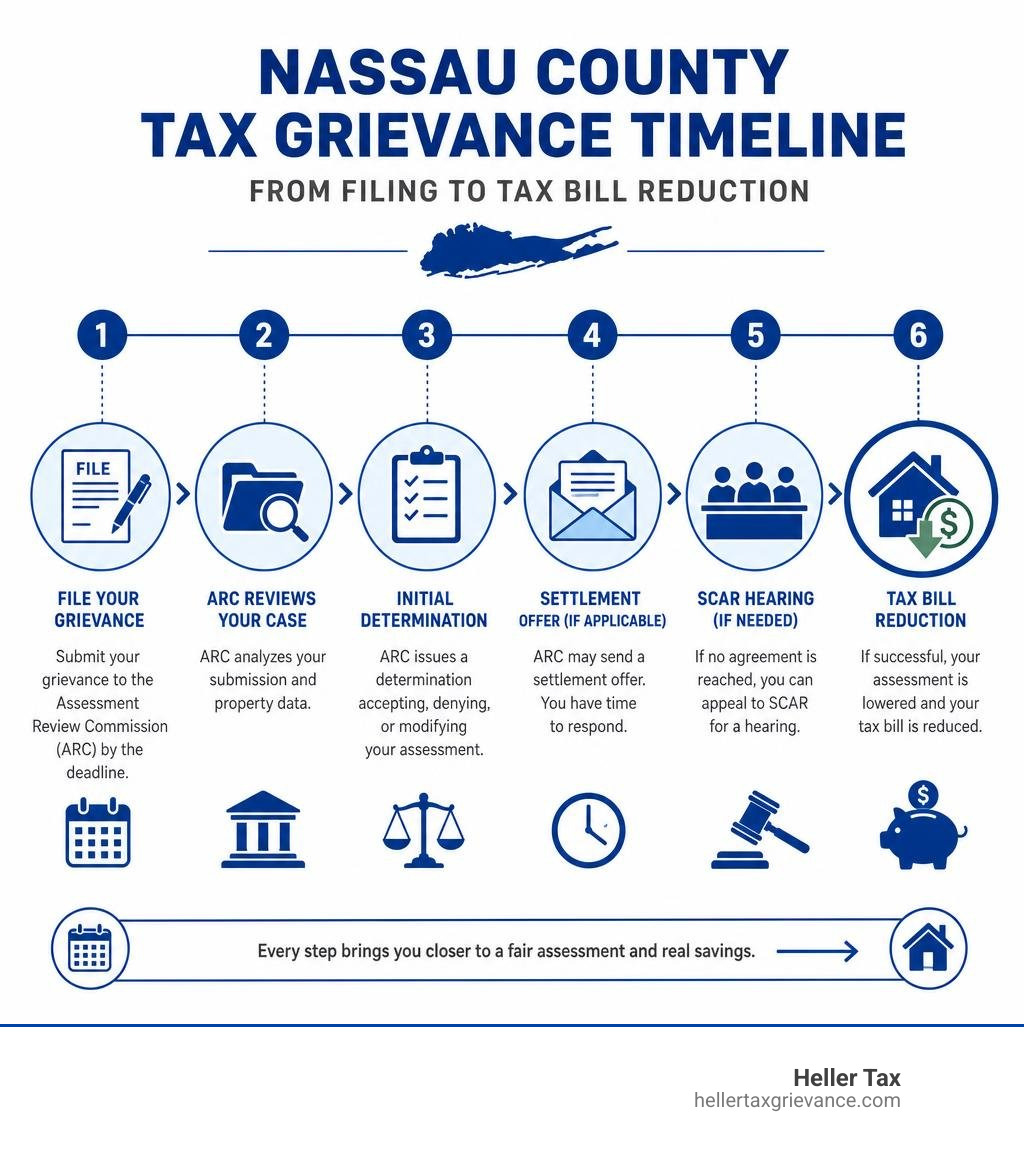
Nassau county tax grievance status vocab explained:
Understanding the Nassau County Tax Grievance Status Timeline
Navigating the property tax system in Nassau County can feel like learning a completely new language. Unlike most counties in New York State that assess properties on a multi-year cycle or only when a sale occurs, Nassau County reassesses every single property annually. This means your home’s tentative assessment changes every single year, requiring vigilant monitoring.
To successfully lower your taxes, you must understand the assessment calendar and how it dictates your Nassau County tax grievance status. The process operates on a massive lag. The grievances we file and track today are for tax years that won’t actually begin for quite some time.
Currently, in June 2026, we are deeply embedded in the cycle for the 2027-28 tax year. The tentative roll for this cycle was published in early 2026, which kicked off the official filing window. When you check your status, you are looking at where your property stands on this specific timeline.
If you miss a step or fail to monitor your status, you run the risk of accepting an unfair assessment or missing the window to appeal a denial. By keeping an eye on the Assessment Review Commission | Nassau County, NY, you remain in complete control of your property’s financial future.
The 2027-28 Tax Year Calendar and Deadlines
The calendar for the 2027-28 tax year follows a strict, legally mandated schedule. Missing any of these dates can completely void your right to challenge your assessment for the year.
- January 2, 2026: The Nassau County Department of Assessment releases the tentative assessment roll. This is the date the grievance filing window officially opens.
- March 2, 2026: This is the statutory deadline established by New York State law for filing property tax grievances.
- March 31, 2026: Because Nassau County’s assessment system is so complex, the Assessment Review Commission | Nassau County, NY officially extended the Nassau County Tax Grievance Deadline to March 31, 2026, for the 2027-28 tax year.
- April 1, 2026 – March 31, 2027: This is the official ARC review period. During these twelve months, the commission reviews all filed grievances, analyzes comparable market data, and issues determinations.
It is vital to distinguish between the statutory deadline (which is March 1 or 2 depending on the calendar year) and the extended deadline. While Nassau County historically extends this window to late March, we always advise homeowners to treat the earlier statutory date as their target. Waiting until the absolute last minute can lead to technical glitches or documentation errors that cannot be corrected once the portal closes.
What Happens After Your Grievance is Filed?
Once you submit your application before the March 31, 2026 deadline, your file enters the hands of the Assessment Review Commission (ARC). It is important to know that ARC is an independent, quasi-judicial body. They are completely separate from the Department of Assessment, which is the agency that set your initial valuation. This separation ensures that you receive a fair, unbiased review of your home’s value.
During the review phase, ARC appraisers examine your tentative assessment against actual market data. They look at comparable home sales in your immediate neighborhood (such as Syosset, Massapequa, or Farmingdale) from the preceding 18 months.
Their goal is to determine if the Department of Assessment’s valuation of your home matches its true market value. If you want a deeper dive into how this valuation is calculated and challenged, check out our Nassau County Tax Appeal Your Guide to Challenging Your Property Value.
While ARC is reviewing your case, your nassau county tax grievance status will remain in a “Review” or “Pending” state. This is completely normal and nothing to panic about. Because ARC handles tens of thousands of filings each year, this review process takes months to complete.
How to Check Your Nassau County Tax Grievance Status Online

In the past, checking your grievance status involved waiting on hold with county offices or hoping a paper notice didn’t get lost in the mail. Today, the county provides digital tools that let you track your case in real-time. Whether you filed the grievance yourself or authorized us to represent you, you have the right to know exactly where your case stands.
To check your case status directly, you can visit the county’s portal or, if you are a client of ours, you can simply use our simplified tracking tools. If you need us to pull your official records and provide an expert analysis of your current standing, you can quickly Request a Case Status through our secure client portal.
Using the AROW Portal to Track Your Nassau County Tax Grievance Status
The primary tool for tracking your grievance is the Assessment Review on the Web system, commonly known as the AROW portal. This system is run directly by the Nassau County Assessment Review Commission.
To use the AROW Citizen portal to check your nassau county tax grievance status, follow these steps:
- Register or Log In: Go to the AROW homepage and log in. If you filed online yourself, use the credentials you created during the filing window.
- Search Your Property: You can search using your Section, Block, and Lot (SBL) number, which is found on your school or general tax bills. Alternatively, you can search by your physical property address.
- Navigate to Status: Once your property page loads, click on the “Appeal Filing/Status/Change” tab or the “Status/Offers” link.
- Review the Status Indicators: The portal will display your current status. Common status indicators include:
- Received/Pending: Your application was successfully submitted and is in queue for review.
- Under Review: An ARC appraiser is actively evaluating your case and comparing market data.
- Offer Pending: ARC has decided to offer a reduction, and an official settlement offer is being drafted.
- Determined: A final decision has been made, and your official determination letter is available for download.
By registering your email address on the portal, you can also opt-in for electronic notifications, which will alert you the moment your status changes or when an offer is issued.
Utilizing the Sales Locator and Other County Tools
The AROW portal is not just a tracking tool; it also hosts several public resources designed to help you verify your property details. One of the most useful tools is the Sales Locator.
The Sales Locator allows you to search for residential property sales in your immediate neighborhood. This tool is highly valuable because it shows you the exact transactions ARC appraisers are looking at when they review your file. If you see that homes identical to yours in Syosset or Massapequa are selling for significantly less than your assessed value, you have strong evidence that your assessment is too high.
Additionally, you should use this time to check your property inventory records on the county’s land records viewer. Make sure the county has accurate information regarding your home’s square footage, number of bathrooms, and overall condition. If there are errors in your property inventory, you can point them out to help support your case. If you need a comprehensive guide on how to navigate these tools, refer to How to Appeal Your Assessment | Nassau County, NY.
Evaluating Your ARC Decision: Offers, Denials, and Next Steps
As the review period progresses through late 2026 and early 2027, ARC will begin issuing determinations. For most homeowners, this results in one of two outcomes: a settlement offer or a denial.
If your assessment is found to be higher than market value, ARC will present a settlement offer. This offer will propose a specific reduction in your property’s assessed value. You or your representative will have a limited window to accept or decline this offer. If you accept, the reduced valuation is locked in for the 2027-28 tax year.
If ARC denies your grievance, or if they offer a reduction that you believe is still far too low, your journey does not have to end there. You have the legal right to appeal their decision through the judicial system.
To help you understand your options, here is a side-by-side comparison of the two primary stages of the tax challenge process:
| Feature | Assessment Review Commission (ARC) | Small Claims Assessment Review (SCAR) |
|---|---|---|
| Type of Body | Independent County Commission | New York State Supreme Court |
| Filing Cost | $0 (Free to file) | $30 State Court Filing Fee |
| Representation | Self-represented or Registered Agent | Self-represented, Agent, or Attorney |
| Finality | Offers can be accepted or declined | Decision of the Hearing Officer is final |
| Requirement | Must file with ARC first to be eligible | Can only file if ARC denied or issued an unsatisfactory offer |
Understanding Your Assessment Review Commission (ARC) Determination
By law, ARC must issue all final determinations for the 2027-28 grievance cycle by March 31, 2027. Once your determination is issued, the final assessment roll for the tax year is published on April 1, 2027.
Your determination letter will clearly state the commission’s findings. If they agree your home is over-assessed, they will show your original tentative assessment alongside your new, reduced assessment. If they deny your claim, the letter will state that your assessment remains unchanged.
It is important to remember that ARC operates under strict administrative codes. They have the authority to lower your assessment or leave it exactly the same — they can never increase your assessment as a result of you filing a grievance. This statutory protection means filing a grievance is entirely risk-free.
Escalating to Small Claims Assessment Review (SCAR)
If you receive a denial from ARC, or if you decline an unsatisfactory settlement offer, your next step is to file a Small Claims Assessment Review (SCAR) petition.
SCAR is a specialized court program designed specifically for owner-occupied, one-to-three-family residential properties. It provides a low-cost, informal way for homeowners to have their assessments reviewed by an independent New York State Supreme Court hearing officer.
Key details about the SCAR process for the 2027-28 cycle include:
- Filing Deadline: The absolute deadline to file a SCAR petition is April 30, 2027 (exactly 30 days after the final assessment roll is published).
- Filing Fee: There is a $30 state court filing fee required to submit your petition.
- The Hearing: Hearings are informal. You or your representative will present evidence — such as recent comparable sales or proof of physical damage to your property — to a hearing officer. The county will also have a representative present to defend their assessment.
- The Decision: The hearing officer will review the evidence and issue a binding decision, which will either lower your assessment or maintain the ARC determination.
Because SCAR is a legal proceeding, many homeowners choose to work with a professional firm like us to handle the preparation, filing, and presentation of their case in front of the hearing officer.
How Approved Reductions Impact Your Property Tax Bills
Once you secure a reduction — either through an ARC settlement or a SCAR decision — you might wonder: When do I actually see the savings?
Understanding how your reduction translates to your actual tax bills requires looking at how property taxes are calculated. Your property tax bill is determined by multiplying your home’s assessed value by the local tax rates set by your school district, town, and county.
When your assessed value is reduced, your share of the local tax levy decreases, resulting in direct savings on your bills.
When Will You See Your Nassau County Tax Grievance Status Savings?
Because Nassau County taxes are billed in arrears and split across different fiscal years, your tax savings will appear on your bills in two distinct phases for the 2027-28 tax year:
- October 2027: Your savings will first appear on your 2027-28 School Tax Bill. School taxes represent the largest portion of your overall property tax burden (often up to 60-70%), so this is where you will see the most significant drop.
- January 2028: The remainder of your savings will appear on your 2028 General Tax Bill, which covers county, town, and special district taxes.
If your grievance is resolved and settled before the school tax bills are printed in September 2027, your savings will be applied directly to the bills, lowering your payments immediately.
School Tax vs. General Tax Bill Adjustments
If your case is delayed — which often happens if you escalate to a SCAR hearing that takes place late in the year — your school tax bill might be printed and paid at the original, higher assessment.
If this happens, do not worry. Once the court issues a reduction, the county will process a corrected bill or issue a refund check for the overpaid amount.
If your property taxes are paid through an escrow account managed by your mortgage lender, you should send a copy of your successful reduction letter to your lender’s tax department. They will adjust your monthly escrow payments and recalculate your escrow cushion, which often results in a lower monthly mortgage payment and a refund of any surplus funds held in your escrow account.
Frequently Asked Questions about Nassau County Tax Grievance Status
Can filing a property tax grievance raise my taxes?
No. There is a strict statutory protection in place that prevents the Assessment Review Commission (ARC) or a SCAR hearing officer from raising your property’s assessment during a grievance review. The review can only result in your assessment being lowered or remaining exactly the same. Filing a grievance is entirely risk-free.
What if I missed the March 31, 2026 deadline for the 2027-28 tax year?
If you missed the March 31, 2026 deadline, you cannot file a late grievance for the 2027-28 tax year. There are no exceptions or late-filing windows. However, you can prepare for the next cycle. The filing window for the 2028-29 tax year will open on January 2, 2027, and we highly recommend setting a reminder to file early in that window.
How does the Nassau County grievance process compare to Suffolk County?
While Nassau County reassesses properties annually and has a grievance filing window that typically runs from January through March, Suffolk County operates on a different schedule. In Suffolk County, the standard grievance filing deadline is the third Tuesday in May. Both counties allow homeowners to appeal county-level decisions through the SCAR hearing process if a satisfactory reduction is not granted.
Conclusion
Keeping track of your Nassau County tax grievance status is the key to ensuring you don’t overpay on your property taxes. Whether you are tracking your case through the online AROW portal, evaluating an ARC settlement offer, or preparing to escalate your case to a SCAR hearing, staying informed at every step of the calendar is essential.
While any homeowner has the right to file and track a grievance on their own, navigating the complex deadlines, analyzing comparable sales, and presenting cases at court hearings can be incredibly time-consuming and stressful.
At Heller Tax Grievance, we take the entire burden off your shoulders. We handle everything from the initial filing and status tracking to representing you at SCAR hearings. Best of all, we stand by our “You Don’t Pay Unless You Save” guarantee. If we don’t successfully reduce your property taxes, you don’t owe us a single penny.
Let us help you secure the savings you deserve. For a complete look at how we can help you lower your property taxes, check out our Nassau County Property Tax Grievance A Comprehensive Guide and get started with us today!