

Are Property Taxes Tax Deductible? The Quick Answer
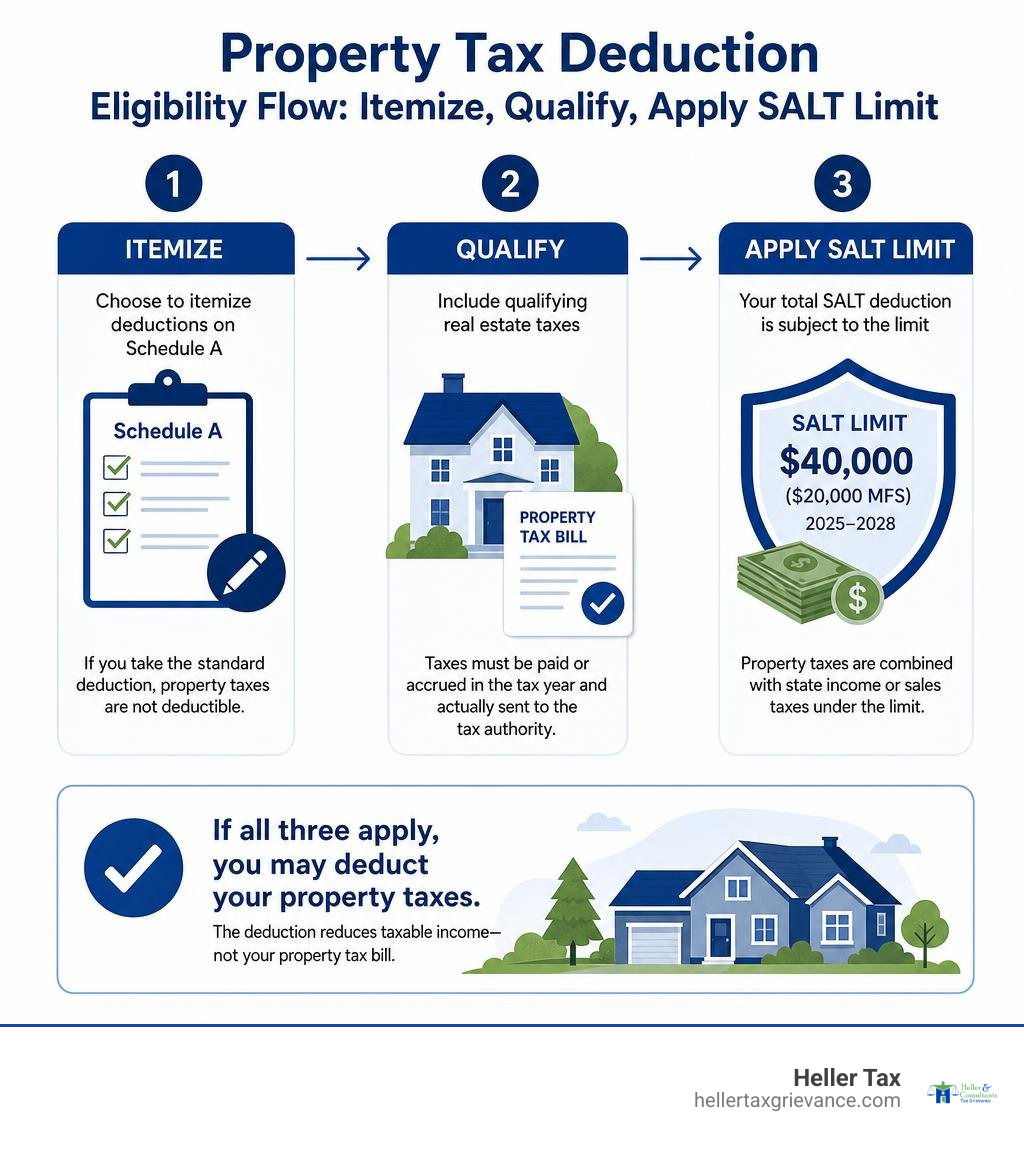
Property taxes tax deductible on your federal return when you itemize deductions instead of taking the standard deduction. For most homeowners, deductible real estate taxes are combined with state income or sales taxes under the federal SALT limit.
| Quick question | Short answer |
|---|---|
| Can homeowners deduct property taxes? | Yes, generally, if they itemize on Schedule A of Form 1040. |
| Can I deduct them with the standard deduction? | No, not for a personal home. |
| What is the 2025 SALT limit? | Up to $40,000, or $20,000 for married filing separately, subject to income-based limits. |
| Are all charges on a tax bill deductible? | No. Fees for trash, water, sewer, HOA dues, transfer taxes, and many special assessments usually do not qualify. |
| Do escrow deposits count? | Only the amount your lender actually sends to the tax authority during the year can count. |
A deduction is helpful, but it does not lower the property tax bill itself. It lowers taxable income, and only if itemizing produces a better result than the standard deduction. For Long Island owners facing high assessments, reducing the assessment can be just as important as claiming the right tax deduction.
I am Adam Heller, founder of Heller Tax, and I have spent decades focused on helping Long Island property owners understand and reduce property-tax burdens. That work has shown me why knowing when property taxes tax deductible matters, but also why paying a fair assessment matters even more.
Are Property Taxes Tax Deductible on Federal Returns?
When filing your annual federal tax return, real estate property taxes paid on your primary residence, vacation home, or land are deductible, provided you elect to itemize your deductions rather than taking the standard deduction. Under Internal Revenue Code guidelines, writing off your local taxes requires claiming them on Schedule A of Form 1040.
For many years following the Tax Cuts and Jobs Act of 2017, federal state and local tax (SALT) deductions were strictly capped at $10,000 ($5,000 if married filing separately). However, recent statutory updates expand these relief options. For tax years 2025 through 2028, the SALT deduction limit rises up to $40,000 ($20,000 if married filing separately). In 2027, tax law adjustments bump that cap slightly higher to $40,400.
To determine whether claiming your property taxes on your return makes financial sense, you must weigh your total itemized write-offs against the standard deduction threshold for the tax year. If your combined deductible expenses—such as mortgage interest, state income taxes, charitable contributions, and real estate taxes—exceed your standard deduction, itemizing delivers direct tax relief.
| Filing Status | 2025 Standard Deduction | 2027 Standard Deduction |
|---|---|---|
| Single | $15,750 | $16,100 |
| Married Filing Jointly | $31,500 | $32,200 |
| Married Filing Separately | $15,750 | $16,100 |
| Head of Household | $23,625 | $24,150 |
If your total itemized deductions fall below these standard thresholds, taking the standard deduction yields greater tax savings. To dive deeper into how itemizing interacts with other housing expenses, check out this comprehensive guide on Itemized Deductions: SALT, Mortgage Interest, Charitable & Medical (2027) | CPA Validated.
We frequently remind homeowners that taking the time to review tax rules can yield significant savings, as explained in our overview of The Ins and Outs of Property Tax Deduction.
What Types of Real Estate and Personal Property Taxes Tax Deductible Qualifications Apply?
Not every payment to a local government qualifies as a deductible tax. The IRS establishes strict criteria for what can be written off under state and local taxes:
- Real Estate Taxes: Taxes assessed on real property (such as your single-family home, condo, co-op unit, or undeveloped land) are deductible if they are levied for the general public welfare and assessed uniformly across the jurisdiction at a like rate.
- Personal Property Taxes: Annual taxes charged on personal items—such as motor vehicles, recreational vehicles, or boats—are deductible, but only if they meet the “ad valorem” rule. This means the tax must be calculated based strictly on the property’s assessed value, rather than weight, size, or model year.
- Vehicle Registration Fees: In some New York jurisdictions, a portion of annual vehicle registration or county excise fees is based on vehicle valuation. Only that value-based portion qualifies as a personal property tax deduction.
According to official guidance in Topic no. 503, Deductible taxes | Internal Revenue Service, any fee levied for specific private services or individual property improvements is strictly excluded.
When Are Escrow Payments for Property Taxes Tax Deductible?
If you pay your property taxes through a monthly mortgage escrow account, it is easy to assume that your monthly escrow contributions are immediately tax-deductible. However, the IRS does not allow write-offs for funds sitting in escrow.
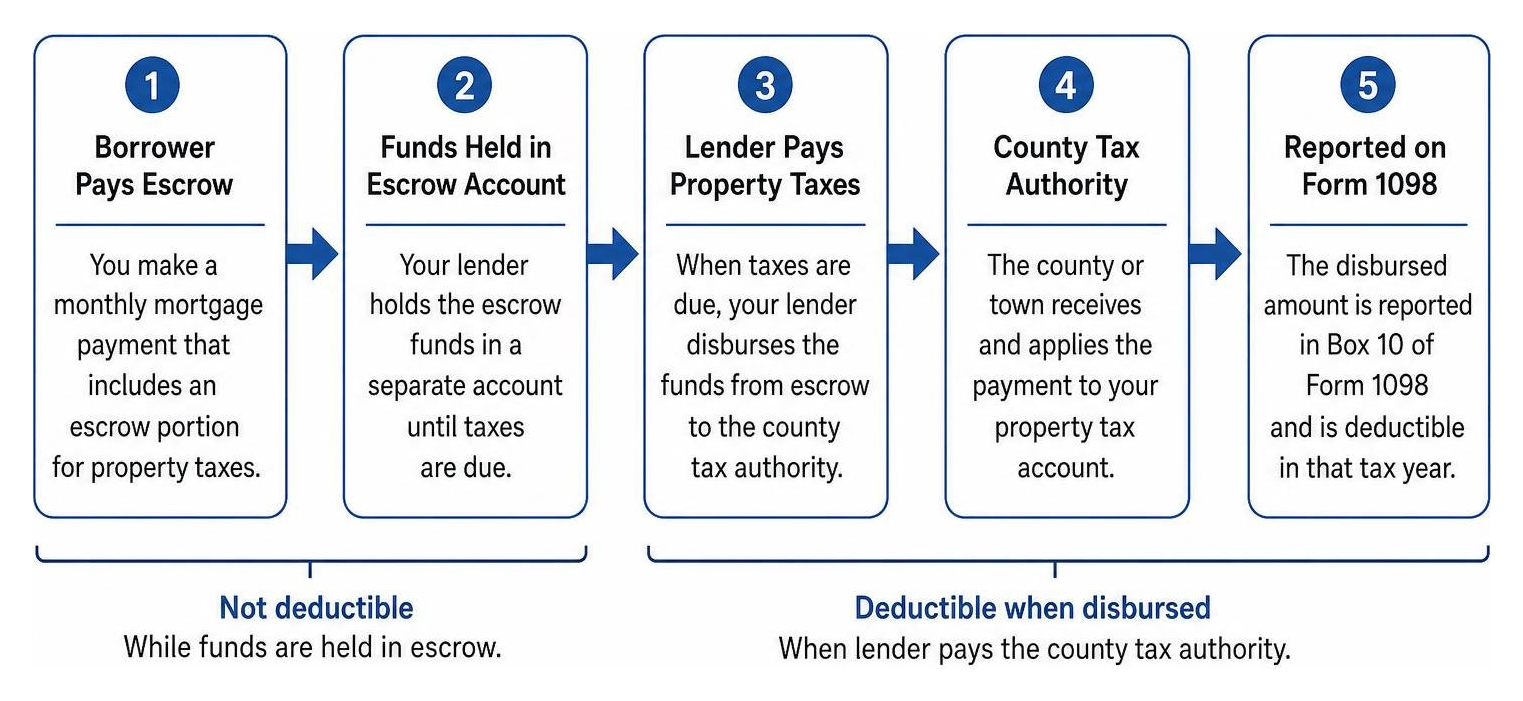
You can only deduct the actual property tax amount disbursed by your mortgage lender to the local county or town tax collector during the calendar tax year. Your mortgage lender will report this exact disbursed total on Box 10 of IRS Form 1098 (Mortgage Interest Statement), sent to you by January 31.
If you make a late escrow deposit in December, but your bank does not remit the payment to the county until January, that payment belongs on the following year’s tax filing. We break down these timing nuances further in our guide on Claiming a Property Tax Deduction on Your Federal Tax Filing.
Key IRS Limits, Exclusions, and SALT Rules for Tax Year 2025-2027
While the higher $40,000 SALT cap for 2025 ($40,400 in 2027) offers substantial relief to homeowners in high-tax regions like Long Island, high earners face income-based phase-outs.
For tax year 2025, if your Modified Adjusted Gross Income (MAGI) exceeds $500,000 ($250,000 for married taxpayers filing separately), your allowable SALT deduction begins to phase down. For 2027, this threshold rises slightly to $505,000 ($252,500 MFS). However, the tax code ensures a protective floor: high-income phase-outs will not reduce your total SALT deduction cap below $10,000 ($5,000 for married filing separately).
Understanding what you cannot deduct is just as critical as knowing what qualifies. Municipal property tax bills on Long Island often bundle general real estate taxes alongside line-item charges for local services. The IRS explicitly prohibits writing off:
- Municipal Service Fees: Itemized line items for trash collection, municipal water, sewer usage, or electric utilities.
- Local Benefit Assessments: Charges levied to build or repair specific infrastructure directly benefiting your property, such as installing local sidewalks, paving neighborhood roads, or extending main sewer lines. (These are treated as capital improvements that increase your home’s cost basis rather than itemized deductions).
- Homeowners Association (HOA) Fees: Regular dues or special assessments charged by private condo boards or homeowner associations.
- Municipal Fines and Penalties: Late payment fees, property maintenance fines, or interest assessed by local tax collectors.
Homeowners navigating these complicated rules often encounter hurdles, which we discuss in detail in State and Local Taxes SALT Deduction Problems Remain.
Deducting Property Taxes When Buying, Selling, or Renting
When real estate changes hands during the tax year, the annual property tax bill must be allocated between the seller and the buyer based on the exact number of days each party owned the property. The official closing date recorded on the settlement statement (HUD-1 or Closing Disclosure) serves as the cutoff line.
- Seller’s Allocation: The seller is treated as having paid property taxes up to, but not including, the date of sale. The seller claims this prorated portion as an itemized deduction for the tax year of the sale.
- Buyer’s Allocation: The buyer is treated as paying real estate taxes starting on the date of sale through the remainder of the tax year, claiming their prorated portion accordingly.
- Delinquent Taxes at Closing: If a buyer agrees to pay delinquent, past-due property taxes owed by the seller to complete the closing, the buyer cannot deduct those delinquent tax payments. Instead, the IRS requires the buyer to add those back-tax amounts to the home’s purchase cost basis, which helps lower potential capital gains tax when selling the home later.
For renters, federal tax law offers no direct real estate tax deduction. Because renters do not own real property, they cannot claim real estate write-offs on federal Form 1040 Schedule A.
State-Specific Relief Programs and Senior Exemptions
In New York State, tax relief programs operate alongside federal deductions to ease the property tax burden directly on local tax bills:
- New York STAR Program: The School Tax Relief (STAR) program offers property tax relief to eligible primary residence homeowners across Nassau and Suffolk counties. Basic STAR is available to homeowners with incomes below $500,000, while Enhanced STAR provides larger savings for qualifying senior citizens aged 65 and older with modest incomes. Learn more about structural updates in New Yorks STAR Rebate Program Undergoes Changes.
- New York Senior Citizens Exemption: Localities on Long Island offer a property tax exemption for seniors aged 65 and older who meet specific income requirements. According to Senior citizens exemption – Tax.NY.gov, this program can reduce a property’s assessed value by up to 50% for local, county, and school tax purposes.
How to Claim Your Property Tax Deduction Step-by-Step

Ready to claim your real estate tax write-off on your federal tax return? Follow this step-by-step process:
- Gather Your Tax Documents: Collect your annual property tax statements from Nassau or Suffolk County tax authorities, alongside your year-end Form 1098 from your mortgage lender.
- Separate Non-Deductible Charges: Review the line-item breakdown on your property tax bill. Subtract non-deductible items such as trash fees, sewer service charges, or local improvement assessments.
- Complete Form 1040, Schedule A:
- Enter deductible real estate taxes paid on Schedule A, Line 5b.
- Enter value-based personal property taxes (such as qualifying vehicle excise taxes) on Schedule A, Line 5c.
- Sum your total state and local taxes (income tax or sales tax plus property taxes) on Line 5d and apply the applicable SALT cap limit ($40,000 in 2025 / $40,400 in 2027, subject to high-income phase-out limits).
- Compare Itemized vs. Standard Deduction: Total all itemized deductions on Schedule A. If your total exceeds your standard deduction threshold, submit Schedule A with your Form 1040.
- Retain Property Records: Maintain your tax bills, canceled checks, closing statements, and Form 1098 records for at least three to four years, as outlined in the official 2025 Instructions for Schedule A (Form 1040).
Understanding how your local assessment translates to these lines is vital for long-term tax planning, as detailed in our guide Property Tax What It Is and How to Save.
Frequently Asked Questions About Property Tax Deductions
Can I deduct property taxes if I claim the standard deduction?
No. For your primary home, secondary residence, or personal land, you cannot deduct property taxes if you take the standard deduction. Personal real estate tax write-offs require itemizing deductions on Schedule A of Form 1040.
However, there is a notable exception for landlords: if you own residential rental property, property taxes paid on the rental home are deducted as ordinary business expenses on Schedule E (Form 1040). Rental property tax deductions can be claimed regardless of whether you take the standard deduction on your personal tax return, and they are not restricted by personal SALT deduction caps.
What happens to delinquent property taxes paid at closing?
When purchasing a home, paying delinquent real estate taxes owed by the previous owner does not yield an immediate property tax deduction. The IRS considers delinquent taxes paid on behalf of the seller to be part of the purchase price of the property. You must add those paid delinquent amounts to your cost basis in the home, which reduces your taxable capital gain when you eventually sell the property.
Are special assessments for sidewalks or sewer lines tax deductible?
No. Special assessments levied by local governments to fund specific neighborhood infrastructure projects—such as building sidewalks, installing streetlights, or laying main sewer lines—are non-deductible. Because these improvements tend to increase the fair market value of your property, the IRS requires you to capitalize these costs by adding them to your home’s basis.
The only exception occurs if a local assessment bill explicitly itemizes a portion of the fee strictly allocated to ongoing maintenance, repair, or interest charges related to that infrastructure.
Lowering Your Property Taxes Beyond Income Tax Deductions
While itemizing your tax write-offs on federal Schedule A provides welcome relief during tax season, income tax deductions only soften the impact of high local tax rates—they do not lower your actual property tax bill.
On Long Island, home values and municipal budgets lead to some of the highest property tax bills in the nation. If your property’s assessed value is set too high by county assessors, you end up overpaying year after year in school, town, and county taxes.
This is where filing a property tax grievance creates true long-term savings. A tax grievance is a formal administrative challenge to your property’s assessed value. Successfully grieving your assessment lowers your local property tax bill directly, delivering recurring annual savings regardless of federal tax law shifts or SALT deduction limits.
At Heller Tax Grievance, we specialize exclusively in helping homeowners in Nassau County and Suffolk County challenge inflated property assessments.
- Our Track Record: We have saved Long Island property owners over $160 million in tax reductions.
- Unmatched Results: We consistently achieve the largest tax reductions in Nassau and Suffolk counties.
- Zero Risk Guarantee: We operate on a strict “You Don’t Pay Unless You Save” guarantee. If we do not successfully lower your property tax assessment, you owe us absolutely nothing.
Navigating the Nassau and Suffolk Tax Grievance Calendars
To protect your rights and secure a lower assessment, you must file within strict county deadlines. We focus strictly on the Nassau County and Suffolk County tax grievance processes rather than individual village-level tax grievance systems to maximize your structural tax relief:
- Nassau County Tax Grievance Calendar: The official Nassau County grievance filing period opens on January 2 and closes on March 1 each year (unless officially extended by county executive order). Grieving your Nassau County assessment during this official window sets your reduced valuation for the upcoming tax roll across communities like Farmingdale, Massapequa, Syosset, Brookville, and Upper Brookville.
- Suffolk County Tax Grievance Calendar: In Suffolk County, tax grievance applications are due annually on or before Grievance Day, which occurs on the third Tuesday in May (May 19, 2027). Grieving your Suffolk County assessment protects homeowners across towns like Rocky Point, Deer Park, Stony Brook, and Miller Place.
Filing a grievance never results in an increase to your property taxes—by law, the tax board can only lower your assessment or leave it unchanged.
If you believe your home is overassessed, do not rely solely on tax write-offs to ease the burden. Partner with Long Island’s leading tax grievance experts to secure the structural relief you deserve. Learn how our team can reduce your annual tax bill by visiting our Property Tax Grievance Services page today!