

Can You Deduct Property Taxes If You Take the Standard Deduction?
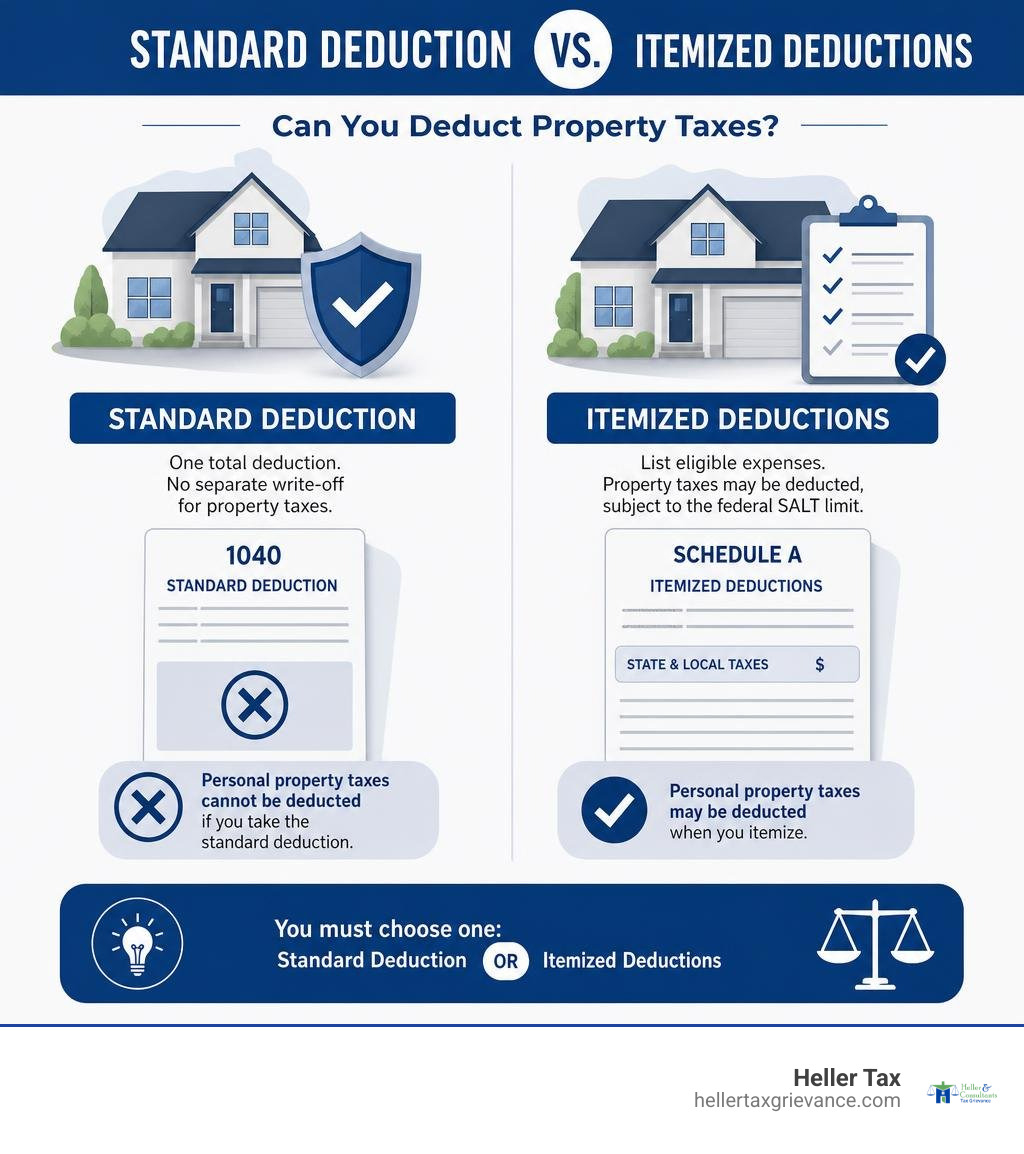
Can you deduct property taxes if you take standard deduction? No. For a personal home, federal tax rules require you to itemize deductions on Schedule A instead of claiming the standard deduction to write off eligible property taxes.
| If you choose… | Can you separately deduct personal property taxes? |
|---|---|
| The standard deduction | No |
| Itemized deductions | Yes, subject to the federal SALT limit |
This matters for Long Island homeowners because a large property tax bill does not automatically create a federal tax break. You must compare your total itemized deductions – including eligible state and local taxes, mortgage interest, charitable gifts, and certain medical expenses – with the standard deduction for your filing status.
I am Adam Heller, and after years in Long Island real estate and property tax grievance work, I have seen how often owners ask, can you deduct property taxes if you take standard deduction. Understanding the federal rule is useful, but reducing an unfair assessment can lower the property tax bill whether you itemize or not.
Can You Deduct Property Taxes If You Take Standard Deduction?
When preparing federal tax returns, homeowners often wonder if their substantial real estate tax bills can automatically lower their federal tax obligation. The straightforward answer is that you cannot claim an extra write-off for local property taxes on top of the standard deduction on Form 1040.
Under the federal tax system, you must choose between two distinct methods when filing: taking the standard deduction (a fixed dollar amount based on your filing status) or itemizing your allowable deductions on Schedule A. When you elect to claim the standard deduction, it acts as a overall deduction that replaces individual deductions for personal expenses, including local real estate property taxes.
Prior to the implementation of the Tax Cuts and Jobs Act (TCJA), roughly 30% of American taxpayers itemized their deductions. However, after the law nearly doubled standard deduction thresholds, IRS data indicates that approximately 87% to 89% of taxpayers now opt for the standard deduction. As a result, millions of homeowners who routinely pay thousands of dollars in annual property taxes no longer receive a direct federal tax write-off on Schedule A. For a comprehensive overview of how these mechanisms interact, see The Ins and Outs of Property Tax Deduction.
IRS Schedule A Rules: Can You Deduct Property Taxes If You Take Standard Deduction?
To claim a federal deduction for real estate taxes paid on a personal residence, IRS regulations require you to forgo the standard deduction and complete Schedule A of Form 1040. The tax law specifies that deductible property taxes must meet the strict definition of an ad valorem tax. This means the tax must be assessed uniformly across all property in the jurisdiction based strictly on the property’s assessed value.
According to official IRS Topic no. 503 guidance on deductible taxes, real property taxes are deductible on Schedule A under the State and Local Tax (SALT) section only if they meet three primary criteria:
- The tax is based on the assessed value of the real estate.
- The tax is charged uniformly at a constant rate on all property within the taxing authority’s jurisdiction.
- The tax proceeds are levied for general public welfare, rather than for specific local benefits, infrastructure upgrades, or commercial services.
If you fulfill these conditions and elect to itemize on Schedule A, your eligible property taxes are combined with your state income taxes (or state sales taxes) and claimed on Line 5b. However, if your total itemized deductions—including mortgage interest, qualifying medical expenses exceeding 7.5% of Adjusted Gross Income (AGI), and charitable contributions—fail to top your applicable standard deduction, claiming the standard deduction remains the choice that lowers your tax bill the most.
2025–2027 Standard Deduction Thresholds vs. Itemizing
Choosing between the standard deduction and itemizing requires comparing your total allowable itemized expenses directly against the statutory standard deduction limit set by the IRS for each tax year.
| Filing Status | 2025 Standard Deduction | 2027 Standard Deduction | Maximum Itemized SALT Cap (2025–2027) |
|---|---|---|---|
| Single | $15,750 | $16,100 | $40,000 (2025) / $40,400 (2027)* |
| Married Filing Jointly | $31,500 | $32,200 | $40,000 (2025) / $40,400 (2027)* |
| Head of Household | $23,625 | $24,150 | $40,000 (2025) / $40,400 (2027)* |
| Married Filing Separately | $15,750 | $16,100 | $20,000 (2025) / $20,200 (2027)* |
*Note: Recent tax legislation under the One Big Beautiful Bill Act updated the federal SALT limit for tax years 2025 through 2028 to $40,000 ($40,400 in 2027), subject to high-income MAGI phase-downs.
For taxpayers aged 65 and older, additional standard deduction allowances apply. In 2025, single filers aged 65 or older receive an additional $2,000 (raising their standard deduction to $17,750), while married couples filing jointly receive $1,600 per qualifying spouse (up to $34,700). Furthermore, starting in 2025 through 2028, a bonus deduction of up to $6,000 is available for senior taxpayers aged 65 and older, subject to Modified Adjusted Gross Income (MAGI) phase-outs starting at $75,000 for single filers and $150,000 for married joint filers.
Because the standard deduction thresholds are high, a married couple in Long Island would need allowable itemized expenses (such as mortgage interest, charitable donations, and capped state/local taxes) exceeding $31,500 in 2025 or $32,200 in 2027 before itemizing provides any incremental federal tax advantage.
Navigating the SALT Cap, Escrow Accounts, and Property Types
Understanding federal property tax rules requires looking beyond simple standard deduction comparisons. The interaction between the State and Local Tax (SALT) deduction cap, mortgage escrow accounts, and property classifications dramatically influences your final tax liability.
Under updated legislative provisions effective for tax years 2025 through 2028, the historical $10,000 SALT cap was increased to $40,000 for 2025 and $40,400 for 2027 for single filers and married couples filing jointly ($20,000 and $20,200 respectively for married filing separately). However, high-earning taxpayers face an income phase-down mechanism. For 2025, when MAGI exceeds $500,000 ($505,000 in 2027), the expanded SALT cap phases down at a rate of 30 cents per dollar until it reaches the baseline floor of $10,000.
For many high-income households or residents in high-tax areas, these ongoing restrictions illustrate why relying solely on federal tax deductions to alleviate property tax burdens can lead to disappointment. For a deeper analysis of these rules, see our article on how State and Local Taxes (SALT) Deduction Problems Remain.
Deductible vs. Non-Deductible Property Charges
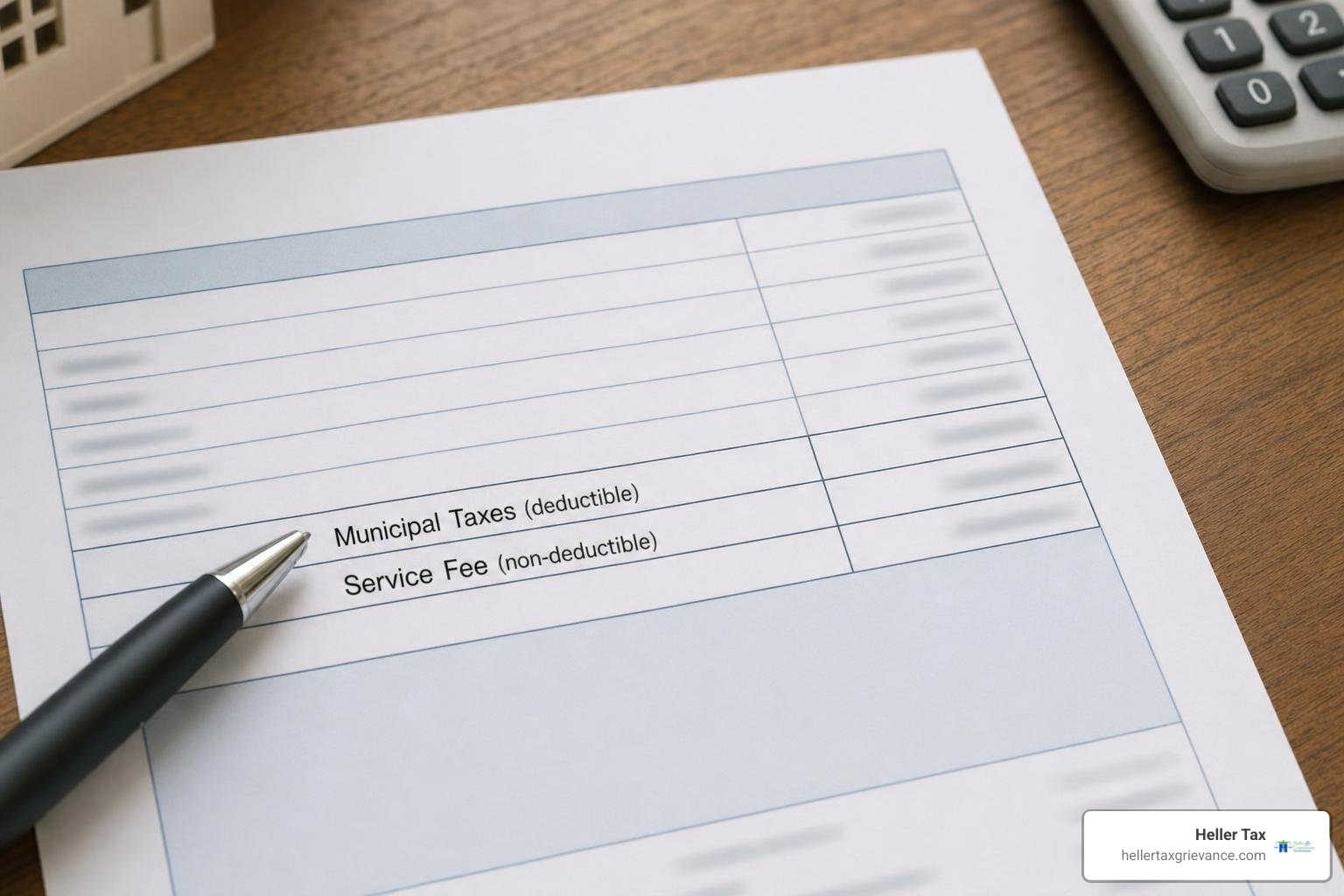
A common mistake made by homeowners when aggregating expenses for Schedule A is assuming that every line item listed on a municipal tax bill qualifies as a deductible real property tax. Local government bills in Nassau and Suffolk counties frequently combine true ad valorem taxes with specific municipal service delivery fees and special assessments.
When evaluating your property tax bill, you must separate core local government taxes from non-deductible charges as outlined in this NerdWallet guide on property tax deductions.
Deductible Property Taxes (Ad Valorem):
- State, county, and town general real estate taxes based on property assessment.
- Local public school district property taxes.
- Fire district assessments calculated uniformly on assessed valuation.
Non-Deductible Charges and Utility Fees:
- Flat municipal trash collection and recycling fees.
- Water usage charges and sewer connection service fees.
- Local benefit special assessments for specific neighborhood improvements (such as installing new sidewalks, paving private roads, or extending public water mains) that increase the property’s market value.
- Homeowners Association (HOA) fees or condominium common charges.
- Compliance penalties, late payment interest, or lawn-mowing code violation fines.
Special assessments levied for capital improvements cannot be deducted as annual taxes on Schedule A. Instead, IRS rules require you to add qualifying improvement assessments directly to your property’s cost basis, which helps reduce capital gains taxes when you eventually sell the home.
Second Homes, Rental Properties, and Escrow Disbursements
The rules governing property tax write-offs vary significantly depending on how the real estate is owned and used.
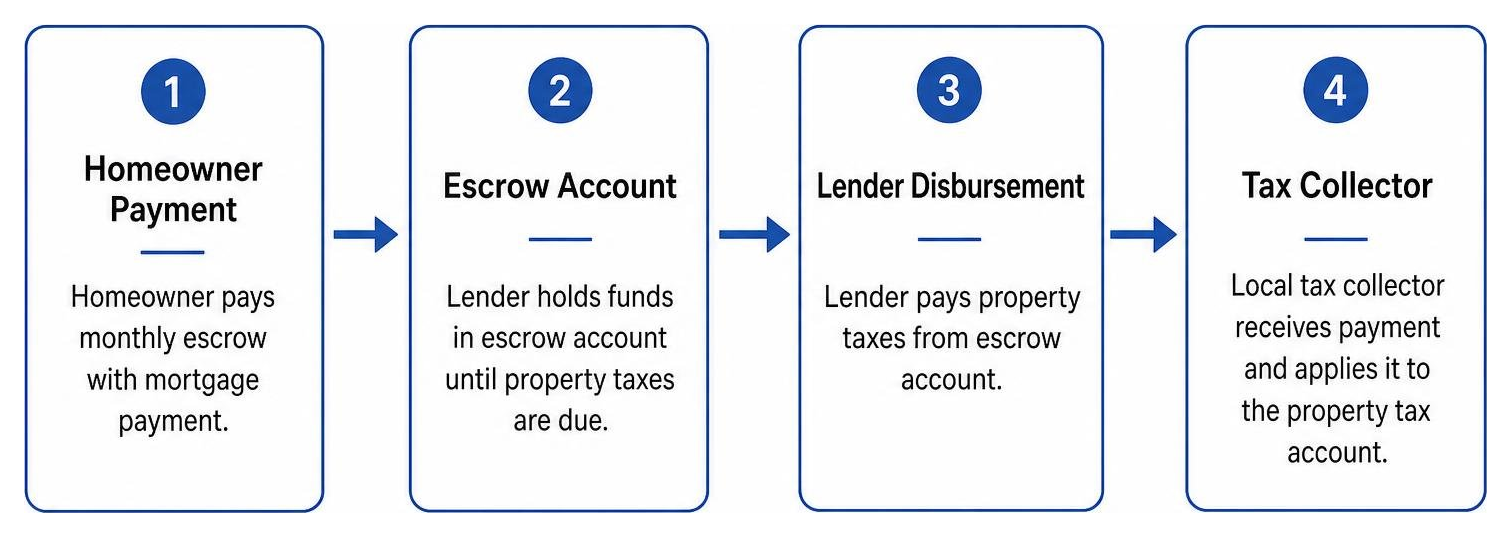
For a primary residence or a second personal home, property tax deductions are claimed on Schedule A and remain bounded by the standard deduction threshold and federal SALT cap limits. If you pay your property taxes through a mortgage escrow account, you cannot deduct the monthly escrow payments deposited into the bank. Instead, you can only deduct the exact amount that your mortgage lender actually remits from the escrow account to the local tax collector during that calendar year. This timing and dollar amount is officially reported in Box 10 of IRS Form 1098.
In contrast, property taxes paid on investment or rental properties follow entirely different, more favorable rules. Real estate taxes for rental properties are classified as ordinary and necessary operating business expenses. They are reported on Schedule E (Form 1040) Line 16 rather than Schedule A.
Key advantages of rental property tax deductions include:
- They directly offset rental gross income dollar-for-dollar on Schedule E.
- They are completely exempt from the federal SALT deduction cap limit.
- Landlords can fully write off rental property taxes on Schedule E while still claiming the full federal standard deduction on their personal Form 1040 return.
For mixed-use properties—such as a personal home with a dedicated rental unit or a home office—taxes must be prorated based on square footage or usage days between Schedule A personal deductions and Schedule C/E business expenses. For detailed filing guidelines, refer to Claiming a Property Tax Deduction on Your Federal Tax Filing.
Deciding Between Itemizing and Taking the Standard Deduction
Determining whether to claim the standard deduction or itemize on Schedule A comes down to basic math: add up all your allowable itemized deductions for the year, and if the sum exceeds your standard deduction threshold, itemize. Otherwise, take the standard deduction.
To illustrate how this works in practice, let’s look at two scenarios using 2027 tax numbers:
Scenario A (Married Couple, Taking Standard Deduction): A married couple in Massapequa pays $12,000 in local real estate property taxes and $6,000 in state income taxes. Their combined SALT total is $18,000. They have $11,000 in mortgage interest and $2,000 in charitable contributions. Their total itemized deductions equal $31,000 ($18,000 SALT + $11,000 mortgage interest + $2,000 charitable). Because their $31,000 itemized total is less than the $32,200 Married Filing Jointly standard deduction for 2027, claiming the standard deduction saves them more money. As a result, they receive no extra tax write-off specifically for their $12,000 property tax bill.
Scenario B (Single Filer, Itemizing): A single homeowner in Syosset pays $10,000 in real estate taxes, $5,000 in state income taxes, $12,000 in mortgage interest, and $2,000 in charitable donations. His total itemized expenses equal $29,000. Since $29,000 far exceeds the 2027 single standard deduction threshold of $16,100, itemizing on Schedule A yields an extra $12,900 in tax deductions.
For additional strategies on evaluating these thresholds, see the Standard vs itemized deduction guidance from TurboTax and our article on 7 Big Tax Breaks for Homeowners.
Tax Bunching Strategies and Essential Recordkeeping
If your annual itemized expenses hover just below the standard deduction threshold, you might benefit from a tax planning technique known as “deduction bunching.” Bunching involves intentionally shifting discretionary itemized expenses into a single calendar year to push your total deductions over the standard deduction line, while claiming the standard deduction in alternate years.
Common bunching strategies include:
- Charitable Giving Concentration: Combining two or three years’ worth of planned donations into a single tax year—often utilizing a Donor-Advised Fund (DAF)—to generate a large single-year Schedule A deduction.
- Medical Expense Timing: Scheduling elective, out-of-pocket medical or dental procedures in the same calendar year to clear the 7.5% AGI threshold.
- Property Tax Timing Caution: While prepaying expenses can sometimes bunch deductions, taxpayers must exercise caution with real estate taxes. IRS rules dictate that property taxes can only be deducted in the year paid if they were officially assessed by the municipality prior to payment. Prepaying unassessed future tax years will not generate an immediate federal tax deduction. Read Why You Should Not Scramble to Make a Prepayment on Your 2027 Property Tax Bill to learn more.
Proper documentation is critical whenever you claim property tax deductions. Under Internal Revenue Code Section 6501, you should maintain copies of official tax bills, annual Form 1098 escrow summaries, canceled checks, and closing settlement statements (Form CPL/ALTA) for at least three to four years after filing.
State vs. Federal Returns: Can You Deduct Property Taxes If You Take Standard Deduction?
A crucial element that many taxpayers overlook is state decoupling. Certain state tax systems operate independently of federal deduction elections, allowing residents to itemize deductions on their state tax returns even if they claim the standard deduction on their federal Form 1040.
In New York State, for example, state tax rules permit taxpayers to claim New York itemized deductions on Form IT-196 even when taking the federal standard deduction. Furthermore, New York State does not impose the federal $40,000/$40,400 SALT cap on its state itemized deduction schedule. This means a Long Island homeowner taking the federal standard deduction can still write off their full local real estate property taxes on their New York State income tax return, provided their total state itemized deductions exceed the New York standard deduction limit ($16,050 for married joint filers).
Understanding how state and local property taxes function helps you optimize both tax returns. Learn more in our overview on Property Tax: What It Is and How to Save.
Frequently Asked Questions About Property Tax Deductions
How do recent tax law changes affect property tax write-offs?
Recent federal updates enacted under the One Big Beautiful Bill Act permanently increased standard deduction baselines while adjusting the SALT deduction limit to $40,000 for tax year 2025 and $40,400 for 2027. While this higher SALT cap allows taxpayers who itemize to write off a larger portion of their combined state income and property taxes, the higher standard deduction thresholds ($31,500 in 2025 and $32,200 in 2027 for joint filers) mean that the vast majority of homeowners continue to save more money by claiming the standard deduction rather than itemizing.
Are property taxes paid through mortgage escrow immediately deductible?
No. Property taxes paid into a mortgage escrow account as part of your monthly home payment are not deductible when deposited. The IRS only allows you to deduct real estate taxes in the calendar year that your mortgage servicer actually remits those funds to the county or town tax receiver. Your lender reports this exact disbursed amount on Box 10 of Form 1098 at year-end.
How do rental property tax rules differ from primary residences?
Real estate taxes paid on a personal primary or secondary home are personal itemized deductions reported on Schedule A, subject to standard deduction comparisons and federal SALT limits. Conversely, property taxes paid on income-producing rental properties are treated as business operating expenses reported on Schedule E. They directly offset gross rental income, are completely exempt from the SALT cap, and can be claimed in full regardless of whether you claim the standard deduction on your personal tax return.
Conclusion

Understanding federal tax law clears up a major point of confusion for homeowners: can you deduct property taxes if you take standard deduction? The answer remains a clear no on your federal Form 1040 personal return. To write off personal real estate taxes, you must itemize on Schedule A, and your total itemized expenses must exceed the generous standard deduction thresholds set for your filing status.
While federal tax write-offs are bounded by rigid rules and limits, reducing the underlying assessment on your property provides direct, guaranteed savings. Lowering your property assessment cuts your actual bill at the local level—putting real cash back in your pocket every single year regardless of whether you claim the standard deduction or itemize on your income tax return.
The Long Island Property Tax Grievance Calendar and Process
For homeowners in Nassau County and Suffolk County, appealing an unfair property tax assessment follows a strict, formal county calendar, as county assessments drive the overwhelming majority of your local property tax bill (including general town, county, and school district taxes).
Mark these key county grievance deadlines on your calendar:
- Nassau County Tax Grievance Calendar: The official tax grievance filing period in Nassau County opens on January 2 and closes on March 1 each year. All grievance applications challenging the county’s tentative assessment roll must be officially received or postmarked by the March 1 deadline.
- Suffolk County Tax Grievance Calendar: In Suffolk County, property tax assessments are administered across the ten individual towns under county-wide real property tax laws. Tax Grievance Day in Suffolk County occurs annually on the third Tuesday in May (the grievance filing window opens in early May and closes strictly on Grievance Day).
Filing a formal grievance challenge does not require a court appearance or home inspection, and it cannot result in an increase to your property tax assessment.
At Heller Tax Grievance, we specialize in helping homeowners across Long Island—including Nassau County and Suffolk County communities such as Rocky Point, Farmingdale, Deer Park, Brookville, Syosset, Upper Brookville, Massapequa, Stony Brook, and Miller Place—successfully challenge excessive property tax assessments. Our team has secured over $160 million in savings for local property owners with the largest assessment reductions in the region.
We operate on a simple, risk-free model backed by our “You Don’t Pay Unless You Save” guarantee: if we do not successfully reduce your property tax assessment, you pay absolutely nothing.
Don’t let an unfair property assessment force you to overpay year after year. Take control of your homeownership expenses today by applying for our professional Heller Tax Grievance property tax reduction services before the upcoming county deadline!