

Why Nassau County Commercial Property Taxes Are Costing You More Than They Should
Filing a nassau commercial tax grievance is the formal process of challenging your property’s assessed value with the Nassau County Assessment Review Commission (ARC) — and it could put thousands of dollars back into your business each year.
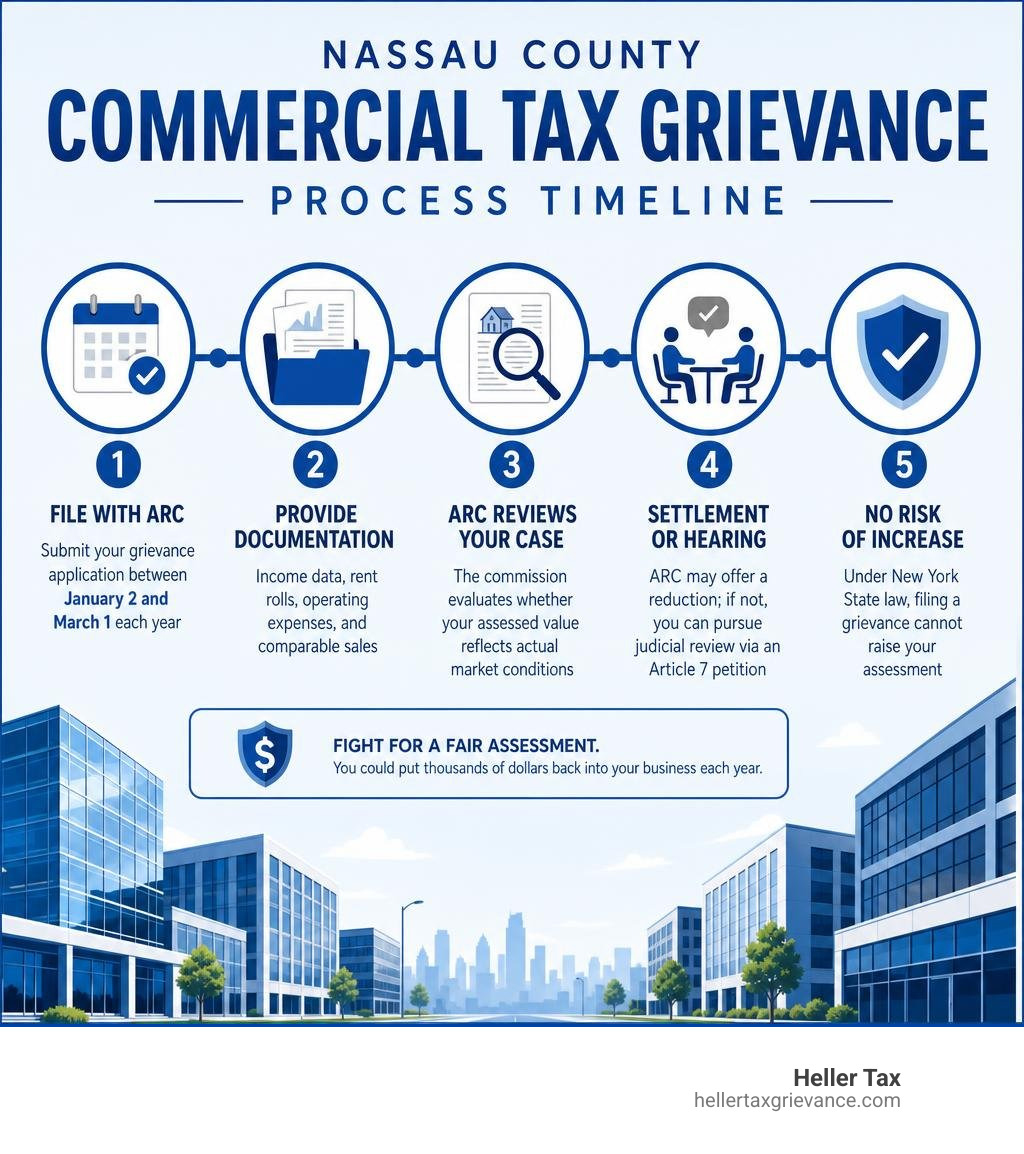
Here’s how the process works at a glance:
- File with ARC — Submit your grievance application between January 2 and March 1 each year
- Provide supporting documentation — Income data, rent rolls, operating expenses, and comparable sales
- ARC reviews your case — The commission evaluates whether your assessed value reflects actual market conditions
- Settlement or hearing — ARC may offer a reduction; if not, you can pursue judicial review via an Article 7 petition
- No risk of increase — Under New York State law, filing a grievance cannot raise your assessment
Nassau County regularly ranks first or second in the entire country for the highest property taxes. For commercial property owners, that’s not just a statistic — it’s a real drain on your bottom line. Property taxes can consume up to 35% of a commercial building’s operating income, and assessors often base their numbers on assumptions — full occupancy, market-rate rents, aggressive cap rates — that may have nothing to do with what your property actually earns.
Most commercial owners assume their assessment is correct. It often isn’t.
I’m Adam Heller, founder of Heller Tax, and I’ve spent nearly two decades helping commercial and residential property owners on Long Island fight back against inflated assessments — including securing the largest nassau commercial tax grievance reductions on record in the county. In this guide, I’ll walk you through everything you need to know to file, what to expect, and how to avoid the mistakes that cost property owners money.
nassau commercial tax grievance word list:
How to File a Nassau Commercial Tax Grievance
Challenging a commercial property assessment in Nassau County is vastly different from grieving a residential home. While residential grievances typically rely on simplified market comparisons of nearby homes, commercial property valuation is much more complex.
Nassau County categorizes properties into different classes. Commercial properties are typically classified as Class 4 (non-homestead). When the Nassau County Department of Assessment calculates your tax assessment, they often apply generalized formulas that fail to account for the unique economic realities of your building.
The primary valuation method used by the county for commercial properties is the income approach. This method estimates your property’s value based on its net operating income (NOI) divided by a capitalization rate (cap rate). However, the county’s model frequently uses idealized assumptions rather than your actual numbers. For instance, they might assume your retail strip is 100% occupied at top-tier market rents, completely ignoring the two vacant storefronts you’ve been trying to lease for a year.
To initiate a challenge, you must file a formal complaint with the Assessment Review Commission – NassauCountyNY.gov. The grievance must be submitted during the official annual filing window. This administrative filing is a mandatory first step; you cannot leap straight to court without first presenting your case to the ARC. For a deep dive into the foundational mechanics of county property taxes, review our Nassau County Property Tax Grievance A Comprehensive Guide.
Key Deadlines and the Nassau County Tax Grievance Calendar

When dealing with county tax authorities, deadlines are absolute. Missing a date by even a single day will completely forfeit your right to seek a reduction for that tax year.
In Nassau County, the standard commercial tax grievance calendar runs as follows:
- January 2: The filing window officially opens.
- March 1: The standard deadline to submit your grievance to the Assessment Review Commission.
However, the county frequently extends this deadline. For instance, in recent cycles, the deadline has been pushed to April 1 or even May to accommodate administrative adjustments. As of June 2026, it is vital to check the exact calendar dates for the upcoming 2028–2029 tax year, which will open for filing on January 2, 2027.
To put things in perspective, neighboring Suffolk County operates on a different schedule. Suffolk’s grievance filing period runs annually until the third Tuesday in May. Understanding these regional differences is critical if you own a commercial portfolio spanning both counties. You can track these differences and stay ahead of key dates by reading about the Nassau County Tax Grievance Deadline and comparing regional systems in our overview of Property Taxes in Nassau County and Suffolk County.
Eligibility, Required Documentation, and the ASIE Filing Mandate
Who is eligible to file a commercial tax grievance? The right to file is not limited solely to the deeded owner of the property. Qualifying parties include:
- The property owner of record.
- A contract vendee (buyer) who has a written agreement to purchase the property.
- A commercial tenant who is contractually obligated to pay all real estate taxes under a net lease.
If you are a tenant paying the tax bills, you have a direct financial stake in ensuring the assessment is fair.
For commercial properties in Nassau County, eligibility and compliance are tied directly to the Annual Survey of Income and Expenses (ASIE) filing mandate. Under Section 6-30 of the Nassau County Administrative Code, commercial property owners must submit their annual financial data electronically.
Even if your property is 100% owner-occupied and does not generate rental income, you are still required to complete the electronic ASIE filing by checking the appropriate owner-occupied designation box. The deadline for this electronic submission is typically April 1 of each year.
Failing to comply with the ASIE mandate carries severe financial consequences. The county can impose steep penalties based on a percentage of the property’s fair market value:
- 0.25% penalty of fair market value for initial non-compliance.
- 0.50% penalty if the filing is not resolved by September 30.
- Up to 0.75% penalty of the fair market value for continued non-compliance.
For a property valued at $4 million, a 0.75% penalty translates to a staggering $30,000 fine. There have been ongoing legal challenges regarding the county’s authority to levy such heavy administrative penalties, but the safest course of action remains full and timely compliance. You can read more about these compliance requirements in the Nassau County Commercial Real Property Tax Alert – Farrell Fritz.
Essential Evidence for a Nassau Commercial Tax Grievance
To build a winning case, you must present concrete, documented evidence that disproves the county’s valuation. The ARC will not grant a reduction based on a general complaint that “taxes are too high.”
The essential evidence package for a commercial grievance includes:
- Certified Rent Rolls: Detailing current occupancy, tenant names, lease terms, and actual rents collected.
- Three Years of Income and Expense Statements: Showing the true operating costs of the property.
- Comparable Sales Data: Documenting recent sales of similar commercial properties within your immediate geographic area.
- Evidence of Property Condition: If your building suffers from structural issues, outdated HVAC systems, or environmental contamination, provide repair estimates, engineering reports, and photographs.
- Local Economic Factors: Documenting local vacancies, road construction affecting access, or zoning changes that decrease utility.
When completing the official complaint forms, it is essential to follow the correct guidelines for New York State. You can review the state’s instructions on Completing the grievance form – Department of Taxation and Finance to ensure your paperwork is legally sound. For a step-by-step breakdown of how this evidence is structured for local filings, refer to our Commercial Tax Grievance Long Island Step-by-Step Guide.
How the Assessment Review Commission (ARC) Evaluates Your Case

Once your grievance is submitted, the Assessment Review Commission (ARC) reviews the filing. ARC is an independent, quasi-judicial body separate from the Department of Assessment.
ARC’s analysts evaluate your property using the income capitalization approach. They look at three primary variables:
- Net Operating Income (NOI): Your gross income minus allowable operating expenses (excluding debt service and income taxes).
- Capitalization Rate (Cap Rate): The rate of return a typical investor would expect from the property.
- Market Rent and Vacancy: They compare your actual performance against local market standards.
If your actual rents are significantly lower than “market rent” due to long-term leases, or if your vacancy rate is higher due to localized economic shifts, we must demonstrate to ARC that these factors are permanent market realities rather than temporary management issues. To understand how to position your property’s financials to get the attention of ARC analysts, read our strategic guide on How to Get Some Much-Needed Commercial Property Tax Relief.
Navigating the Post-Filing Steps and Article 7 Judicial Review
After the filing window closes, Nassau County enters “settlement season.” During this administrative review phase, ARC reviews the submitted economic data and may issue a settlement offer to reduce your assessment.
If ARC issues a deficiency notice requesting additional documentation, you must respond promptly within the specified cure period. Failing to provide requested financial records will result in a denial of your grievance.
If ARC does not offer a satisfactory reduction, the administrative phase ends, and the next step is judicial review. To appeal an ARC decision, your legal representative must file an Article 7 petition (Tax Certiorari) in the Nassau County Supreme Court. This initiates a formal legal proceeding where your attorney will negotiate directly with the county’s legal team, backed by certified appraisals and expert valuation testimony, to secure the reduction your property deserves.
Estimating Savings and Avoiding Common Pitfalls
Many commercial owners fail to realize how much money they are leaving on the table by accepting the county’s default valuations. The table below illustrates how a correction in the county’s assumptions can lead to massive tax savings:
| Valuation Factor | Assessor’s Assumption | Actual Property Performance | Impact on Valuation |
|---|---|---|---|
| Occupancy Rate | 100% (Fully Leased) | 80% (2 Vacant Units) | Overstates income by 20% |
| Rental Income | $30/sq. ft. (Market) | $24/sq. ft. (Actual Leases) | Overstates gross revenue |
| Cap Rate | 6.5% (Aggressive) | 8.0% (Realistic for condition) | Artificially inflates property value |
| Assessed Value | $5,000,000 | $3,600,000 | Over-assessed by $1,400,000 |
By correcting these assumptions through a grievance, a commercial property owner could easily save tens of thousands of dollars on their annual tax bill.
However, many owners fall into common pitfalls that derail their cases:
- Using “Cookie-Cutter” Filings: Submitting generic forms without detailed, property-specific economic evidence.
- Failing to File the ASIE: Incurring massive fines and weakening their credibility with ARC.
- Assuming Grievances Hurt Resale Value: In reality, a lower tax burden increases your property’s Net Operating Income, which directly increases its market value and makes it far more attractive to buyers.
Maximizing Your Nassau Commercial Tax Grievance Outcome
To achieve the best possible outcome, commercial tax grievances should be treated as a routine, annual financial checkup. Because market conditions and property performance fluctuate constantly, filing every single year ensures your assessment never drifts out of alignment with reality. Under New York State law, there is absolutely zero risk of your assessment being increased as a result of filing a grievance, meaning there is no downside to challenging your valuation annually.
Partnering with experienced local professionals who understand the nuances of the Nassau County market, the inner workings of ARC, and the legal intricacies of Article 7 petitions is the most effective way to protect your cash flow and ensure you never pay more than your fair share.
Frequently Asked Questions About Nassau County Commercial Grievances
What is the deadline to file a commercial tax grievance in Nassau County?
The annual window to file a grievance with the Nassau County Assessment Review Commission (ARC) opens on January 2 and typically closes on March 1. However, the county frequently extends this deadline. It is highly recommended to consult with our team early in the calendar year to ensure your application is prepared and filed well ahead of any shifting deadlines.
Can my property assessment increase if I file a grievance?
No. Under New York State law, filing a property tax grievance cannot result in an increase to your assessed value. The court or the Assessment Review Commission can only lower your assessment or leave it unchanged. There is no risk to filing a challenge.
What are the penalties for failing to file the ASIE form?
Under Section 6-30 of the Nassau County Administrative Code, failing to file the mandatory Annual Survey of Income and Expenses (ASIE) results in steep penalties ranging from 0.25% up to 0.75% of your property’s fair market value. These penalties accumulate over the course of the year and are enforced despite ongoing legal challenges.
Conclusion
Navigating Nassau County’s commercial property tax system requires deep local expertise, precise financial analysis, and an aggressive approach to county-level negotiations. At Heller Tax, we handle the entire process for you — from analyzing your property’s performance and filing the initial ARC paperwork, to representing your interests in Supreme Court if an Article 7 appeal is necessary.
We stand by our work with a simple, risk-free promise: You Don’t Pay Unless You Save. We have helped Long Island property owners save over $160 million, delivering some of the largest tax reductions in Nassau and Suffolk counties.
Don’t let inflated county assessments drain your business’s operating income. Contact us today or visit our Commercial Info page to secure the property tax relief your business deserves.