
Why Property Tax Reduction Matters for Long Island Homeowners
Property tax reduction is the process of lowering your annual tax bill by challenging your property’s assessed value, claiming exemptions, or using legal relief programs. Here’s how you can reduce your property taxes:
Quick Ways to Reduce Property Taxes:
- Challenge your assessment – File a grievance if your home is overvalued compared to similar properties
- Claim exemptions – Apply for homestead, senior (age 65+), veteran, or disability exemptions
- Review your property card – Check for errors in square footage, lot size, or property features
- Request a Proposition 8 review (California only) – Get a temporary reduction when market value drops
- Use professional services – Tax grievance firms can handle appeals on a contingency basis
Property taxes are often the largest expense for Long Island homeowners, sometimes costing more than mortgage payments. In Nassau and Suffolk Counties, homeowners face some of the highest property tax rates in the nation. The average Nassau County homeowner pays over $10,000 annually in property taxes, while Suffolk County residents pay nearly as much.
Many property owners don’t realize their assessments may be unfair. Small errors in your property card—like incorrect square footage or an extra bathroom that doesn’t exist—can add hundreds or thousands of dollars to your annual tax bill. Even without errors, your home’s assessed value might simply be too high compared to what similar homes are selling for in your neighborhood.
The good news is that property tax reduction is achievable through several proven strategies. Whether you’re eligible for exemptions, can identify assessment errors, or have grounds for an appeal based on comparable sales, there are concrete steps you can take to lower your tax burden.
I’m Adam Heller, and I’ve dedicated my career to property tax reduction after founding Heller & Consultants Tax Grievance in 2006, following seven years in real estate where I saw how high taxes affected property values. My team holds the record for the largest single-year property tax reductions in both Nassau County ($73,000) and Suffolk County ($17,000), and we’ve helped over 50,000 Long Islanders reduce their tax burden.
Understanding Property Tax Assessments and Appraisal Districts
Property tax in New York, and specifically on Long Island, is locally assessed and locally administered. This means there’s no single state property tax; instead, your property tax bill is determined by various local taxing authorities such as your town, county, school district, and special districts (like fire or water districts). Each of these entities sets its own tax rate, which is then applied to your property’s assessed value.
The core of your property tax bill is the assessed value of your home. This value is determined by your local assessor’s office. On Long Island, this involves the Nassau County Department of Assessment and the various town assessors in Suffolk County (e.g., Brookhaven, Islip, Huntington, Smithtown, etc.). These offices are responsible for:
- Valuing your property: Assessors gather information about your home, including its size, features, age, and location, to estimate its market value. They also consider recent sales of comparable properties in your area.
- Maintaining assessment rolls: These rolls are public records listing all properties within a taxing unit, their assessed values, and any applicable exemptions.
- Ensuring uniformity: Ideally, all properties within a jurisdiction should be assessed uniformly and at a consistent percentage of market value.

The assessor’s office plays a crucial role in the property tax cycle. They continuously monitor real estate market conditions and review property values to ensure assessments reflect current market trends. However, this process isn’t always perfect. Errors can occur, market values can shift rapidly, and sometimes your property might simply be assessed higher than similar homes. This is where the opportunity for property tax reduction often begins.
For homeowners in Nassau County, the Department of Assessment handles the valuation process. In Suffolk County, each town has its own assessor’s office. Understanding how these local administrations operate is the first step in effectively managing your property tax burden. Your property’s assessed value is the foundation upon which your tax bill is built, so ensuring its accuracy is paramount.
Proven Strategies for Property Tax Reduction
We know that property taxes on Long Island can be substantial, but we also know that there are proven methods to achieve property tax reduction. These strategies primarily revolve around ensuring your property’s assessed value is fair and taking advantage of all available exemptions.
One of the most effective strategies is to challenge your property’s assessment if you believe it’s too high. Your local assessor’s office collects data about your property over the years, from its initial construction to any renovations or additions. This information is compiled into what’s often called your “property tax card” or assessment record.
It’s vital to:
- Obtain your property tax card: You can request a copy from your local assessor’s office.
- Review it for discrepancies: Look for errors in square footage, lot size, number of bathrooms, or other features. Small mistakes can inflate your assessment. If you find any, raising these issues with your tax assessor can lead to corrections and a lower assessed value.
- Compare your assessment to market value: Even if your property card is accurate, your assessed value might still be higher than what your home would sell for on the open market, or higher than comparable properties in your neighborhood. This is a strong basis for an appeal.
Many homeowners are surprised to learn that their assessment can be reduced simply by correcting factual errors or demonstrating that their home is overvalued compared to its true market worth. This proactive approach can lead to significant savings.
Maximizing Property Tax Reduction through Exemptions
Beyond challenging your assessment, leveraging property tax exemptions is a powerful way to achieve property tax reduction. Exemptions remove a portion of your property’s assessed value from taxation, effectively lowering your tax bill. While the specific exemptions and their amounts can vary slightly by municipality on Long Island, several common types are available to homeowners:
- Homestead Exemption (STAR Program): New York State’s School Tax Relief (STAR) program provides property tax relief for owner-occupied primary residences. There are two types:
- Basic STAR: Available to all homeowners who own and live in their home, regardless of age or income.
- Improved STAR: Offers a greater exemption for senior citizens (age 65 and older) who meet certain income requirements.
- Age 65+ Exemption (Senior Citizen Exemption): Many towns and counties on Long Island offer additional exemptions for seniors who meet specific age and income criteria. These are distinct from Improved STAR and can provide further savings.
- Disabled Persons Exemption: Homeowners with disabilities who meet income requirements may be eligible for an exemption. The definition of “disabled” for tax exemption purposes often aligns with federal disability benefits.
- Veterans Exemption: Veterans who served during specified periods of war or who received certain medals may be eligible for exemptions. The amount of the exemption can vary based on service dates, disability status, and the taxing jurisdiction. Surviving spouses of eligible veterans may also qualify.
- Agricultural Property Exemption: While less common for residential properties in our service areas of Nassau and Suffolk Counties, some agricultural land may qualify for specific exemptions.
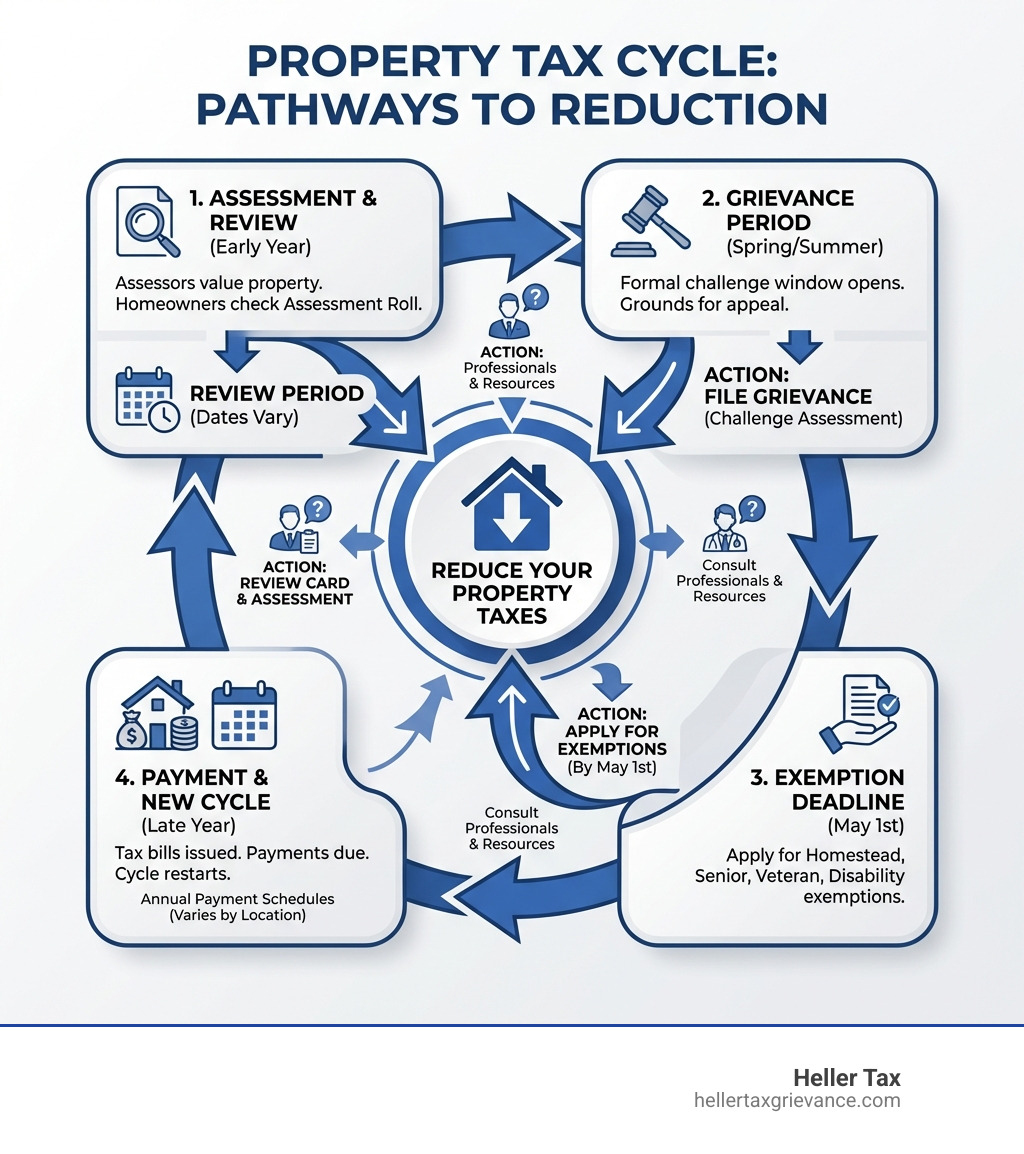
To apply for these exemptions, you typically need to file an application with your local assessor’s office. The deadlines for filing exemptions vary by municipality and exemption type, but often fall around March 1st or May 1st. It’s crucial to check with your specific town or county assessor’s office for the exact dates and required documentation. For instance, for inherited property, you might need to provide an affidavit establishing ownership, a death certificate, and a utility bill.
When we work with clients, we ensure they are aware of and apply for every exemption they qualify for, maximizing their potential for property tax reduction. These exemptions are not automatically applied in many cases; you must actively apply for them.
Federal Tax Implications: The SALT Deduction and IRS Rules
While our focus is on reducing your local property tax bill, it’s also worth understanding how property taxes can impact your federal income tax return, particularly through the State and Local Tax (SALT) deduction. This deduction allows itemizing taxpayers to deduct certain state and local taxes they’ve paid.
The general rule is that you may take an itemized deduction for certain state, local, and foreign taxes you pay. For most homeowners on Long Island, this primarily includes:
- State and local real property taxes: These are the property taxes you pay to your county, town, school district, and other local entities.
- State and local income taxes: If you pay New York State income tax, this is also deductible. You generally choose between deducting state income taxes or state and local general sales taxes, but for most Long Islanders, income tax deductions are more beneficial.
However, there’s a significant limitation to the SALT deduction that directly impacts homeowners in high-tax states like New York. The deduction for state and local taxes (SALT) is capped at a combined total of $10,000 per household ($5,000 if married filing separately). This means that even if you pay $20,000 or $30,000 in property and state income taxes, you can only deduct $10,000 on your federal income tax return. This cap has been a point of contention for many Long Island residents, as it limits the federal tax benefit of owning property in our high-tax region.
It’s also important to know what types of taxes and fees are generally not deductible for federal income tax purposes:
- Federal income taxes and Social Security taxes.
- Transfer taxes and stamp taxes (often associated with property sales).
- Homeowner’s association (HOA) fees.
- Service charges for utilities like water, sewer, or trash collection. These are typically considered fees for services, not taxes.
- Taxes for local benefits, unless they are for maintenance, repair, or interest related to those benefits.
For your real property taxes to be deductible, they must be assessed uniformly against all real property in the jurisdiction at a like rate. This is generally the case for the property taxes we pay on Long Island. While New York doesn’t typically have a separate “personal property tax” in the way some other states do (which would also be deductible if based solely on value and charged annually), our real property taxes are the primary avenue for the SALT deduction for homeowners.
Understanding these federal implications helps put your local property tax reduction efforts into a broader financial context. While the SALT cap limits federal benefits, reducing your actual local property tax bill remains a direct and significant way to save money.
How to Appeal Your Assessment and Use Professional Services
When you believe your property’s assessment is unfair or inaccurate, appealing it is your right and a key strategy for property tax reduction. The process, often called a tax grievance, involves formally challenging the assessor’s valuation.
Here’s a general overview of the appeal steps on Long Island:
- Review Your Assessment: Obtain your property tax card and review it for any factual errors. Also, compare your home’s assessed value to recent sales of similar properties in your neighborhood (comparable sales) to determine if your assessment is out of line with market value.
- File a Grievance: This is the formal application to challenge your assessment. In Nassau County, this is filed with the Assessment Review Commission. In Suffolk County, it’s filed with your local town assessor’s office. The deadline for filing is typically May 1st, but it’s crucial to confirm the exact date for your municipality.
- Provide Supporting Evidence: You’ll need to submit documentation that supports your claim of overassessment. This often includes comparable sales data, photos of discrepancies, or any other information that proves your property’s market value is lower than its assessed value.
- Attend a Hearing (if necessary): In some cases, you might be required to attend a hearing or informal review with the assessor or review board to discuss your appeal.
- Receive a Decision: The review board will issue a decision on your grievance. If you’re satisfied, the process ends here, and your assessment will be adjusted.
- Further Appeals (if necessary): If you’re not satisfied with the decision, you can pursue further appeals, such as filing a Small Claims Assessment Review (SCAR) petition in New York State Supreme Court.
Navigating this process can be complex and time-consuming. This is where property tax reduction services, like ours, come into play. We are experts in the local assessment rules for Nassau and Suffolk Counties and can guide you through every step.
How Property Tax Reduction Services Work:
- Expert Analysis: We conduct a thorough market analysis of your property, comparing it to recent sales of similar homes in your neighborhood to identify potential overassessment.
- Documentation and Filing: We prepare and file all necessary paperwork, including your grievance application and supporting evidence, ensuring it meets all local requirements and deadlines.
- Representation: We act as your exclusive agent, representing you before the Assessment Review Commission or town assessor’s office. This includes preparing petitions and, if necessary, appearing in court on your behalf for Small Claims Assessment Review.
- Negotiation and Settlement: We negotiate with the taxing authorities to achieve the best possible property tax reduction for you. We handle all communications and settlement offers.
- Contingency Fees: Many reputable property tax reduction services, including Heller Tax, operate on a “You Don’t Pay Unless You Save” guarantee. This means we only charge a fee if we successfully reduce your property taxes, and our fee is typically a percentage of the savings achieved. This arrangement ensures that our interests are aligned with yours – we’re motivated to get you the largest possible reduction.
Benefits of Using a Property Tax Reduction Service:
- Expert Knowledge: We understand the nuances of the assessment process and the specific criteria for challenging valuations in Nassau and Suffolk Counties.
- Time-Saving: The grievance process can be lengthy and requires attention to detail. We handle all the paperwork and follow-up, saving you valuable time.
- Higher Success Rate: Our experience and expertise often lead to a higher success rate in achieving property tax reduction compared to homeowners attempting the process on their own.
- No Upfront Risk: With our “You Don’t Pay Unless You Save” guarantee, you have no financial risk if we’re unable to secure a reduction.
- Peace of Mind: You can rest assured that your case is being handled by professionals dedicated to lowering your tax burden.
While you are not legally required to use a tax reduction service to file for an assessment reduction, the benefits of professional representation often outweigh the effort and potential pitfalls of going it alone. We’ve helped thousands of Long Island homeowners achieve significant savings, holding the record for the largest single-year property tax reductions in both Nassau County ($73,000) and Suffolk County ($17,000).
Frequently Asked Questions about Property Tax Reduction
We encounter many questions from homeowners about property tax reduction. Here, we address some of the most common inquiries to provide clarity and empower you with knowledge.
What is a property tax deferral and who is eligible?
A property tax deferral allows eligible homeowners to postpone the payment of their property taxes until a later date, typically when the property is sold or changes ownership. This can be a lifeline for those on fixed incomes or facing financial hardship, helping to prevent foreclosure due to unpaid taxes.
On Long Island, some municipalities offer tax deferral programs, often aimed at senior citizens or disabled homeowners, similar to programs found in other states. For example, some programs might allow you to postpone taxes, though accumulated deferred taxes often accrue interest (which could be around 5% annually, though rates vary by program and location).
The eligibility criteria usually include:
- Age: Typically, the homeowner must be 65 years or older.
- Income: There are often income limitations to qualify.
- Residency: The property must be your primary residence.
- Equity: There might be requirements regarding the amount of equity you have in your home.
Deferrals postpone the due date; they don’t eliminate the tax liability. The deferred taxes, plus any accrued interest, become due when the property is sold, transferred, or the homeowner passes away. Your heirs may make payments to cover these deferred taxes. We recommend checking with your specific town or county tax office in Nassau or Suffolk County to learn about any available deferral programs and their precise terms.
How do home upgrades affect my property tax bill?
Home upgrades can significantly affect your property tax bill, and it’s a crucial consideration for any homeowner planning renovations. When you make significant structural changes or additions to your home, you’re likely increasing its market value. Assessors typically reassess properties after such improvements.
Examples of upgrades that can trigger an assessment increase include:
- Adding square footage (e.g., a new room, second story, or finished basement/attic).
- Major renovations like adding a new bathroom or extensively remodeling a kitchen.
- Building a new garage, deck, or in-ground pool.
Conversely, minor cosmetic changes like painting, new flooring, or updating fixtures usually do not trigger a reassessment or significantly impact your assessed value.
A key tip for homeowners aiming for property tax reduction is to be mindful of the timing of significant upgrades. If you complete major structural changes right before the annual assessment period, your increased value could be reflected in your next tax bill. While we don’t advise against improving your home, being aware of the assessment cycle can help you anticipate potential tax increases. Always check with your local building department in Nassau or Suffolk County regarding permits, as these records are often shared with the assessor’s office and can flag your property for review.
What are the deadlines for applying for tax exemptions?
The deadlines for applying for property tax exemptions are incredibly important, as missing them can mean missing out on valuable savings. While the general guideline for filing many property tax-related applications, including grievances, is often around May 1st on Long Island, exemption deadlines can vary significantly by:
- Type of exemption: Basic STAR, Improved STAR, Senior Citizen, Veteran, and Disabled exemptions often have different application deadlines.
- Municipality: Deadlines can differ between Nassau County and the various towns in Suffolk County (e.g., Brookhaven, Islip, Huntington, etc.).
It’s crucial to check with your specific local assessor’s office in your town or county for the precise deadlines for each exemption you wish to claim. For instance, some exemptions might have a March 1st deadline, while others could be later.
Late Applications: In some cases, especially for certain exemptions like those for veterans or surviving spouses, there might be provisions for late applications or even retroactive relief for past years. However, these are exceptions, not the rule, and often come with stricter requirements or limited windows (e.g., a 2-year or 5-year look-back period, depending on the specific exemption and municipality). It’s always best practice to apply as early as possible to ensure you don’t miss out.
We always advise our clients to be proactive. If you believe you qualify for an exemption, contact your local assessor’s office or reach out to us well in advance of any potential deadlines. Being prepared ensures you maximize your potential for property tax reduction.
Conclusion
Navigating the complexities of property taxes on Long Island can feel overwhelming, but achieving property tax reduction is a tangible goal for many homeowners. From understanding your assessment and identifying errors to claiming all eligible exemptions and strategically planning home improvements, there are numerous avenues to lower your annual tax bill.
For over a decade, we at Heller Tax have been dedicated to helping Long Island homeowners in Nassau County and Suffolk County. We understand the local assessment systems intimately, and our track record speaks for itself – including the largest single-year property tax reductions in both counties ($73,000 in Nassau and $17,000 in Suffolk) and over $160 million saved for our clients.
We believe in a straightforward approach: “You Don’t Pay Unless You Save.” This guarantee means there’s no risk in exploring how much we can reduce your property taxes. Our team of experts handles everything from the initial analysis and filing of your tax grievance to representing you throughout the appeal process.
Don’t let an unfair assessment or missed exemption cost you thousands of dollars each year. Take control of your property tax burden.