
Why Your Commercial Property Tax Bill Deserves a Second Look
A commercial property tax protest — known in New York as a tax grievance — is one of the most powerful tools available to Long Island business and property owners who are paying more than their fair share.
Here’s what you need to know at a glance:
- What it is: A formal challenge to your property’s assessed value, filed with your county’s assessment authority.
- Who can file: Commercial property owners in Nassau County or Suffolk County (and in some cases, tenants under certain lease agreements).
- Why it matters: If your assessed value is too high, you overpay every single year — often by thousands of dollars.
- When to file: Nassau and Suffolk counties have specific annual deadlines. Missing them means waiting another full year.
- What it costs to try: Many professional grievance firms, including Heller Tax, work on a contingency basis — no savings, no fee.
The reality is that county assessors set values for thousands of properties at once. They use broad data and general assumptions. Your specific property — its condition, its income, its vacancy, its expenses — rarely gets the individual attention it deserves.
That gap between the assessor’s assumption and your actual numbers is exactly where savings are found.
I’m Adam Heller, founder of Heller & Consultants Tax Grievance, and I’ve spent nearly two decades helping Long Island homeowners and commercial property tax protest filers reduce their assessments — including holding the record for the largest single reductions in both Nassau and Suffolk counties. In the sections below, I’ll walk you through exactly how the process works and how to give yourself the best shot at a meaningful reduction.
Commercial property tax protest further reading:
The Power of a Commercial Property Tax Protest for Long Island Owners
When you own commercial real estate on Long Island—whether it is a retail storefront in Syosset, an industrial warehouse in Farmingdale, or an office building in Stony Brook—your property taxes represent one of your largest fixed overhead costs. Unlike residential properties, which are valued primarily on comparable sales, commercial property valuation is deeply tied to the property’s ability to generate economic value.
When the Nassau County or Suffolk County assessor determines your property’s assessed value, they are estimating its market value as of a specific valuation date. However, county appraisal systems rely on mass appraisal techniques. These algorithmic models frequently fail to account for hyper-local economic realities, such as a major tenant vacating a shopping center in Massapequa, structural damage to a building in Rocky Point, or rising utility and insurance costs that eat away at your bottom line.
By filing an annual commercial property tax protest, you force the county to look at the actual performance and unique characteristics of your specific parcel. Securing a reduction in your assessed value provides direct, immediate tax relief. Because local school, town, and county tax rates are applied directly to this assessed value, even a modest percentage reduction in your assessment can translate into tens of thousands of dollars saved annually.
Filing annually is highly recommended. Market conditions shift, tenant rolls fluctuate, and municipal budgets rise. If you do not actively challenge your assessment every year, you are essentially accepting the county’s default, computerized valuation—and likely overpaying. For more detailed insights on how to secure this financial breathing room, read our guide on how to get some much-needed commercial property tax relief.
The Long Island Tax Grievance Calendar and Deadlines
In property tax grievances, deadlines are absolute. If you miss the filing window, New York State law provides virtually no administrative recourse until the following tax year. As we navigate the current tax calendar in June 2027, it is critical to understand the differing schedules for Nassau County and Suffolk County.
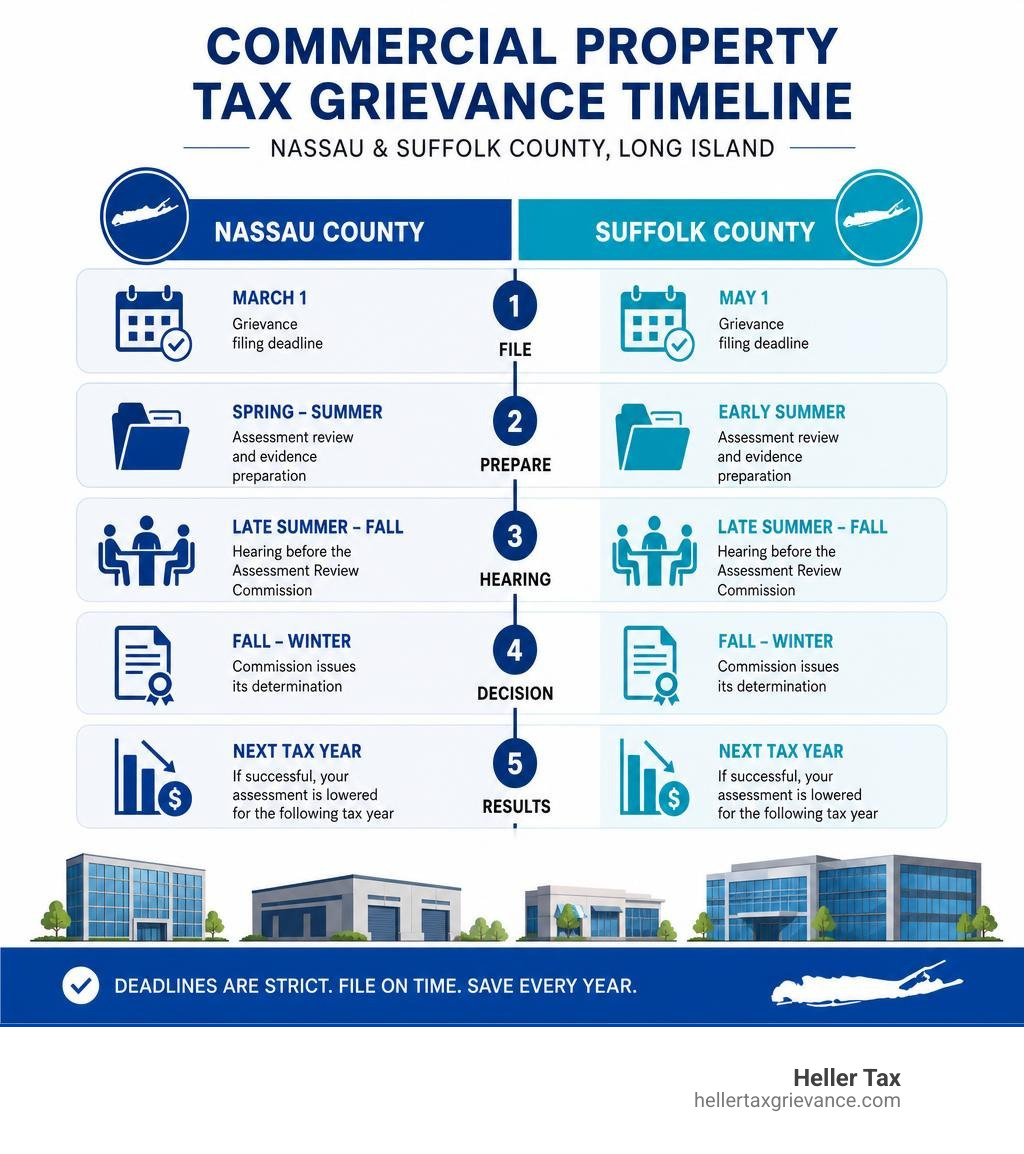
Nassau County Calendar
Nassau County operates on a multi-year lag system. The Nassau County Assessment Review Commission (ARC) typically opens the filing period for commercial grievances in January when the tentative assessment roll is published. For the tentative roll issued in early 2027, the standard deadline to file a commercial grievance is March 2, 2027 (or the first business day of March). Protests filed during this window challenge the assessments that will impact the 2027/2028 school taxes and the 2028 general town/county taxes.
Suffolk County Calendar
Suffolk County’s assessment structure is decentralized, organized by its ten individual towns (such as Brookhaven, Huntington, Babylon, and Islip). However, they largely follow a synchronized state-mandated calendar. The tentative assessment rolls for Suffolk County towns are published on or around May 1st. The deadline to file a commercial property tax grievance with each town’s Board of Assessment Review (BAR) is Grievance Day, which always falls on the third Tuesday in May (May 19, 2027).
Whether your commercial property is located in Syosset, Melville, Woodbury, or Miller Place, staying ahead of these county and town-level dates is paramount. To help visualize these timelines, review the comparison table below:
| Feature / Step | Nassau County | Suffolk County (Towns) |
|---|---|---|
| Primary Valuation Body | Nassau County Assessment Review Commission (ARC) | Individual Town Boards of Assessment Review (BAR) |
| Tentative Roll Publication | January | May 1st |
| Standard Grievance Deadline | March 1st (or first business day of March) | Third Tuesday in May (Grievance Day) |
| Subsequent Appeal Route | Supreme Court (Article 7 Tax Certiorari) | Supreme Court (Article 7 Tax Certiorari) |
For a deeper dive into how these local tax structures impact commercial assets, see our resource on commercial real estate property taxes.
How to Prepare and Win Your Commercial Property Tax Protest

A successful commercial property tax protest is built entirely on verifiable, mathematical evidence. You cannot win an appeal by simply complaining that your taxes are too high or that local municipal spending is out of control. To convince an appraisal analyst or a judge to lower your assessment, you must present a cohesive valuation case.
While there are three traditional valuation methods—the cost approach, the sales comparison approach, and the income approach—the income approach is the undisputed gold standard for income-producing commercial properties. Under New York law, assessors must consider the income-generating capacity of commercial real estate.
To win your protest using the income approach, you must systematically reconstruct your property’s Net Operating Income (NOI) and apply an appropriate market capitalization rate (cap rate) to determine its true economic value. This involves:
- Documenting Actual Revenue: Compiling all rental income, utility reimbursements, parking fees, and laundry or storage income.
- Normalizing Expenses: Stripping out non-allowable expenses (such as depreciation, mortgage interest, income taxes, capital improvements, and personal owner expenses) to isolate true operating expenses.
- Establishing Market Vacancy: Proving that your vacancy rates and collection losses reflect local market conditions.
- Applying the Cap Rate: Dividing your normalized NOI by a defensible, market-supported capitalization rate to calculate the indicated market value.
If you are looking for a complete roadmap of this process, consult our commercial tax grievance Long Island step-by-step guide.
The Role of Financials in a Commercial Property Tax Protest
To execute the income approach successfully, you must compile a robust financial package. The two most critical documents in your arsenal are your certified rent rolls (as of January 1st of the tax year under appeal) and your trailing 12-month Profit & Loss (P&L) statements.
- Rent Rolls: These provide a snapshot of your actual tenancy. They reveal contractual rent rates, lease start and end dates, square footage allocations, and vacant spaces. If your property has long-term tenants paying below-market rents, the rent roll proves that your contract rent is lower than the county’s assumed “market rent.”
- Profit & Loss Statements: Your P&L reveals the actual operational costs of running the property. Rising property insurance premiums, local utility hikes, and localized maintenance costs in Suffolk and Nassau counties can significantly reduce your NOI. Presenting these real-world figures forces the county to abandon idealized pro forma expense ratios.
For properties operating under triple net (NNN) leases, where tenants pay for taxes, insurance, and maintenance, the financial analysis requires careful handling. In New York, commercial tenants contractually obligated to pay the property taxes often have the legal standing to file a grievance themselves to protect their bottom line.
Regardless of who files, having organized financial data is the single most important factor. Explore our commercial info hub to learn more about preparing these crucial documents.
Navigating the Income Approach for Your Commercial Property Tax Protest
When the county appraisal district values a commercial asset, they typically model a pro forma scenario. They might assume a generic 5% vacancy rate and a 35% operating expense ratio for a standard office building in Syosset. However, if your building is experiencing a 15% vacancy rate due to local economic shifts, and your actual operating expenses are closer to 45% due to aging HVAC systems, the county’s model is fundamentally flawed.
By using actual financial data, we can highlight these discrepancies. Let’s look at a simplified example of how capitalization rate arbitrage and expense normalization work in practice:
Suppose the county assesses your retail strip in Massapequa at $5,000,000, assuming a Net Operating Income of $350,000 capitalized at a 7.0% cap rate ($350,000 / 0.07 = $5,000,000).
Through careful analysis of your actual rent rolls and P&L, we normalize your expenses and establish that your true, sustainable NOI is actually $280,000 due to higher local vacancy and maintenance costs. Furthermore, we compile local market data showing that similar properties in Suffolk or Nassau County are trading at an 8.0% capitalization rate due to economic conditions.
$$text{Indicated Value} = frac{text{Actual NOI}}{text{Market Cap Rate}} = frac{$280,000}{0.08} = $3,500,000$$
By presenting this mathematically sound income approach, we can argue for an assessed value reduction corresponding to a market value of $3,500,000 instead of the county’s $5,000,000. That is a $1.5 million reduction in market value, which translates directly to massive tax savings.
For professional assistance in analyzing and structuring your commercial income valuation, you can partner with Heller Tax Grievance Commercial Services.
The Step-by-Step Grievance and Appeals Process

Protesting your commercial property taxes on Long Island is a multi-tiered administrative and legal process. It is structured to allow multiple opportunities to resolve the valuation dispute.
Step 1: The Administrative Filing
The process begins by submitting a formal grievance application to the appropriate municipal agency—the Assessment Review Commission (ARC) in Nassau County, or the local town Board of Assessment Review (BAR) in Suffolk County. This initial filing must include your basic property details, your claimed market value, and the legal grounds for your protest (typically overvaluation or unequal assessment).
Step 2: The Administrative Review and Determination
Once filed, the ARC or BAR reviews the application. In Nassau, ARC analysts may extend settlement offers if your evidence is compelling. In Suffolk, the BAR meets on Grievance Day to review submissions and subsequently mails out official determinations. If they agree with your valuation, your assessment is lowered. If they deny the application or offer an insufficient reduction, you must proceed to the next step.
Step 3: Judicial Appeal (Tax Certiorari / Article 7 Petition)
Unlike residential homeowners who can resolve disputes through Small Claims Assessment Review (SCAR) hearings, commercial property owners must file a formal Article 7 petition in the New York State Supreme Court. This legal process is known as tax certiorari.
Filing an Article 7 petition initiates a formal lawsuit against the assessing municipality. During this phase, your tax certiorari attorney or designated representative will engage in pre-trial discovery, exchange certified appraisals, and enter negotiations with the county or town attorney. The vast majority of these cases are settled out of court through structured settlement agreements, resulting in retroactive refunds or future tax credits. To learn more about maximizing your chances during these negotiations, read our article on the top 5 ways you can pay fewer commercial property taxes.
Frequently Asked Questions about Commercial Property Tax Protests
Can commercial tenants file a property tax grievance?
Yes, under New York law, a commercial tenant often has the legal standing to file a tax grievance. To do so, the tenant must have a lease agreement (typically a triple net or NNN lease) that contractually obligates them to pay or reimburse the landlord for 100% of the property taxes. The tenant must also show that their leasehold interest is directly affected by the overassessment. Because only one protest can be filed per property per year, it is vital for tenants to coordinate closely with their landlords before filing.
What happens if my commercial property tax protest is denied?
If your administrative grievance is denied by the Nassau ARC or a Suffolk Town BAR, your recourse is to file an Article 7 petition in the New York State Supreme Court within 30 days of the publication of the final assessment roll. This transitions your protest into a judicial tax certiorari proceeding. During this phase, professional representation is highly recommended, as it involves formal legal filings, appraisal exchanges, and court-supervised settlement conferences.
How much can I save by protesting my commercial property taxes?
Your total savings depend on the size of your assessment reduction and your local municipal tax rates. On Long Island, commercial tax rates are exceptionally high, meaning even a 10% to 15% reduction in your assessed value can result in thousands—or tens of thousands—of dollars in annual savings. For larger commercial assets, such as shopping centers or industrial complexes, successful tax certiorari proceedings frequently yield six-figure savings and substantial retroactive refunds.
Conclusion
Navigating a commercial property tax protest on Long Island requires a deep understanding of local tax calendars, meticulous financial analysis, and the expertise to navigate both administrative reviews and New York State Supreme Court proceedings. Trying to handle this process on your own can lead to missed deadlines, rejected filings, or leaving substantial savings on the table.
At Heller Tax Grievance, we take the stress and complexity out of commercial tax reduction. Serving Nassau and Suffolk counties, we have secured over $160 million in savings for our clients. Our industry-leading experience allows us to build bulletproof valuation cases designed to win. Best of all, we operate under a strict “You Don’t Pay Unless You Save” guarantee—there are absolutely no upfront costs or hidden fees. We only get paid if we successfully reduce your property taxes.
Do not let inflated county assessments drain your business’s cash flow. Contact us today to secure your free commercial property tax consultation and start keeping your money where it belongs.
Get started now by visiting our commercial info hub.
Additional Resources for Property Owners:
- For nearby metropolitan procedures, check out Challenge Your Assessment – NYC.gov.
- For standard procedural forms and protest templates, you can review the PROPERTY APPRAISAL NOTICE OF PROTEST TAX YEAR 2024 and the Property Owner’s Notice of Protest.