

How Suffolk County Taxes Affect Your Property
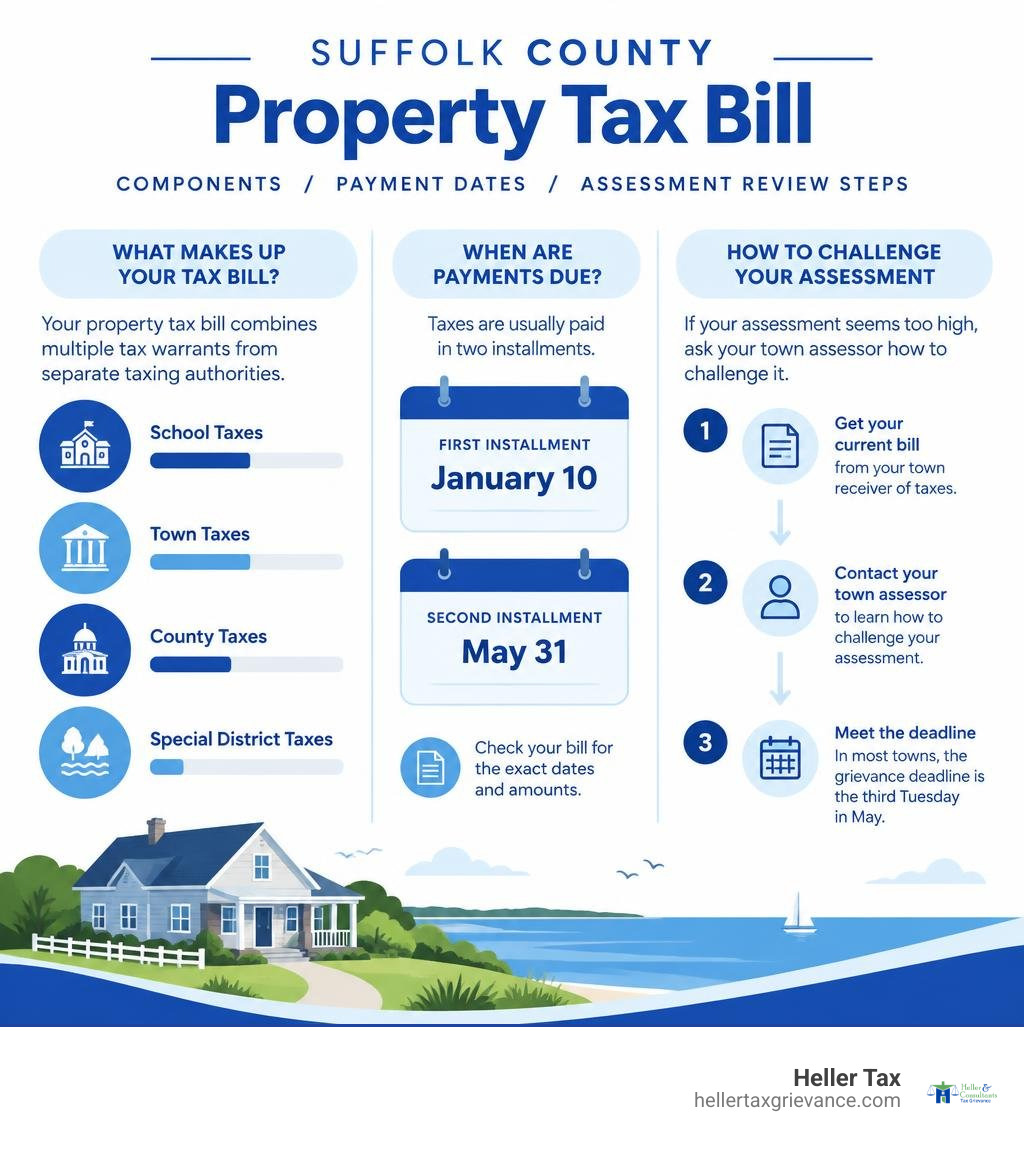
Suffolk County taxes are not one flat charge. Your property tax bill combines school, town, county, and special district taxes. To see what you owe, get the current bill from your town receiver of taxes. If your assessment seems too high, ask your town assessor how to challenge it. In most towns, the grievance deadline is the third Tuesday in May.
Taxes are usually paid in two installments: the first by January 10 and the second by May 31. Check your bill for the dates and amounts that apply to your property.
I’m Adam Heller, a lifelong Long Islander and former real estate broker who now helps property owners challenge assessments behind their Suffolk County taxes. At Heller Tax, my team and I help more than 6,000 Long Islanders each year seek a fairer tax bill.
Breakdown: How Suffolk County Taxes Are Calculated
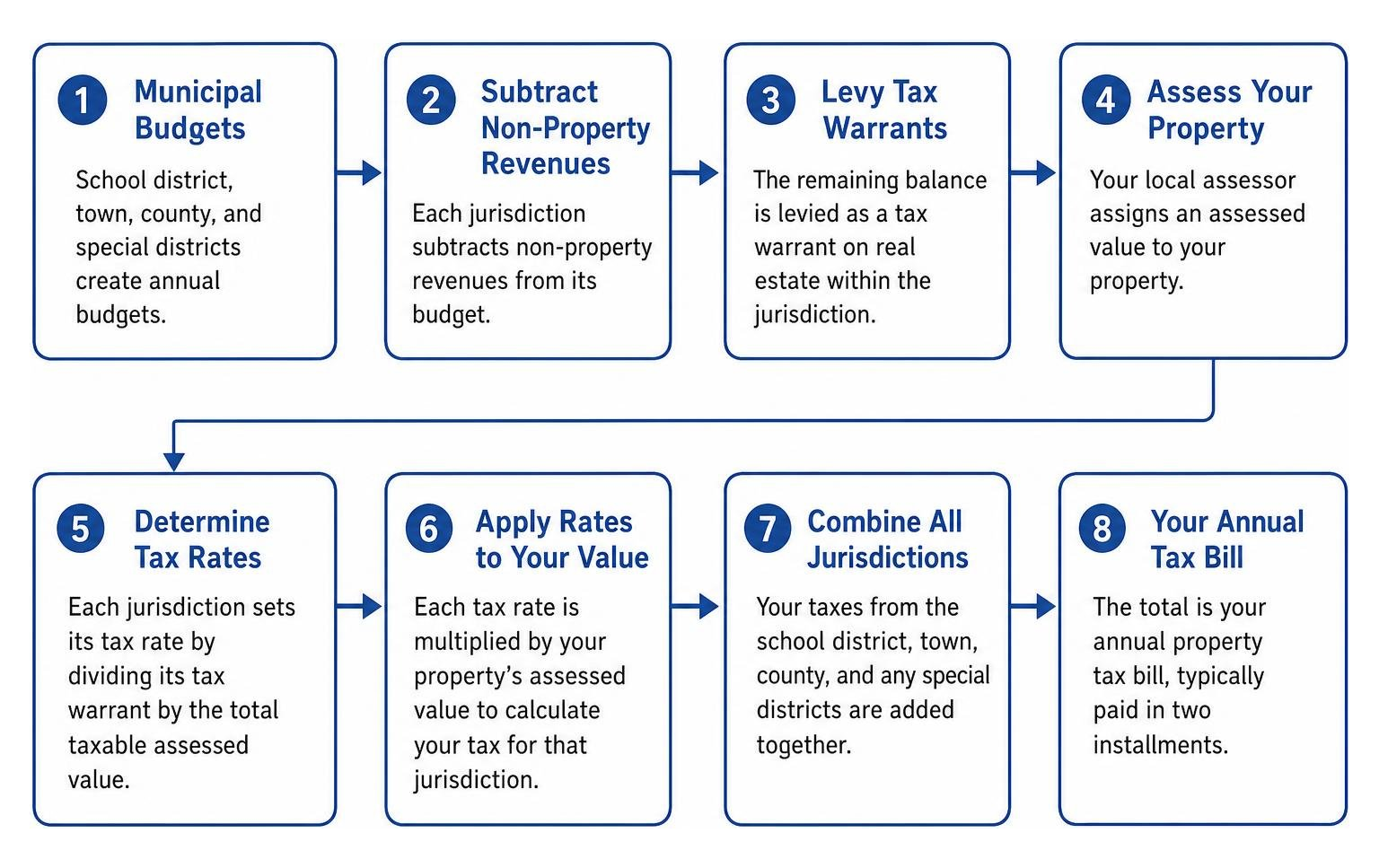
Understanding your tax bill starts with realizing that no single government entity sets the entire amount. Instead, your annual bill is an aggregation of multiple tax warrants levied by distinct taxing authorities.
To determine what you owe, each jurisdiction establishes an annual budget, subtracts non-property revenues, and levies the remaining balance against the taxable assessed value of real estate within its borders. Your local assessor assigns an assessed value to your home, which is then multiplied by the tax rates established across all overlapping jurisdictions.
The official Information for Taxpayers published by the county details how these tax warrants are assembled across ten separate townships, each operating its own assessment rolls and collection schedules.
School, Town, and County Portions in Suffolk County Taxes
When you look at the breakdown of your bill, the distribution among public entities is heavily weighted toward education. In most Suffolk communities—from Stony Brook to Miller Place—school district levies represent the overwhelming majority of your bill.
- School District Taxes: Typically account for more than 60% (and often up to 70%) of your total bill, funding local K-12 public education, facilities, and transportation.
- Town and Special District Levies: Fund local township services, highway maintenance, refuse collection, fire protection, and local public libraries.
- Suffolk County Portions: The county portion represents roughly 10.7% of the total tax warrant, split between the County General Fund and specialized districts such as the Police District.
| Taxing Jurisdiction | Typical Share of Tax Warrant | Primary Services Funded |
|---|---|---|
| School Districts | 60% – 70% | Public K-12 education, teacher salaries, school facilities |
| Town Governments & Special Districts | 18% – 28% | Local roads, garbage collection, parks, fire districts, libraries |
| Suffolk County (General & Police) | ~10.7% | County roads, emergency services, county courts, police district |
For the 2025 county budget, the adopted general fund property tax warrant increased by 2% ($980,733), bringing the average homeowner’s general fund contribution to $89.88. Meanwhile, the police district property tax warrant rose to $644,531,316, bringing the total county property tax warrant to $711,495,847 (an average of $1,264.38 per household).
Looking ahead, the Suffolk County Legislature approved a $4.3 billion budget for 2026 that includes a 3.18% overall property tax increase, remaining below New York State’s statutory 3.25% property tax cap limit.
Why Tax Rates Vary by School District and Town
Homeowners are often surprised to discover that two nearly identical houses on opposite sides of the same street carry drastically different tax bills. This happens because Suffolk County contains over 125 school districts, 10 towns, 64 incorporated villages, and more than 100 special taxing districts.
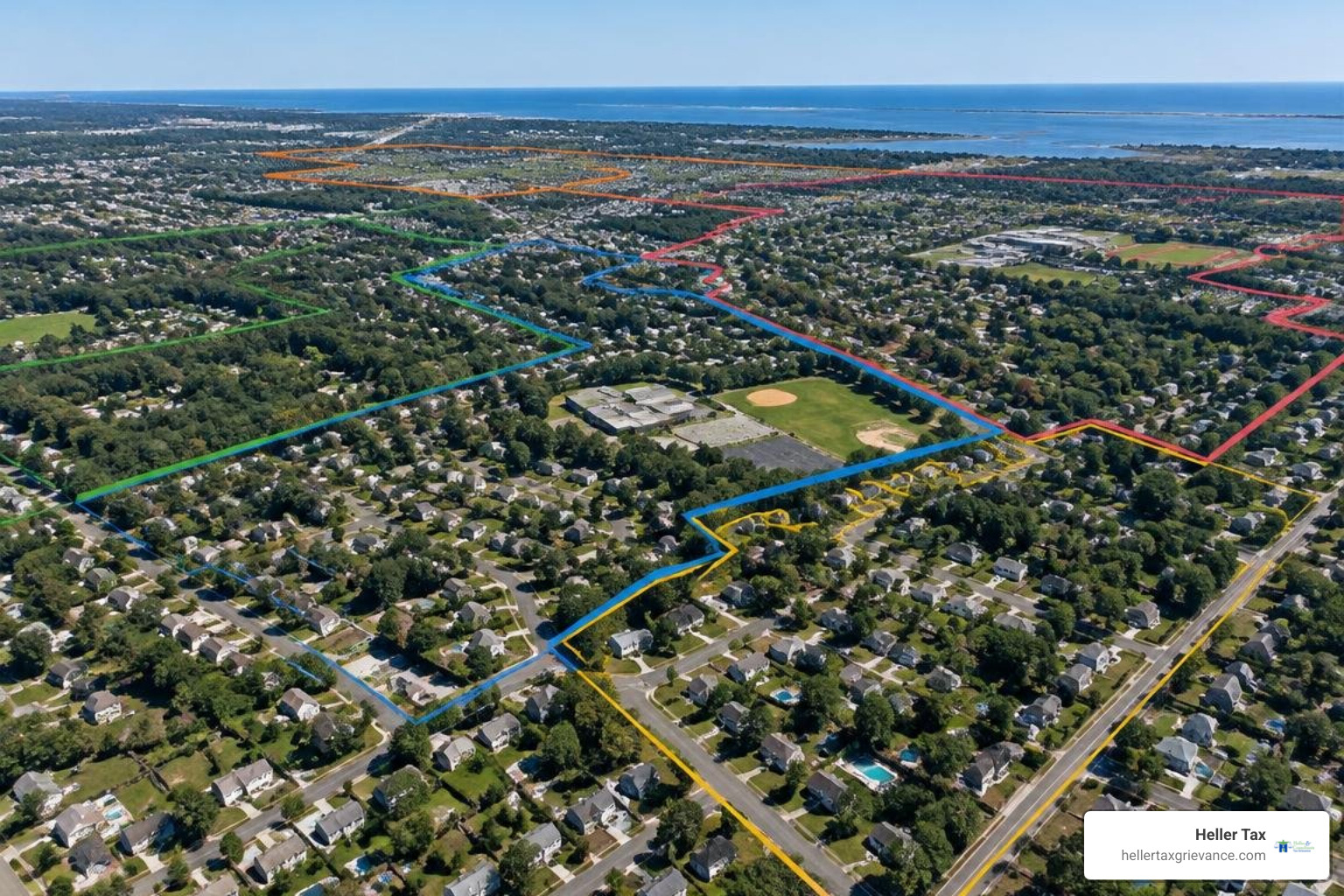
If your property sits within an independent village or a specialized fire protection district with high capital debt, those supplemental millage rates are added directly to your standard town and school levies. Because school district borders do not strictly follow municipal town lines, crossing a single intersection in areas like Deer Park or Farmingdale can shift your property into an entirely different school system with distinct budget requirements and tax levies.
Property Tax Rates, Median Costs, and Buyer Budgeting
It is no secret that Long Island features some of the highest real estate carrying costs in the country. In fact, research shows that Suffolk County ranks 12 in the nation in property taxes, driven primarily by our top-rated public school systems and independent emergency service districts.
Effective Tax Rates Compared to National Averages
The overall effective property tax rate in Suffolk County is approximately 2.42%. In contrast, the median annual property tax bill in Suffolk County runs around $9,472—nearly three times the national average of approximately $3,399.
| Location | Effective Tax Rate | Median Annual Tax Bill |
|---|---|---|
| Suffolk County, NY | ~2.42% | $9,472 |
| National Average | ~0.99% | $3,399 |
| Typical $500,000 Suffolk Home | ~2.42% | ~$12,100 |
Buyer Framework for Escrow and Annual Increases
When purchasing residential property in Suffolk County, planning your monthly payment requires factoring in mortgage escrow requirements and annual rate growth. Lenders collect one-twelfth of your annual property taxes each month, holding funds in escrow alongside a mandatory two-month cushion.
To build a reliable budgeting framework:
- Obtain the Prior-Year Tax Bill: Never rely solely on real estate listing estimates. Review the actual bill from the town Receiver of Taxes.
- Calculate Monthly Escrow: Divide the annual total by 12, adding a standard 5% to 8% cushion to account for annual school and municipal budget adjustments.
- Budget for Reassessments: If you purchase a property that has undergone recent renovations or lost legacy exemptions, anticipate potential upward adjustments in subsequent roll cycles.
Payment Deadlines, Penalties, and Delinquency Rules
Suffolk County operates on a tax year running from December 1st through November 30th of the following year. Tax bills are generated and mailed by local town Receivers of Taxes in mid-December. Homeowners can review official Payment Options to understand local and county collection procedures.
Payment Schedule and Partial Payment Guidelines
Property taxes are split into two standard installments:
- First Half: Due December 1st; payable without penalty through January 10th. If paid after January 10th, a 1% per month penalty applies to the first-half balance.
- Second Half: Payable through May 31st without penalty.
If full payment is difficult, town Receivers of Taxes and the County Comptroller are legally authorized to accept partial payments of $200 or more before May 31st. Making partial payments reduces the outstanding principal balance, lowering the cumulative interest charged on remaining amounts.
Delinquency, County Penalties, and Tax Lien Sales
On June 1st, all unpaid taxes become delinquent, and collection authority transfers entirely from the local town Receiver to the Suffolk County Comptroller.
As outlined in the Suffolk County Comptroller’s Office > Taxpayer FAQs, delinquent accounts incur an immediate 5% county penalty plus interest charged at 1% per month, calculated retroactively from February 1st:
- June: 5% penalty + 5% interest (10% total)
- July: 5% penalty + 6% interest (11% total)
- August: 5% penalty + 7% interest (12% total)
- September: 5% penalty + 8% interest (13% total)
- October: 5% penalty + 9% interest (14% total)
- November: 5% penalty + 10% interest (15% total)
- December: 5% penalty + 11% interest (16% total)
If taxes remain unpaid by late summer, an advertising fee is added, and the county prepares the parcel for its annual tax lien sale in November or December. Following a lien sale, property owners have a statutory redemption period:
- 12 Months: For vacant land and commercial parcels.
- 36 Months: For one-, two-, and three-family residential homes.
If the lien is not redeemed within the designated period by paying all back taxes, penalties, and accrued interest, the lienholder can take title to the property through a tax deed.
STAR Credit Registration and Property Exemptions
New York State provides property tax relief to primary homeowners through the School Tax Relief (STAR) program, alongside veteran, senior citizen, and disability exemptions.
Basic and Enhanced STAR Credit Guidelines
For all homeowners who purchased their residence after 2015, the STAR benefit is issued as a direct state credit check or direct deposit from the NYS Department of Taxation and Finance, rather than an assessment reduction on the local tax bill. The STAR credit value grows by up to 2% annually.
| Program Feature | Basic STAR Credit | Enhanced STAR Credit |
|---|---|---|
| Eligibility Age | Any age (owner-occupied primary residence) | Age 65 or older by December 31st |
| Income Limit | Combined household income up to $500,000 | ~$107,300 (for the 2025–2026 school year) |
| Administration | NYS Department of Taxation and Finance | NYS Department of Taxation and Finance |
| Benefit Delivery | Direct check or direct deposit | Direct check or direct deposit |
Senior, Veteran, and Local Assessment Exemptions
Beyond STAR, local townships offer property tax exemptions that reduce your assessed value:
- Senior Citizen Exemption: Available to qualifying homeowners 65 and older with limited incomes; must be filed directly with your town assessor.
- Veterans’ Exemption: Available to wartime and combat veterans, as well as qualifying family members.
- Persons with Disabilities: Assessment relief based on demonstrated income criteria and state guidelines.
Applications for town-level exemptions must be submitted to your local Town Assessor by the taxable status date (March 1st in most Suffolk towns).
Property Tax Grievances and Assessment Reductions
While tax rates are determined by municipal budgets, your individual share of that burden is governed by your assessed value. If your home’s assessed market value is higher than its realistic market worth, you are overpaying.
Every spring marks the opening of Suffolk County property tax grievance season, giving homeowners the legal right to challenge their assessment without risk of their taxes being raised due to the appeal.
Challenging Over-Assessments on Suffolk County Taxes
If you recently purchased your home for less than the town’s implied market value, your closing statement provides immediate evidence of an over-assessment. Learning how to determine if you have a property tax grievance case in Suffolk County involves comparing your assessed value (adjusted by the township’s equalization rate) against recent, verified sales of comparable homes in your immediate neighborhood.
The Board of Assessment Review Grievance Process
The official Suffolk County LI property tax filing deadline is May—specifically, the third Tuesday in May (Grievance Day) across Suffolk County townships.
Key dates on the Suffolk County property tax grievance calendar include:
- March 1 (Taxable Status Date): Deadline for towns to evaluate property condition and process local exemption requests.
- May 1 (Tentative Roll): Town assessors publish the tentative assessment roll for property owner inspection.
- Third Tuesday in May (Grievance Day): Mandatory deadline to submit formal grievance complaints to your town Board of Assessment Review (BAR).
- July 1 (Final Roll): Townships publish the finalized assessment roll.
- 30 Days Post-Final Roll: The filing window for a Small Claims Assessment Review (SCAR) appeal in New York State Supreme Court if the BAR denies or under-reduces your grievance.
To file a grievance, you must prepare and submit:
- Form RP-524: The official complaint on real property assessment.
- Comparable Market Analysis (CMA): Recent, arm’s-length sales of similar homes within your school district or neighborhood.
- Appraisal or Purchase Documentation: Closing disclosures, certified appraisals, or contractor estimates documenting structural defects.
Frequently Asked Questions About Suffolk County Taxes
Where can homeowners find and pay their current property tax bill?
Current-year bills must be paid directly to your local town Receiver of Taxes (e.g., Town of Babylon, Islip, Huntington, Smithtown, Brookhaven, Riverhead, Southampton, East Hampton, Southold, or Shelter Island). Most towns offer online lookup and payment portals. For delinquent bills from prior years, payments must be processed directly through the Suffolk County Comptroller’s Office in Riverhead.
What happens if property taxes remain unpaid past May 31st?
On June 1st, unpaid tax rolls are transferred from the town to the Suffolk County Comptroller. An automatic 5% late penalty is added immediately, alongside 1% monthly interest retroactive to February 1st. If left unpaid by late autumn, the tax lien will be sold at public auction.
How does the county sales tax rate change affect total local taxation?
In addition to real property levies, local sales taxes fund public infrastructure. Effective March 1, 2025, Suffolk County increased its local sales and use tax rate from 4¼% to 4⅜% to finance clean water and wastewater management initiatives. This adjustment brought the total combined sales tax rate in Suffolk County (including the 4% New York State levy) to 8¾%.
Conclusion
Navigating the layers of Suffolk County property taxes requires attention to municipal budgets, assessment rolls, and statutory deadlines. Whether you are budgeting for a new home purchase in Setauket, Stony Brook, Huntington, or Southampton, or managing long-term carrying costs across Long Island, verifying your assessed value is essential to avoiding unnecessary tax burdens.
For an exhaustive breakdown of local assessments and tax rolls, consult our Complete Guide for 2026 Property Taxes in Suffolk County.
At Heller Tax Grievance, we believe no homeowner should pay more than their fair share. We represent clients across Nassau and Suffolk counties with our simple, risk-free guarantee: You Don’t Pay Unless You Save. If we do not successfully reduce your property tax assessment, you pay nothing. With over $160 million saved for Long Island homeowners, our team is here to help you secure the lowest legal assessment possible.