

How to Read Your Property Tax Assessment Notice
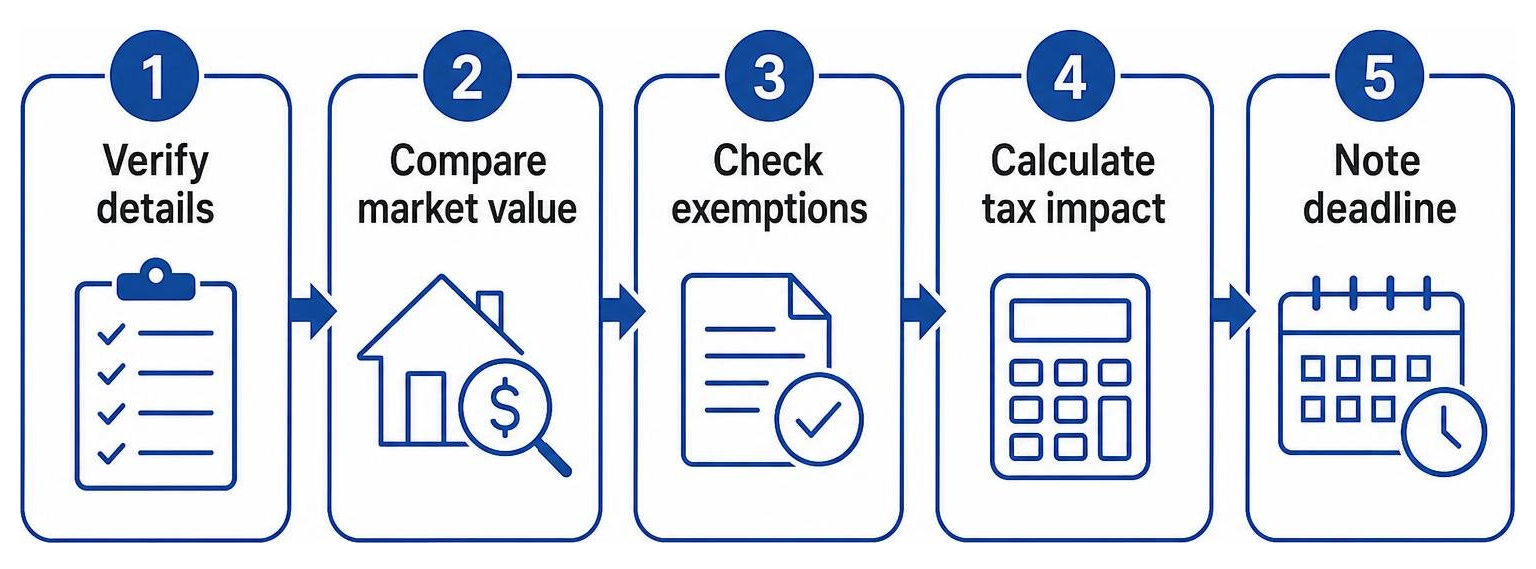
A property tax assessment notice tells you how your local assessor values your property. It is usually not a tax bill. To see whether the value is worth challenging, check five things:
- Confirm your property details.
- Compare the value with recent sales of similar properties.
- Check exemptions and other adjustments.
- Estimate how the value could affect your taxes.
- Find the appeal deadline printed on the notice.
Don’t wait for a tax bill to review the notice. The time to challenge an assessment may run out before the bill arrives.
I’m Adam Heller, founder of Heller Tax and a former Long Island real estate broker. Seeing how high property taxes affected buyers and owners led me to help property owners review each assessment notice and challenge values that may be too high.
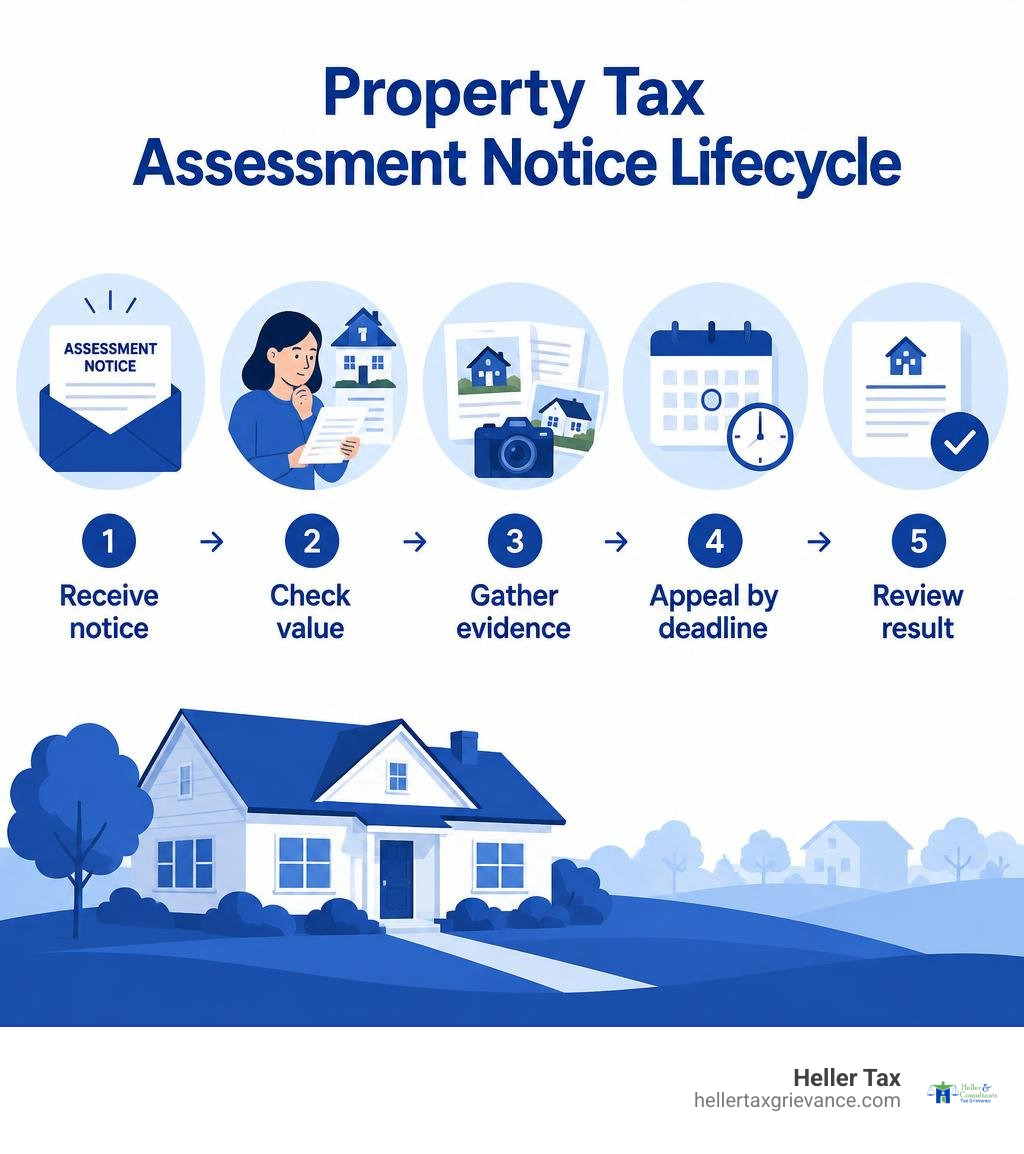
Understanding Property Tax Valuations and Why You Received an Official Determination
Opening your mailbox to find an official letter from the local assessor can make your pulse spike. Many homeowners immediately assume they are facing an unexpected, immediate bill. In reality, municipal assessors send these documents periodically to update property records, reflect changes in market trends, account for structural renovations, or comply with scheduled county-wide valuation cycles.
Your local taxing jurisdiction uses mass appraisal techniques to estimate what your home was worth as of a specific statutory valuation date. Because assessors evaluate thousands of parcels simultaneously using automated algorithms, these calculations often fail to capture individual property flaws, outdated interiors, or hyper-local market shifts. Understanding this notification gives you the power to verify whether the county’s numbers reflect reality or if you are shouldering an unfair portion of the local tax levy.
What Is a Property Tax Assessment Notice?
A property tax assessment notice is an informational document issued by your local government detailing the official valuation placed on your real estate for upcoming tax rolls. It is essential to distinguish this document from an actual tax bill; the notice simply states the valuation metrics used to compute your tax liability later in the fiscal year.
The document outlines two primary figures: the full market value (what the assessor estimates the home would sell for on the open market) and the assessed value (the portion of market value subject to taxation after applying assessment ratios or equalization factors). To understand how local authorities convert these figures into taxable numbers, consult our guide to understanding assessed value.
Statutory rules require assessors to categorize properties into distinct classifications—such as residential Class 1, commercial, or vacant land—each subject to unique assessment ratios and caps. For example, jurisdictions often publish classification frameworks similar to the official Michigan property classification guidance to clarify how different real estate types are categorized. If your property classification or equalized valuation is recorded incorrectly, your baseline tax calculation will be flawed from day one.
5 Quick Steps to Read and Respond to Your Assessment Notice

Navigating official assessment paperwork does not require a finance degree. By following a structured five-step review process, you can quickly spot clerical discrepancies, identify valuation errors, and determine whether you should file a formal grievance.
Step 1: Verify Property Details and Classification
The first step is to scrutinize your property’s inventory card and physical description. Assessors rely on municipal records that are frequently outdated or contain administrative typos. Check every line item carefully:
- Square Footage: Ensure the finished interior living area matches your actual layout (assessors sometimes count unfinished basements or open porches as heated living space).
- Bedrooms and Bathrooms: Confirm the room count reflects current reality.
- Parcel Identification: Verify your section, block, and lot numbers.
- Property Class: Ensure your home is designated correctly (e.g., single-family residential vs. multi-family or mixed-use).
Even minor clerical errors can artificially inflate your baseline valuation. To understand how municipalities maintain and refresh these records annually, review how annual property assessments are conducted.
Step 2: Compare Assessed Value to True Market Value
Assessors do not inspect every home individually each year. Instead, they utilize mass appraisal software and automated valuation models (AVMs), which apply broad statistical averages across entire neighborhoods. These algorithms often miss specific neighborhood nuances, deferred maintenance, foundation issues, or outdated interior conditions.
To evaluate whether your assessment is fair, pull sales data for 3 to 5 comparable properties (“comps”) in your immediate neighborhood that sold near the official valuation date. Look for homes with similar square footage, age, architectural style, and lot size. If similar neighboring properties sold for significantly less than the market value listed on your notice, your property may be overassessed. For a deeper breakdown of how this valuation directly dictates your future payments, see how property assessment relates to your actual tax bill.
Step 3: Check for Applied Exemptions and Multipliers
Your taxable assessed value is calculated by taking the assessed market value and subtracting any legal exemptions you are eligible to receive. Scrutinize the notice to ensure your active tax relief programs are credited properly:
- STAR / Enhanced STAR: New York State School Tax Relief credits.
- Senior Citizen & Disability Exemptions: Tiered relief based on income qualifications.
- Veterans Exemptions: Credits for eligible military service members.
- Equalization Rates and Inflation Multipliers: State-mandated ratios applied to balance local assessment rolls.
If an exemption was accidentally removed during an ownership transfer or administrative update, contact your assessor immediately to restore your rightful deductions.
Step 4: Calculate the Financial Impact on Your Taxes
While your assessment notice displays property value rather than a dollar-for-dollar bill, you can project the financial impact on your wallet. Your ultimate tax bill is determined by multiplying your taxable assessed value by the combined tax rates established by your local school district, county legislature, and town board.
If your assessed value increased while neighboring parcels remained flat or decreased, your proportional share of the local tax levy will expand. Reviewing an official disclosure notice, such as a Nassau County assessment disclosure notice, allows you to observe the estimated market value changes before budgets and tax levies are finalized.
Step 5: Identify the Strict Appeal Deadlines
Every assessment notice features a rigid, legally mandated grievance deadline. If you believe your valuation is inaccurate, you must file a formal challenge within this specific statutory window. Missing the deadline by even a single day forfeits your right to contest your valuation for the entire tax cycle.
To ensure you follow the correct administrative channels, review how property tax grievance works and calendar the required filing dates well in advance.
How Appeals and Valuation Timelines Vary Across Jurisdictions

Property tax grievance calendars and valuation cycles differ significantly across local, state, and regional jurisdictions. While some states reassess property values on a continuous annual cycle, others conduct county-wide valuations every two, three, or four years.
Understanding your local assessment calendar is vital for preparing evidence and filing appeals on time.
Reviewing the Valuation and Dates on Your Assessment Notice
Different assessment appeal boards enforce strict filing timelines based on statutory notice dates, administrative guidelines, and local tax calendars:
| Jurisdiction / System | Assessment Cycle | Typical Appeal Window | Primary Review Body |
|---|---|---|---|
| Nassau County, NY | Annual reassessment rolls | Jan 2 – March 1 (Extended to April 1 in recent cycles) | Assessment Review Commission (ARC) |
| Suffolk County, NY (Towns) | Annual assessment rolls | Third Tuesday in May (“Grievance Day”) | Local Town Board of Assessment Review (BAR) |
| Maryland | Triennial (every 3 years) | 45 days from date of notice | Property Tax Assessment Appeal Board |
| Texas | Every 1–3 years | May 15 (or 30 days post-notice) | Appraisal Review Board (ARB) |
| Ohio | Triennial updates / Sexennial reassessments | March 31 of tax payable year | County Board of Revision |
For taxpayers handling state-level disputes or out-of-state assets, regulatory agencies provide specific structural guidelines, such as the Ohio Department of Taxation assessment notice guidelines, which outline the necessary administrative petitions and evidence requirements for formal hearings.
Consequences of Ignoring an Official Tax Determination
Setting an assessment notice aside without reviewing its contents can lead to compounding financial repercussions.
If you disagree with an inflated valuation but fail to file a grievance within the statutory timeline, the proposed assessed value automatically becomes finalized on the official tax roll. You will be legally obligated to pay property taxes calculated against that higher valuation when school and general tax bills arrive months later.
Failing to pay the resulting tax bills triggers severe administrative consequences:
- Statutory Interest and Penalties: Late fees accrue quickly, compounding the total balance owed.
- Default Determinations: Tax authorities can enter administrative judgments confirming the debt.
- Tax Liens: The municipality can place a tax lien on your real estate, restricting your ability to refinance, sell, or transfer the title.
- Tax Foreclosure: Sustained non-payment can ultimately lead to a municipal tax lien sale or foreclosure action.
Proactively reviewing your notice prevents overpaying on taxes you do not legally owe.
When to Get Help With Your Valuation Appeal
Building a persuasive property tax grievance requires meeting a defined evidentiary burden. You must construct a comprehensive comparative market analysis (CMA), document structural flaws or deferred maintenance with dated photographs and repair estimates, and calculate accurate assessment equalization ratios.
For many homeowners, managing administrative paperwork and tracking rigid county deadlines can be overwhelming. Working with experienced property tax reduction professionals levels the playing field against municipal mass appraisal systems.
At Heller Tax Grievance, we handle the entire appeal process from start to finish. We conduct comprehensive market analysis, file official petitions, negotiate directly with assessment review boards, and advocate on your behalf in Small Claims Assessment Review (SCAR) proceedings if necessary. We operate under a “You Don’t Pay Unless You Save” guarantee—meaning there are no upfront costs, and you pay absolutely nothing unless we secure a successful reduction in your property taxes. With over $160 million saved for Long Island homeowners across Nassau and Suffolk counties, we make challenging your assessment straightforward and risk-free.
Frequently Asked Questions About Property and Tax Appraisals
Does receiving an official tax statement mean I have to pay immediately?
No. An assessment notice is an informational valuation determination, not an immediate tax bill. It informs you of the market value and assessed valuation that will be used to calculate future tax bills. You do not need to send payment when you receive this notice; rather, it opens your statutory window to review the numbers and file an appeal if the valuation is excessive.
Can an appeal cause my property taxes to increase?
In New York residential tax grievance proceedings (such as in Nassau and Suffolk counties), filing an administrative grievance cannot result in an increase in your assessed value. The review board can grant a reduction or maintain the current assessment, but they will not raise your assessment as a consequence of your appeal.
What documents do I need to challenge an assessed value?
To successfully contest an assessed value, you should gather verifiable evidence proving your home’s actual market value is lower than the county’s assessment. Essential evidence includes:
- Recent closing statements or sales records of comparable nearby homes.
- A recent professional appraisal report.
- Dated photographs documenting severe deferred maintenance, structural cracks, or water damage.
- Written repair estimates from licensed contractors detailing necessary structural or cosmetic fixes.
Conclusion
Your property assessment notice plays a central role in determining your annual housing expenses. By taking the time to verify property records, analyze local comparable sales, confirm your eligible exemptions, and track strict appeal deadlines, you can protect your household finances from unjustified tax increases.
If you suspect your home has been overassessed, do not navigate the appeals process alone. With our “You Don’t Pay Unless You Save” guarantee, our team at Heller Tax Grievance will analyze your valuation, build a data-driven appeal, and fight for the maximum tax relief possible. Take the first step today and start your Nassau County tax appeal with expert guidance.