

Your Commercial Property Tax Bill Is Probably Too High
A commercial property tax consultant is a specialist who reviews your property’s assessed value, identifies errors or overassessments, and fights to lower your tax bill — often at no cost to you unless they win.
Here’s what they typically do:
- Review your assessment against actual market value
- File a tax grievance with Nassau or Suffolk County on your behalf
- Represent you at hearings before the Assessment Review Commission (Nassau) or Board of Assessment Review (Suffolk)
- Negotiate settlements to reduce your taxable value
- Work on contingency — you pay nothing if there’s no reduction
Property taxes are one of the biggest fixed costs for commercial property owners on Long Island. Unlike income taxes, they don’t go down when business slows. And assessors don’t always get the numbers right — outdated valuations, wrong property classifications, and missed exemptions can leave you overpaying year after year without even knowing it.
The problem? The appeal process is strict, deadline-driven, and requires real evidence. Miss the filing window and you’re locked in for another year.
I’m Adam Heller, founder of Heller Tax and a Long Island commercial property tax consultant with roots in the local real estate market going back to 1999 — experience that directly shapes how I approach every commercial tax grievance case. Over the years, I’ve helped thousands of Long Island property owners pay only their fair share, and I’ll walk you through exactly how the process works.
Why You Need a Commercial Property Tax Consultant
When you receive your tax bill in places like Farmingdale, Syosset, or Melville, it can feel like a bill from the universe—unchangeable and absolute. But that bill is based on a human calculation, and humans make mistakes. A commercial property tax consultant acts as your defense against these inaccuracies.
Commercial property taxes are “ad-valorem” taxes, meaning they are based on the value of the real estate. County and town assessors determine this value using several methods, most commonly the income approach for commercial assets. They look at what a property “should” be earning in rent, subtract “typical” expenses, and apply a capitalization rate.

The issue is that “typical” rarely describes your specific business reality. If your office building in Brookville has high vacancy rates or your retail space in Massapequa requires significant capital improvements, the county’s cookie-cutter formula won’t reflect that. Common overassessment triggers include:
- Data Errors: Incorrect square footage or building classifications in county records.
- Economic Obsolescence: External factors (like a new bypass moving traffic away from your retail center) that lower property value.
- Functional Obsolescence: Internal flaws, such as an industrial warehouse in Deer Park with ceiling heights that are too low for modern equipment.
- Market Shifts: Assessments that haven’t caught up with a downturn in local commercial real estate prices.
By understanding Commercial Real Estate Property Taxes, we can pinpoint exactly where the county’s math went wrong.
Navigating the Nassau and Suffolk County Tax Calendars
Timing is everything in property tax. If you miss the window to file, you are essentially agreeing to pay whatever the county asks for the next year. On Long Island, we focus on the Nassau and Suffolk County calendars, the two primary systems every owner must navigate.
Nassau County Deadlines
In Nassau County, the grievance period typically opens in January. The hard deadline to file your appeal is March 31st. This is for the assessment roll that will determine your taxes for the following year. Because Nassau uses a complex multi-year phase-in system, having an expert who understands the current Commercial Grievance Rates is vital to ensuring your “market value” is accurate on the tentative roll.
Suffolk County Deadlines
Suffolk County operates on a different rhythm. The tentative assessment rolls are usually published in early May, and “Grievance Day” is the third Tuesday in May. For most towns like Huntington, Brookhaven, and Islip, the deadline is May 19th.
Our team of property tax advisors tracks these dates across all Nassau and Suffolk jurisdictions—from Rocky Point to Stony Brook—to ensure no client is left behind. We handle the procurement of tax bills and the monitoring of assessment rolls so you can focus on running your business.
How a Commercial Property Tax Consultant Maximizes Your Savings
Residential grievances are often straightforward—you compare your house to the one next door. Commercial assessments are a different beast entirely. They require a deep dive into the “Income and Expense” (I&E) statements that commercial owners are required to file annually.
| Feature | Residential Assessment | Commercial Assessment |
|---|---|---|
| Primary Method | Sales Comparison | Income Capitalization |
| Data Points | Square footage, beds/baths | NOI, Cap Rates, Rent Rolls |
| Complexity | Low to Medium | High |
| Evidence | Recent neighborhood sales | Certified appraisals, audits |
To maximize savings, we don’t just look at the building; we look at the business. We analyze your Net Operating Income (NOI) and argue for appropriate capitalization rates that reflect the risk and condition of your specific asset class.
Identifying Errors with a Commercial Property Tax Consultant
Sometimes the biggest savings come from the simplest mistakes. We check for data inaccuracies in the county’s “Property Record Card.” Is the county charging you for 50,000 square feet when you only have 42,000? Is your Stony Brook warehouse classified as high-end office space? These are among the Top 5 Ways Can Use Pay Fewer Commercial Property Taxes.
Advanced Valuation and Appeal Strategies
Beyond simple errors, we employ advanced expert property tax consulting strategies. This includes:
- Rent Roll Analysis: Proving that your actual contract rents are lower than the “market rents” the assessor is using.
- Equity Appeals: Ensuring your property isn’t being taxed at a higher percentage of value than similar properties in Nassau or Suffolk.
- Obsolescence Adjustments: Arguing for value reductions based on physical wear or changes in the industry (like the shift to e-commerce affecting retail footprints).
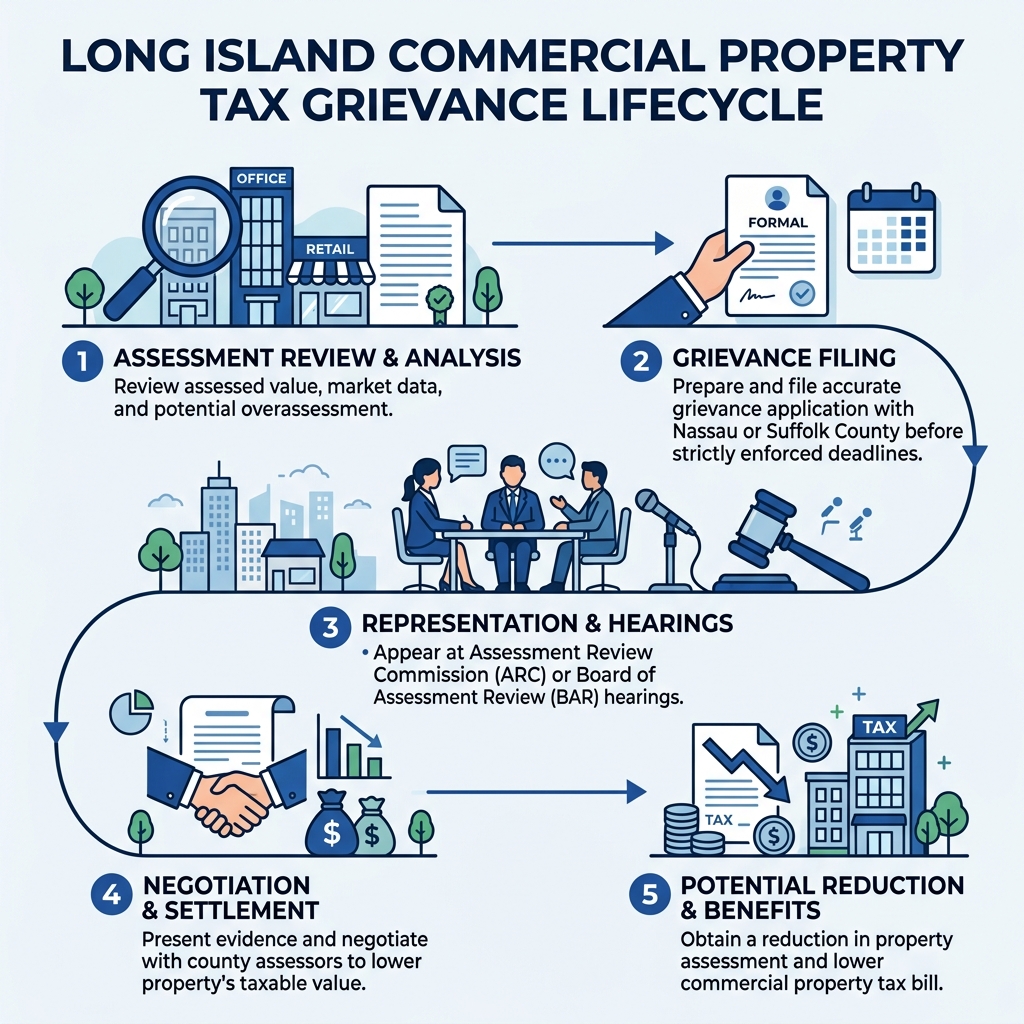
The Step-by-Step Commercial Tax Appeal Process
The road to a lower tax bill is a marathon, not a sprint. It involves multiple levels of government and rigorous documentation.
- Analysis and Filing: We start by reviewing your Commercial Info and financial records. Once we determine you are overassessed, we file the formal grievance before the deadline.
- Administrative Review: In Nassau, this goes to the Assessment Review Commission (ARC). In Suffolk, it’s the Board of Assessment Review (BAR).
- Evidentiary Documentation: This is where we shine. We prepare a comprehensive package that includes:
- Certified appraisals
- Three years of I&E statements
- Current rent rolls
- Photographs of deferred maintenance
- Negotiation: Most cases are settled here. We meet with county representatives to present our case. Our long-standing relationships in Nassau and Suffolk jurisdictions allow for professional, fact-based negotiations.
- Litigation Support: If the county refuses a fair settlement, we don’t back down. We move the case to a “Small Claims Assessment Review” (SCAR) for smaller commercial properties or an Article 7 tax certiorari proceeding in New York State Supreme Court for larger assets.
Selecting a Commercial Property Tax Consultant for Your Business
Choosing the right partner is the difference between a 2% reduction and a 20% reduction. You want a firm that knows the local streets of Miller Place and Massapequa as well as they know the tax code.
Qualifications and Local Expertise
Look for a consultant with a proven track record in New York. While some national firms handle multi-state portfolios, they often lack the “boots on the ground” knowledge of Long Island’s unique tax landscape. At Heller Tax, we’ve saved over $160 million for our clients because we understand the specific nuances of the Nassau and Suffolk County assessors.
Technology and Compliance
The best consultants use modern tools for deadline tracking and data integration. Whether you own a single storefront in Syosset or a portfolio of industrial buildings across Deer Park and Farmingdale, our reporting software ensures you are always in the loop. We provide audit defense and ensure that all personal property filings and Nassau and Suffolk County real estate appeals are handled with precision.
Frequently Asked Questions about Commercial Property Taxes
How are commercial property taxes calculated on Long Island?
They are calculated by multiplying your property’s assessed value by the county or town tax rate (the mill rate). The assessed value is usually a percentage of the “fair market value.” Because commercial properties generate income, the county focuses heavily on your potential rental revenue to determine that value.
What is the “You Don’t Pay Unless You Save” model?
This is our commitment to you. We work on a contingency fee basis. This means we take on all the upfront costs of filing, researching, and negotiating. If we don’t succeed in lowering your property tax assessment, you owe us absolutely nothing. It is a risk-free way to ensure you aren’t overpaying.
Can I appeal my commercial assessment every year?
Yes! In fact, we recommend an annual review. Market conditions change, building conditions change, and tax laws evolve. A property that was fairly assessed last year might be overassessed this year due to local economic shifts.
Conclusion
At Heller Tax Grievance, our mission is simple: we protect your bottom line. We have spent decades mastering the tax grievance process in Nassau County and Suffolk County, achieving some of the largest tax reductions in the region. With over $160 million saved for our clients, we have the experience and the local relationships to get results.
Don’t let an unfair tax bill drain your business’s resources. Whether your property is in Upper Brookville or Rocky Point, we are ready to fight for you.