
Understanding the Suffolk County Property Tax System and Grievance Deadlines
To grieve taxes in Suffolk County, you must complete New York State Form RP-524 (Complaint on Real Property Assessment), gather supporting evidence such as recent comparable sales or an appraisal, and submit your application directly to your local town assessor by the third Tuesday in May. Under New York Real Property Tax Law (RPTL) §512, property owners are granted the legal right to challenge their tentative assessment every year.
Unlike neighboring Nassau County, which handles tax grievances centrally through an Assessment Review Commission, Suffolk County delegates all assessing authority directly to its 10 individual townships. That means there is no central “Suffolk County Tax Assessor.” Instead, your assessment is determined and reviewed entirely at the town level.
Every year, the official Suffolk County Property Tax Grievance Season opens on May 1 when towns publish their tentative assessment roll. The legal filing deadline across all Suffolk townships is strictly set by state law as the third Tuesday in May (which is May 18, 2027, for the 2027/2028 tax cycle and will be May 16, 2028, for the following year).
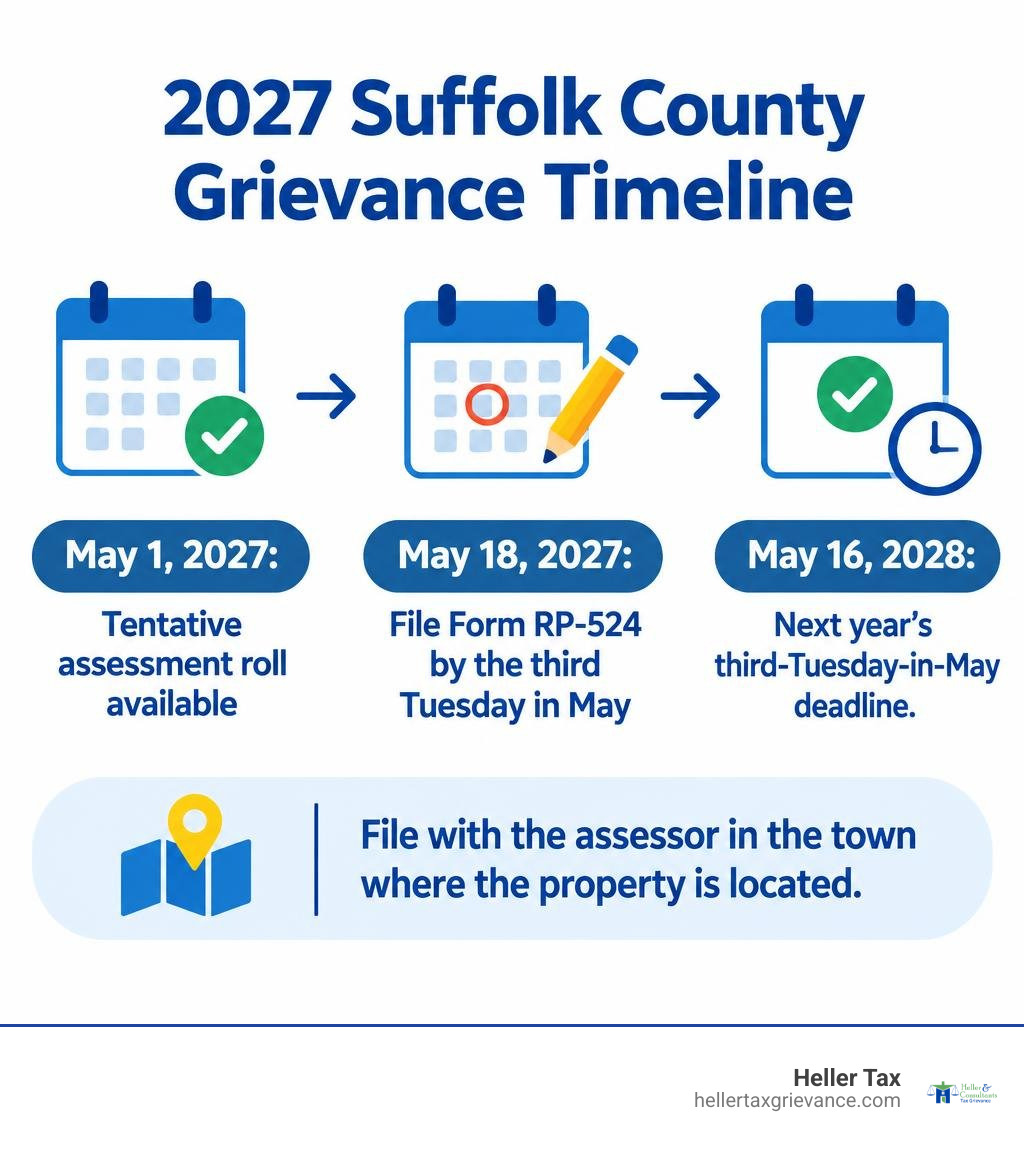
Because this date is statutory, town assessors and Boards of Assessment Review (BAR) have zero legal authority to grant extensions, accept late filings, or waive deadlines for personal emergencies.
Understanding How to Grieve Taxes in Suffolk County: Assessing Value vs. Market Value
To know whether you should challenge your valuation, you must understand the difference between your home’s market value and its assessed value.
- Market Value: What your home would realistically sell for in an arm’s-length transaction in today’s real estate market.
- Assessed Value: The valuation placed on your property by the town tax assessor to calculate your share of municipal, county, and school taxes.
- Level of Assessment (LOA) / Equalization Rate: The percentage of full market value at which properties in your town are assessed.
In Suffolk County, towns assess at fractional rates rather than 100% full market value. For example, a town might establish a uniform Level of Assessment of 0.10% or 1.00%. To determine your home’s implied market value according to the town, divide your total assessed value by the municipality’s Equalization Rate or Residential Assessment Ratio (RAR).
If your property’s implied market value is higher than what recent, comparable homes in your immediate neighborhood are actually selling for, you think you are over assessed and have solid grounds to file a grievance.
Navigating the 10 Suffolk County Town Assessors and Jurisdictions
Because assessments are decentralized, you must file your grievance directly with the town assessor’s office in the township where your real estate is physically situated. The 10 Suffolk County towns are:
- Town of Babylon: (631) 957-3014
- Town of Brookhaven: (631) 451-6300
- Town of Huntington: (631) 351-3226
- Town of Islip: (631) 224-5585
- Town of Smithtown: (631) 360-7560
- Town of Riverhead: (631) 727-3200
- Town of Southampton: (631) 283-6020
- Town of East Hampton: (631) 324-4187
- Town of Southold: (631) 765-1937
- Town of Shelter Island: (631) 749-1080
Whether you live in Stony Brook, Deer Park, Rocky Point, or Miller Place, you can review our full directory of Suffolk County Tax Grievance Cities We Service to confirm which municipal office manages your parcel.
Step-by-Step Guide: How to Grieve Taxes in Suffolk County Using Form RP-524
Challenging your assessment on your own requires submitting New York State Form RP-524 (Complaint on Real Property Assessment). Following official Grievance procedures ensures your application is processed without administrative rejection.
How to Grieve Taxes in Suffolk County: Gathering Evidence and Comparable Sales
The burden of proof falls entirely on the property owner. You must provide clear evidence demonstrating that your property is over-assessed relative to the local market.
Effective evidence includes:
- Recent Comparable Sales (“Comps”): Identify 3 to 5 recent sales of similar homes in your immediate neighborhood. Look for properties with similar square footage, lot size, architectural style, bedroom/bathroom counts, and general condition that sold within the past 12 months.
- Professional Appraisal Reports: A formal appraisal conducted by a licensed New York real estate appraiser carries substantial weight before the review board.
- Recent Arm’s-Length Purchase Contracts: If you purchased your property within the past calendar year, your closing disclosure and purchase contract serve as strong proof of fair market value.
- Photographic Evidence of Property Defects: Significant structural issues, severe water damage, deferred maintenance, or proximity to external nuisances (such as commercial properties or high-traffic roadways) can lower your property’s actual market value.
Completing Form RP-524 Section by Section
When filling out Form RP-524, accuracy is vital:
- Part One (General Information): Enter your contact details, property location, and exact Tax Map ID (Section, Block, and Lot number), which you can find on your latest tax bill.
- Part Two (Value of Property): State the current assessed value listed on the town’s tentative roll, your estimate of the property’s true full market value, and your requested assessed value.
- Part Three (Grounds for Complaint): Select the legal grounds for your grievance. Most residential cases claim Unequal Assessment (the property is assessed at a higher percentage of value than the average of all other properties in the town) or Excessive Assessment (the assessed value exceeds the full market value multiplied by the town’s LOA).
- Part Four (Representative Authorization): If you designate a professional representative or firm to act on your behalf, complete and sign this authorization section.
- Part Six (Stipulation): Allows you or your representative to sign an agreed-upon reduction directly with the assessor prior to Grievance Day if a mutual valuation is reached.
For a comprehensive walkthrough of the entire filing strategy, read the Long Island homeowners guide to grieving your assessment.
The Aftermath: Board of Assessment Review (BAR) Decisions and SCAR Appeals
Once Form RP-524 is submitted on or before the third Tuesday in May, your town’s Board of Assessment Review (BAR)—an independent panel of 3 to 5 local residents appointed by the town board—evaluates your complaint.
The BAR issues formal written determination notices between late June and mid-July. If your grievance is granted, your assessment is lowered on the town’s final assessment roll published in late summer. However, because town boards face tight administrative deadlines and review thousands of complaints, initial administrative applications are frequently denied or granted only minimal reductions.
If you receive a denial, you still have powerful legal recourse through a Suffolk property tax grievance appeal.
Filing a Small Claims Assessment Review (SCAR) Appeal
If the BAR denies your initial application or provides an unsatisfactory reduction, owner-occupants of one-, two-, or three-family residential properties can file for a Small Claims Assessment Review (SCAR) in New York State Supreme Court.
Key steps for a SCAR appeal:
- Filing Window: You must file your SCAR petition within 30 days of the town filing its final assessment roll (typically throughout July and August, though some towns like Huntington operate on a slightly shifted timeline).
- Court Fee: A state-mandated $30 filing fee must accompany the petition.
- Pre-Hearing Settlement Conferences: Many Suffolk townships schedule informal settlement conferences with town attorneys and assessors before a hearing takes place, frequently resolving cases through negotiated assessment reductions.
- Hearing Officer Review: If an agreement is not reached during conference, an impartial, state-appointed Judicial Hearing Officer hears your evidence and determines whether your assessment should be reduced.
DIY Filing vs. Professional Contingency Representation
Homeowners often wonder whether they should handle the grievance and court appeals themselves or hire professional representation.
| Consideration | DIY Grievance Filing | Professional Representation (Heller Tax Grievance) |
|---|---|---|
| Upfront Cost | $0 for RP-524; $30 for SCAR filing fee | $0 Upfront (100% contingency-based) |
| Time & Effort | Extensive (sourcing comps, compiling evidence, completing forms, attending hearings) | Minimal (apply in minutes; we handle evidence, filings, and court appearances) |
| Evidence Preparation | Homeowner must source and analyze neighborhood comps manually | Advanced proprietary sales databases and professional valuation analysis |
| Appeals & Court Attendance | Homeowner must file SCAR petition and represent themselves before hearing officers | Full representation at town settlement conferences and Supreme Court SCAR hearings |
| Fee Structure | Keep 100% of savings | 50% of first-year savings only if successful; No reduction = No fee |
If you are not sure how to get a property tax reduction in Suffolk County, working with a dedicated firm ensures you do not miss strict deadlines or undervalue your potential reduction.
Integrating Property Tax Exemptions and Managing Payment Deadlines
Filing an assessment grievance is just one component of managing your overall property tax burden. Staying aware of your annual property tax billing schedule and available exemptions helps maximize your total savings.
In Suffolk County, real property taxes are billed annually and payable in two equal installments:
- First Installment Due: December 1 (payable without penalty through January 10).
- Second Installment Due: May 10 (payable without penalty through May 31).
Missing these payment windows triggers a progressive monthly penalty scale starting at 1% in January and climbing to 5% by May 31. Unpaid taxes after May 31 become officially delinquent, incur an additional 5% statutory penalty, and transfer from your local Town Receiver of Taxes to the Suffolk County Comptroller’s Office for collection.
To ensure your annual tax obligations remain organized alongside your grievance schedule, keep track of the Suffolk County tax grievance legal filing deadline for all townships.
Basic STAR, Enhanced STAR, and Alternative Tax Exemptions
Property tax exemptions reduce your taxable assessed value independently of a tax grievance. You can safely grieve your property taxes while maintaining all of your exemptions:
- Basic STAR: Available to owner-occupied primary residences where the combined household income is $500,000 or less.
- Enhanced STAR: Available to qualifying seniors aged 65 and older. For 2027, confirm the current household-income eligibility requirements with the New York State Department of Taxation and Finance before filing.
- Veterans’ Exemptions: Offers alternative assessment reductions for wartime service (15%), combat zone deployment (additional 10%), and service-connected disability ratings.
- Senior Citizens / Limited Income Disability Exemptions: Provides up to a 50% reduction on assessed valuation for qualified low-income seniors and individuals with disabilities.
- Volunteer Firefighter & Ambulance Worker Exemption: Offers up to a 10% assessment reduction for eligible emergency service volunteers.
Most exemption applications must be filed with your local town assessor by the taxable status date (March 1 in most Suffolk towns). For a closer look at how these programs operate together, review our guide on understanding property tax grievance process.
What to Do If You Missed the Grievance Deadline
Because Suffolk County’s grievance deadline is governed strictly by state statute, missing the third Tuesday in May means you cannot challenge your assessment for the current tax roll.
If you missed the window:
- Audit Your Current Assessment: Compare your property’s implied market value against three recent sales of similar homes in your neighborhood.
- Apply for Eligible Exemptions: Check with your town assessor to confirm that all STAR, Senior, or Veterans’ exemptions are applied to your parcel.
- Prepare for the Next Cycle: The next grievance window will open on May 1, 2027, closing on May 18, 2027. You can start assembling your comparable sales, appraisal records, and property condition photos ahead of time so your case is ready to file on day one.
Frequently Asked Questions about Suffolk County Property Taxes
Can filing a property tax grievance in Suffolk County increase my taxes?
No. Under New York State law, the Board of Assessment Review and the courts are strictly prohibited from increasing your property assessment in response to a grievance filing. The outcome of a property tax grievance can only be a reduction in your assessed value or no change at all. Filing carries zero downside risk.
How much money can I save by grieving my property taxes in Suffolk County?
Suffolk County homeowners who successfully grieve their assessment achieve average savings of $1,500 per year, with some reductions reaching substantially higher amounts depending on the degree of over-assessment. Because an assessment reduction lowers your baseline property valuation, your savings compound year after year. A lower property tax bill also improves home marketability and resale value.
Do I need to let an assessor inspect the inside of my home during a grievance?
No. You are not required to let town assessors or review board members inspect the interior of your home as part of a standard property tax grievance. Valuations and reductions are established using exterior property records, public square footage databases, and verifiable market sales data.
Conclusion
Managing property taxes on Long Island requires vigilance. With median property tax bills in Suffolk County among the highest in the country, accepting an inaccurate assessment means overpaying by thousands of dollars over time.
At Heller Tax Grievance, we have helped over 100,000 Long Island homeowners successfully challenge their valuations, recovering more than $160 million in property tax savings. We operate on a clear “You Don’t Pay Unless You Save” guarantee—if your assessment is not reduced, you owe us nothing.
To review our complete breakdown of local assessment formulas, town tax rates, and filing strategies, explore our complete guide to property taxes in Suffolk County. Apply online today to secure the maximum property tax reduction allowed by law.