
Is Your Nassau County Property Assessment Too High?
Nassau County assessment review is the formal process that lets property owners challenge their assessed value — and potentially lower their tax bills.
Here’s a quick overview of how it works:
| Step | What You Do | Deadline |
|---|---|---|
| 1. Check your assessment | Compare to market value | January 2, 2027 |
| 2. File a grievance | Submit via AROW online, mail, or in person | March 1, 2027 (extended) |
| 3. ARC reviews your case | Independent commission decides | After filing period |
| 4. If denied, appeal further | File a SCAR petition in court | After ARC decision |
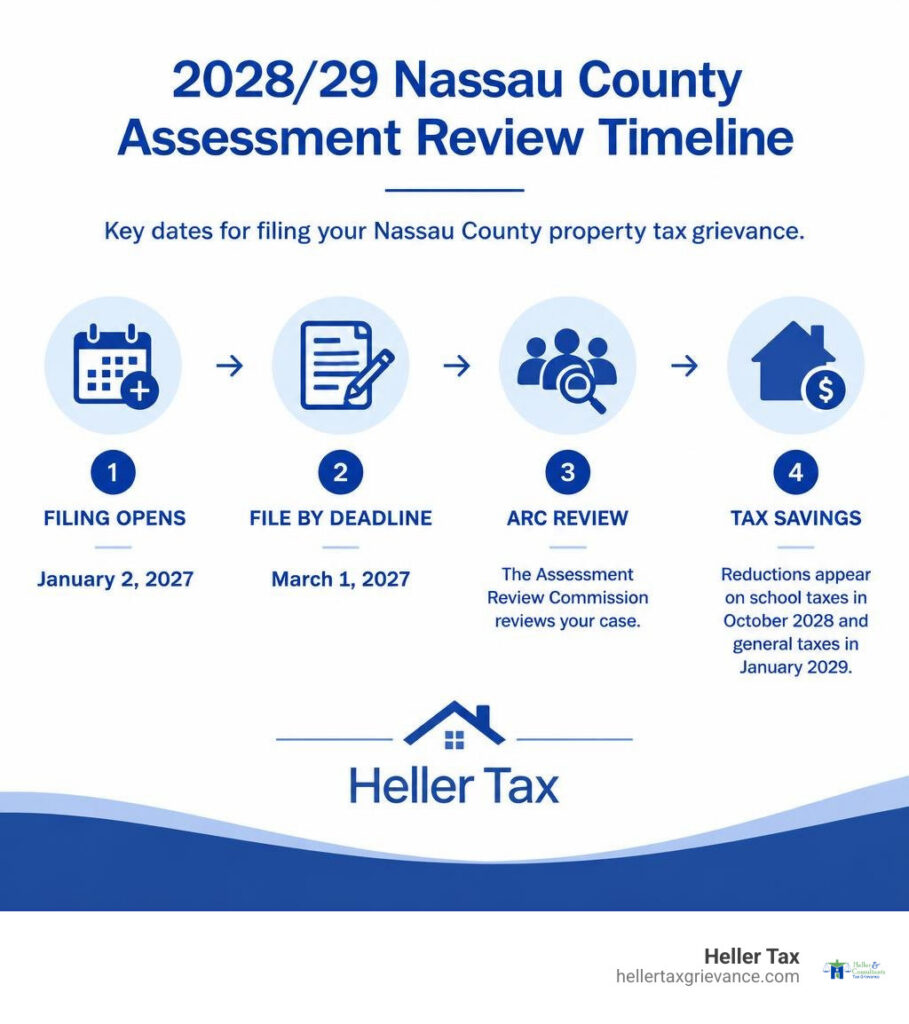
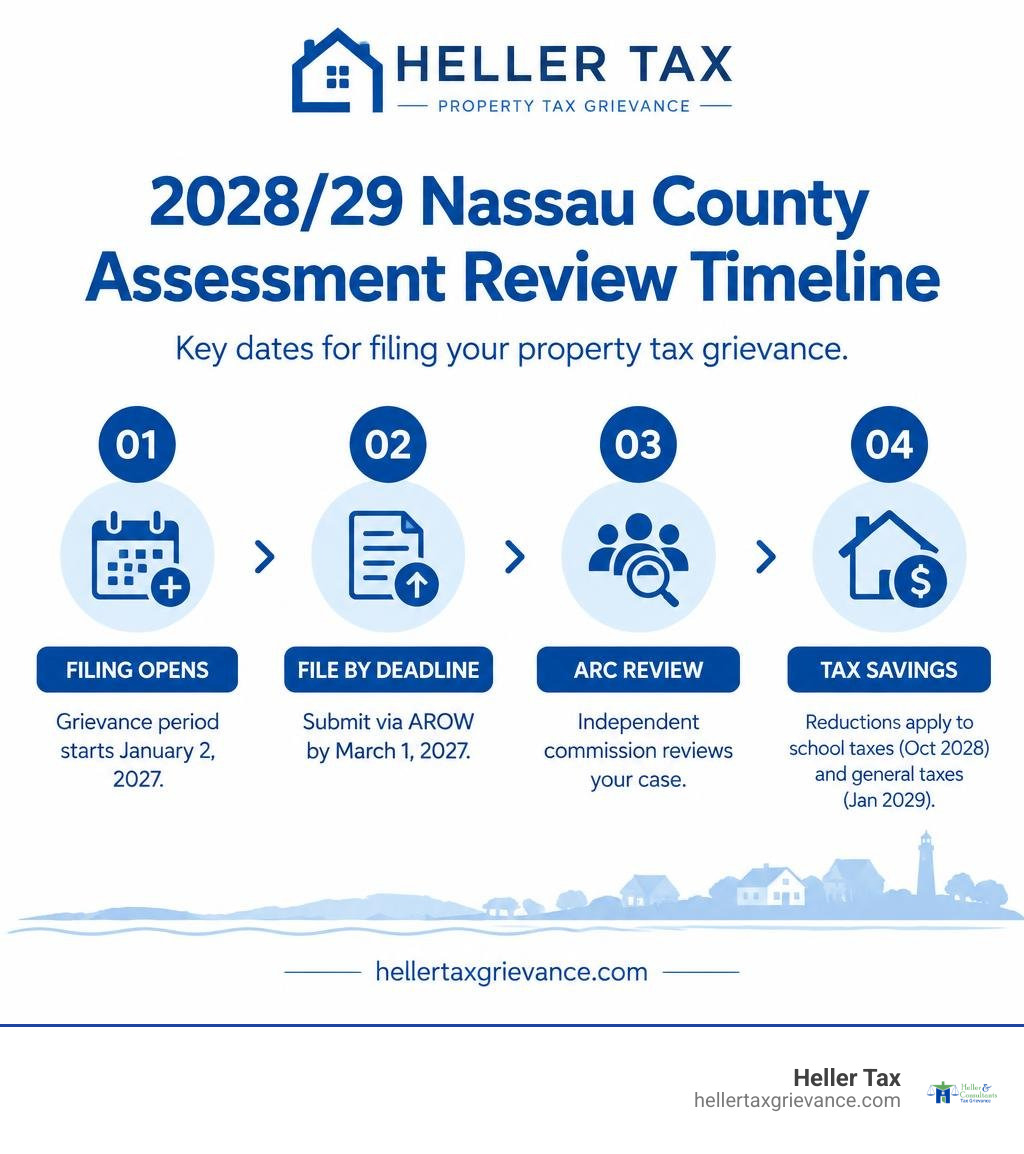
If you file by March 1, 2027, you are challenging your 2028/29 assessment — meaning the tax savings will show up in your school tax bill in October 2028 and your general tax bill in January 2029.
Every year, Nassau County homeowners overpay on property taxes simply because they don’t know they can fight back. The assessment on your property may not reflect what your home is actually worth in today’s market — and the county’s process exists specifically to correct that.
The good news? Filing a grievance costs you nothing, carries no risk of raising your taxes, and could result in real, lasting savings.
I’m Adam Heller, founder of Heller Tax Grievance, and I’ve spent nearly two decades helping Long Island homeowners navigate the Nassau County assessment review process — recovering record-breaking reductions for thousands of property owners across the county. In this guide, I’ll walk you through everything you need to know to challenge your assessment effectively.
Simple Nassau County assessment review word guide:
- Brookville property tax grievance
- Old Westbury property tax grievance
- Oyster Bay property tax grievance
Understanding the Nassau County Assessment Review Commission (ARC)
When you decide to challenge your property taxes, you aren’t dealing with the same people who set your home’s value in the first place. The Assessment Review Commission (ARC) is an independent, quasi-judicial agency. Its primary role is to act as a neutral third party that reviews applications for the correction of assessments.
It is important to distinguish between the Department of Assessment and the ARC. The Department of Assessment is responsible for creating the “tentative roll”—the list of what they think every house in Nassau County is worth. The ARC, on the other hand, is there to listen to your side of the story. They have the power to lower those valuations if you can prove they are excessive or incorrect.
This independent structure is designed to ensure fairness. Because the ARC is separate from the department that sets the values, they can provide objective assessment corrections that lead to substantial taxpayer savings. For many homeowners, this commission is the first and most vital line of defense against rising tax burdens.
The 2028/289 Nassau County Assessment Review Calendar and Deadlines
In Nassau County, timing is everything. The property tax calendar operates on a significant “lag,” which can be confusing for many residents. To understand why we are filing now, we have to look at the Nassau annual property assessments timeline.
For the upcoming 2028/29 tax year, the grievance filing period officially opens on January 2, 2027. While the statutory deadline is usually March 1, Nassau County has historically extended this window.
Why such an early deadline for a tax year that sounds so far away? It is because of the two-year lag in the Nassau system:
- January 2, 2027: The tentative assessment roll for 2028/29 is published.
- March 1, 2027: This is the final day to file your grievance to challenge that roll.
- October 2028: If successful, your reduction first appears on your School Tax Bill.
- January 2029: Your reduction then appears on your General (Town/County) Tax Bill.
Missing the March 1 deadline is a big deal. If you don’t get your application in by then, you lose your legal right to contest your assessment for that entire tax year. You would have to wait until the next January to try again, effectively locking in your higher taxes for another twelve months.
How to Challenge Your Property Valuation Successfully
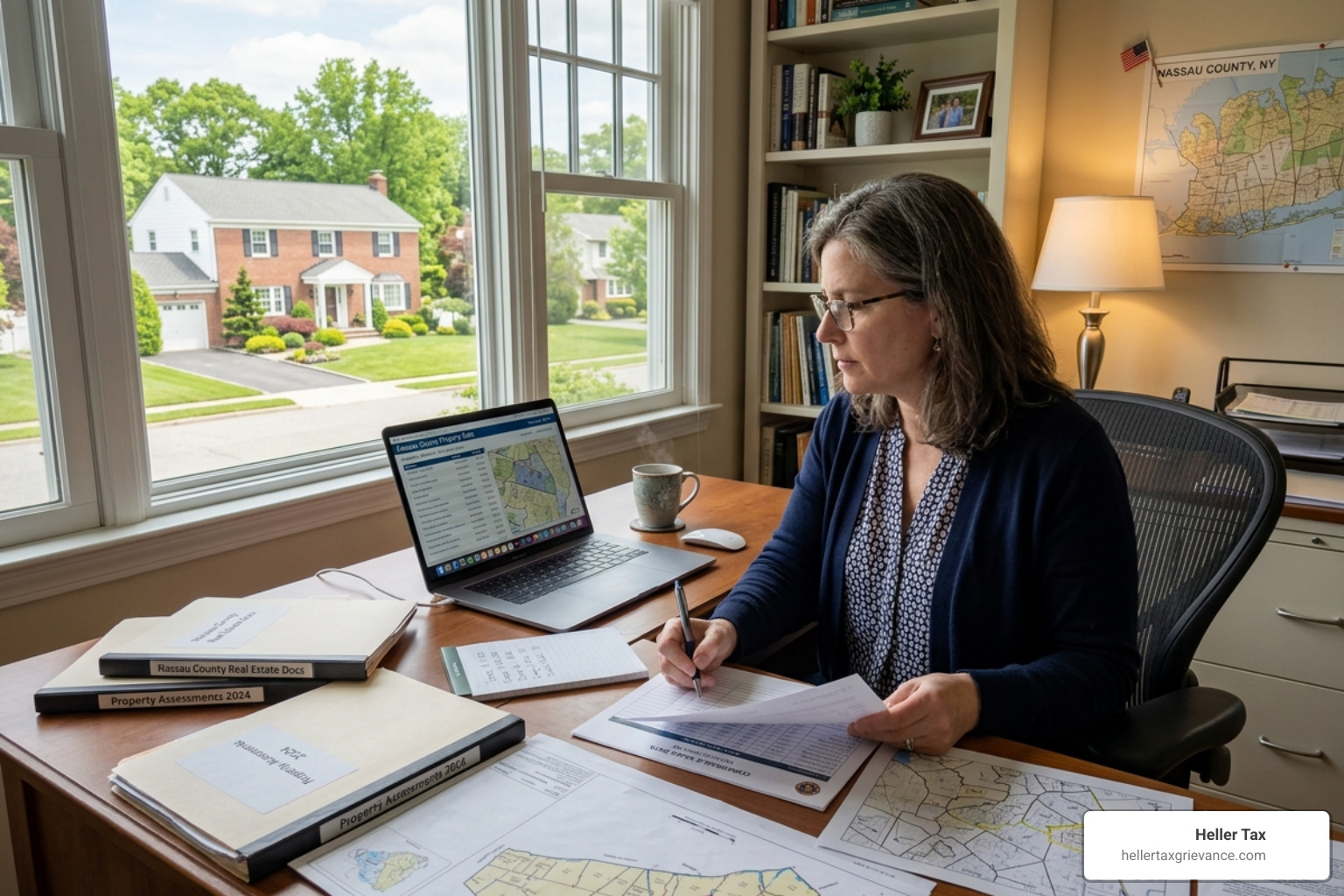
Successfully winning a Nassau County assessment review requires more than just a feeling that your taxes are too high. You need evidence. The most common way to win is by proving that your home’s “Fair Market Value,” as determined by the county, is higher than what the house would actually sell for.
To do this, you generally need to look at comparable sales. These are homes similar to yours in size, style, and location that have sold recently. If three houses on your block just like yours sold for $600,000, but the county says your market value is $750,000, you have a very strong case for a reduction.
When you receive your Nassau County NY assessment disclosure notice, don’t take the numbers at face value. Review the property data the county has on file. Sometimes they have the wrong number of bathrooms or incorrect square footage, which can artificially inflate your value.
What if ARC Denies Your Claim?
If the ARC does not grant a reduction, or if the reduction they offer isn’t enough, you haven’t reached the end of the road. The next step is the Small Claims Assessment Review (SCAR). This is a court-level appeal where a hearing officer reviews your case. There is a $30 court filing fee for an index number, but this is often where the most significant reductions are won.
Pro-Se vs. Professional Representation
You are allowed to file a grievance yourself (known as filing “pro-se”). However, statistics show that homeowners who use professional representation often see much better results.
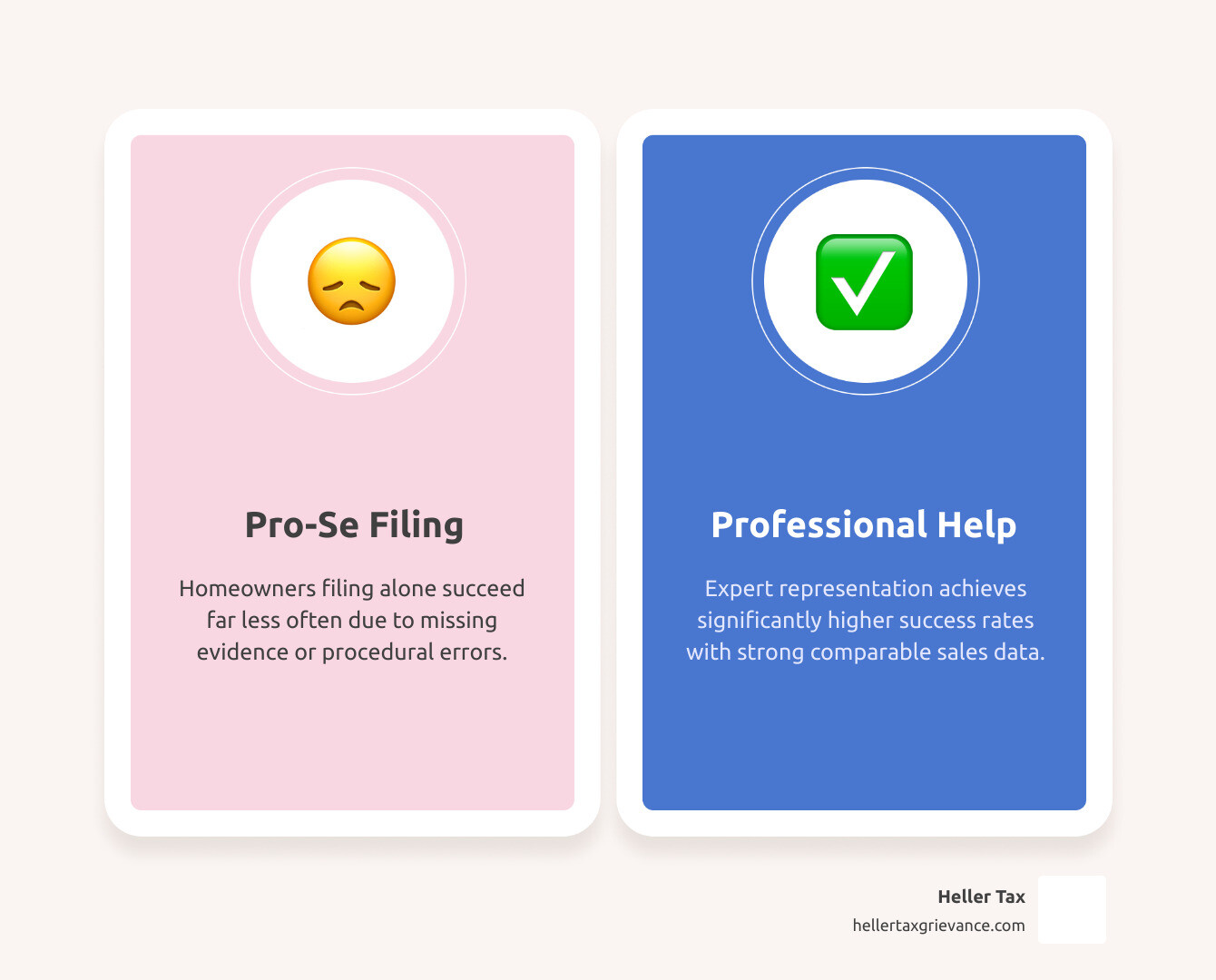
| Filing Type | Success Rate (Approx.) | Risk of Defective Filing |
|---|---|---|
| Pro-Se (Self-Filed) | Significantly Lower | High |
| Professional (Heller Tax) | Significantly Higher | Very Low |
Professionals have access to advanced software and databases to find the best “comps” (comparable sales) and understand the complex rules of procedure that the ARC and SCAR hearing officers follow.
Step-by-Step: Filing Your Nassau County Assessment Review via AROW
The county has made the filing process more accessible through the AROW (Assessment Review on the Web) system. This portal allows for electronic filing, which is the fastest way to ensure your grievance is received.
- Visit the AROW Portal: Go to the official Nassau County ARC website.
- Property Lookup: Search for your property using your address or Section, Block, and Lot (SBL) number.
- Review Data: Check the “Fair Market Value” the county has assigned to you.
- Complete Form AR1: This is the official Application for Correction of Assessment. You will need to provide your contact information and the reason you believe the assessment is wrong.
- Submit Evidence: You can upload comparable sales data directly through the system.
- Instant Confirmation: Once submitted, the AROW system provides a confirmation number. Keep this for your records!
Debunking Myths About the Nassau County Assessment Review Process
There are several myths about the Nassau County property tax grievance process that prevent homeowners from filing. Let’s clear those up:
- Myth #1: My taxes will go up if I file. This is the most common fear, and it is 100% false. The ARC does not have the authority to increase your assessment because you filed a grievance. The worst-case scenario is that your assessment stays the same.
- Myth #2: The Fair Market Value is always right. The county uses mass appraisal techniques. They aren’t coming inside your home to see that your kitchen hasn’t been updated since 1970 or that your basement has water issues. These factors affect your property taxes and are great reasons to grieve.
- Myth #3: I can’t file if I live in a village. Every property owner in Nassau County has the right to challenge their assessment through the county’s review process. Regardless of your specific village or town, you can file a grievance to lower the assessment used for your school and general tax bills.
- Myth #4: I already filed last year, so I don’t need to file again. Assessments change every year. To ensure you are always paying your fair share—and not a penny more—you should file a grievance every single year.
Frequently Asked Questions about Nassau County Assessments
What happens if I miss the March 1, 2027 deadline?
If you miss the deadline, you have unfortunately forfeited your right to challenge your 2028/29 taxes. There are no “late filings” accepted by the ARC. You will have to wait until the next filing window opens on January 2, 2027, to challenge the following year’s taxes. This is why we always tell our clients in Nassau and Suffolk County to get their paperwork in early.
Which tax bills are affected by the current grievance filing?
The grievance you file by March 1, 2027, is for the 2028/29 tax roll. Because of how the reassessment affects you, this filing will impact:
- School Tax Bill: Mailed in October 2028.
- General Tax Bill: Mailed in January 2029.
Can filing a grievance increase my property taxes?
No. There is absolutely no penalty for filing. Filing a grievance is a protected right for every property owner in New York State. Whether you win a reduction or the ARC denies your claim, your tax grievance process cannot result in an assessment increase.
Conclusion
Navigating the Nassau County assessment review can feel overwhelming, but it is one of the most effective ways to protect your finances. Whether you live in Massapequa, Syosset, or Farmingdale, you deserve to pay a tax bill that is based on the true market value of your home—not an inflated estimate from the county.
At Heller Tax Grievance, we make the process completely stress-free. We handle everything from the initial filing through the ARC review and, if necessary, the SCAR hearing in court. Best of all, we offer a “You Don’t Pay Unless You Save” guarantee. We have saved Long Island homeowners over $160 million, and we would love to help you next.
Don’t let the March 1, 2027 deadline pass you by. Take the first step toward lower property taxes today by visiting our Property Tax Grievance Nassau Complete Guide and letting our experts fight for the reduction you deserve.