
Understanding the Tax Appraisal Appeal and Why Property Owners File
To successfully navigate a tax appraisal appeal, property owners must verify assessment notice deadlines, compile supporting market evidence (such as recent comparable sales and independent appraisals), submit official grievance petitions, and present their case before an administrative review board. A property tax appeal (often referred to as a tax grievance) is an administrative proceeding where a homeowner challenges the taxable valuation established by local government assessors. Local assessing jurisdictions do not inspect every single home individually each year. Instead, they rely on computer-assisted mass appraisal modeling to generate values for tens of thousands of parcels at once.
This broad-brush approach frequently produces discrepancies between a home’s statutory assessed value and its true fair market value. If the municipality overestimates what your home is worth—or applies an incorrect equalization rate to your property class—your baseline tax liability becomes artificially inflated. By understanding property tax grievance process fundamentals, property owners can identify assessment discrepancies and formally request an administrative correction to lower their overall tax burden.
Common Valuation Errors and Reasons to Appeal
Municipal assessment records are prone to clerical and factual mistakes. When you request and inspect your official Property Record Card from the county or town assessor, look for specific inaccuracies that distort your valuation:
- Clerical and Inventory Inaccuracies: The assessor’s file might list four bedrooms and three full bathrooms when your home actually has three bedrooms and one-and-a-half baths.
- Incorrect Square Footage: Finished basements, unheated porches, or detached sheds are sometimes erroneously counted as primary above-ground heated living space.
- Unrecorded Structural Defects: Mass appraisal algorithms assume properties are in average or good condition. They cannot account for hidden foundation cracks, severe roof leaks, outdated electrical infrastructure, or termite damage unless you present physical proof.
- Excessive Assessment Jumps: If your assessed valuation increases dramatically from one tax roll to the next without any physical renovations, your assessment may be unequal compared to neighboring parcels. Learning how property is assessed & tax grievance works gives you the framework to identify whether your assessment is equitable relative to actual market transactions.
Informal vs. Formal Appeal Procedures
Depending on the jurisdiction, challenging an assessment involves navigating different administrative levels:
| Feature | Informal Assessor Review | Formal Board / Judicial Hearing |
|---|---|---|
| Primary Forum | Local Assessor’s Office / Assessment Review Commission | Board of Assessment Review (BAR) / Assessment Appeals Board / Small Claims Court |
| Format | Administrative review, telephone conference, or brief office meeting | Formal submission, evidentiary hearing, or judicial proceeding |
| Burden of Proof | Informal review of property characteristics and obvious errors | Documented evidence, certified appraisals, and comparable sales analysis |
| Binding Authority | Assessor can agree to an administrative reduction or stipulation | Independent board or hearing officer issues a legally binding determination |
In an informal process, a property owner or their designated representative meets directly with assessing staff to present corrected inventory data or obvious clerical errors. If the assessor refuses to adjust the valuation, the dispute advances to formal administrative review before independent bodies, such as the Board of Assessment Review (BAR) or County Board of Equalization. In formal proceedings, structured petition forms—such as the standard forms referenced by regulatory bodies like the Nevada State Board of Equalization—require clear factual statements, verified property identification numbers, and documented market comparables.
The Step-by-Step Guide to Filing a Tax Appraisal Appeal
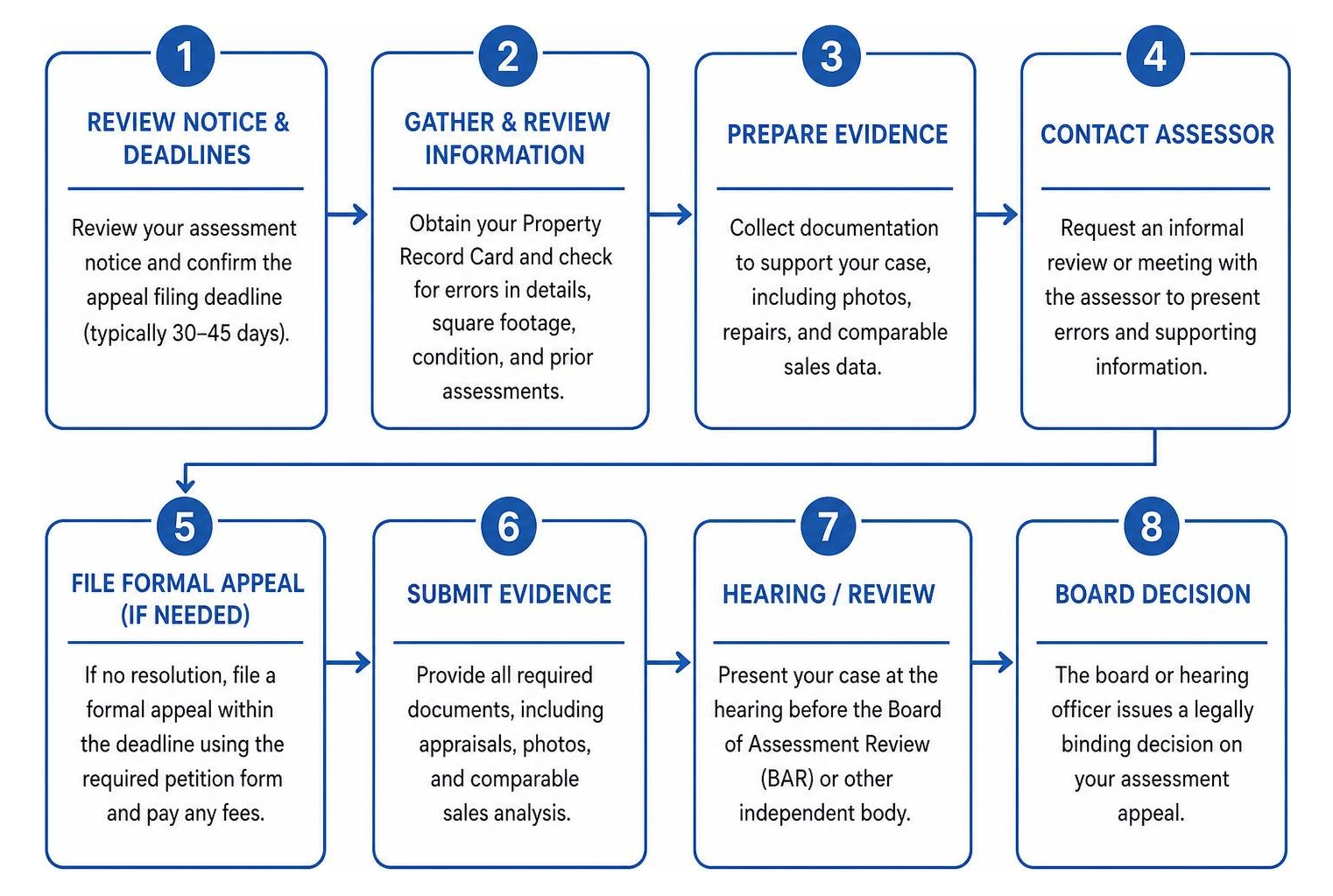
Successfully challenging a valuation requires strict adherence to administrative filing procedures. A procedural error or a missed deadline will result in an automatic dismissal of your petition for that tax year. Understanding The Tax Grievance Process and How It Works and reviewing official state Grievance procedures will help keep your filing compliant at every stage.
Step 1: Review Your Assessment Notice and Verify Filing Deadlines
The appeal process begins when the municipality publishes its tentative assessment roll and issues valuation notices. Property owners typically have a narrow statutory window of 30 to 45 days to file an appeal.
You must align your appeal with the local tax grievance calendar:
- Nassau County: The formal annual appeal window opens when the tentative assessment roll is published on January 2 and closes on the statutory deadline of March 1. Homeowners file their challenges through the Nassau County Assessment Review Commission (ARC). Detailed timelines can be reviewed in our Nassau County Property Tax Grievance: A Comprehensive Guide.
- Suffolk County: In most Suffolk County townships, the tentative assessment roll is published on May 1. The official grievance deadline—known as Grievance Day—is statutorily set as the third Tuesday in May (in contrast to the fourth Tuesday in May standard used in many upstate New York communities).
Step 2: Gather Evidence to Support Your Tax Appraisal Appeal
The legal burden of proof rests entirely on the property owner to demonstrate that the assessor’s valuation is incorrect. To build an unassailable evidentiary record, gather:
- Arm’s-Length Comparable Sales: Identify three to five recent sales of properties in your immediate neighborhood that share similar square footage, age, architectural style, and lot size. Exclude foreclosures, bank-owned liquidations, and short sales, as administrative boards generally reject distress transactions.
- Independent Appraisal Reports: A full, interior/exterior appraisal report prepared by a licensed real estate appraiser provides authoritative market support.
- Contractor Repair Estimates: Itemized written estimates from licensed contractors detailing the cost to fix structural issues, foundation settlement, or deteriorated roofing.
- Photographic Documentation: High-resolution, dated photographs illustrating severe deferred maintenance, external obsolescence (e.g., proximity to heavy commercial zones), or internal property defects.
For additional strategies on assembling strong comparative evidence, consult our 15 Pro Tips for Appealing Your Property Tax Assessment.
Step 3: Complete and Submit Official Appeal Petitions
Once your evidence is assembled, complete the designated state or county appeal petition. In many New York jurisdictions, this requires Form RP-524 (Complaint on Real Property Assessment), while Nassau County utilizes its own proprietary ARC filing portal and forms.

Carefully fill out every section, stating your claimed market value, property class, and the precise legal grounds for complaint (e.g., unequal assessment or excessive valuation). Attach your supporting exhibits, comparable sales matrices, and—if an agent represents you—an authorized Letter of Authorization, similar to the representation standards outlined by municipal bodies like the Fairfax County Board of Equalization Assessment Appeals. If you are filing independently for the first time, our guide on How to File a Property Tax Grievance Even If You’ve Never Done It covers standard petition requirements step by step.
Step 4: Present Your Case and Await Results of a Tax Appraisal Appeal
After filing, administrative review begins. In Nassau County, the Assessment Review Commission (ARC) reviews the submission and may issue an initial reduction offer via a formal settlement stipulation. If accepted, the reduced assessment becomes final for that tax year.
If a hearing is required before a local Board of Assessment Review (BAR), the petitioner or their representative presents the factual evidence directly to the board members. As illustrated in the procedural rules of bodies like the Minnesota Tax Court, hearings emphasize concise, factual presentations focusing on sales data, property condition, and valuation methodology. Following the review or hearing, the board mails an official Determination Notice either granting a full reduction, offering a partial reduction, or sustaining the original assessment.
Next Steps: What to Do If Your Appeal Is Denied or Missed
If the Board of Assessment Review or county review commission denies your appeal or offers an inadequate reduction, your administrative remedies are not exhausted.

Owner-occupants of one-, two-, or three-family residential properties have the legal right to file for Small Claims Assessment Review (SCAR). A SCAR petition allows you to present your case before an impartial, state-appointed Judicial Hearing Officer (JHO) in New York State Supreme Court. The filing fee is a nominal $30, and the hearing is relatively informal compared to commercial tax certiorari litigation.
For commercial properties, multi-family apartment complexes, or complex real estate holdings, property owners pursue formal tax certiorari proceedings under Article 7 of the Real Property Tax Law. If you are assessing post-board escalation pathways, explore our overview of appealing your property tax assessment and review the multi-tiered appeal models provided by regulatory frameworks such as the Utah State Tax Commission.
Options for Late Filers and Missed Deadlines
Filing deadlines for property tax grievances are statutory and strictly enforced by local assessing departments. If you miss the primary appeal deadline:
- Clerical and Factual Error Petitions: If your assessment was inflated due to an objective clerical error (e.g., a mathematical typo in square footage or an unbuilt garage listed on the property card), you can file an administrative correction application with the assessor outside the standard grievance window under specific correction of errors legislation.
- Prepare for the Next Cycle: If the dispute involves market valuation rather than a clerical typo, late appeals cannot be filed retroactively. You must prepare your comparable sales and documentation early so you are ready to file the moment the next assessment roll opens.
Filing Costs, DIY Appeals, and Professional Representation
Filing an initial administrative grievance with a local assessor, the Nassau County ARC, or a Suffolk County Board of Assessment Review incurs $0 in municipal filing fees. However, independent appeals carry indirect costs:
- Private Real Estate Appraisals: Professional residential appraisals typically cost between $400 and $800, while commercial property appraisals can exceed several thousand dollars.
- Judicial Filing Fees: Submitting a SCAR petition requires a mandatory $30 court filing fee. In some state-level commissions—such as the tiered fee schedule used by the Nebraska Tax Equalization and Review Commission—statutory appeals require scale-based filing fees ranging from $40 to $85.
- Professional Representation vs. Pro Se: While property owners can file pro se (representing themselves), property tax laws, equalization formulas, and appraisal methodologies are complex.
Heller Tax Grievance represents Long Island homeowners across Nassau and Suffolk counties on a contingency fee model with our “You Don’t Pay Unless You Save” guarantee. There are no upfront retainers or consultation fees; you only pay a fee if we successfully secure an official reduction in your property taxes. Having secured over $160 million in cumulative property tax savings for our clients, our dedicated property tax specialists navigate every deadline, evidentiary filing, and administrative hearing on your behalf. If you are looking to appeal property tax bill charges, professional representation ensures your case is backed by comprehensive market analysis.
Frequently Asked Questions About Property Tax Appeals
How long does a property tax appeal take to resolve?
The lifecycle of an appeal varies by jurisdiction and board workload. In Nassau County, ARC reviews and potential settlement offers unfold over a multi-month period following the March 1 deadline. In Suffolk County, determinations from May Grievance Day filings are generally mailed between July and September. If a case proceeds to Small Claims Assessment Review (SCAR), hearings and final judicial determinations typically take an additional 6 to 12 months. For detailed timelines, review our Property Tax Reassessment FAQ.
Can filing an appeal cause my property taxes to increase?
Under New York State property tax law, filing an administrative grievance for a residential property cannot result in an increase in your assessed valuation for that tax year. The Board of Assessment Review and SCAR hearing officers only have the authority to lower your assessment or sustain the current value. Addressing common misconceptions is detailed further in Demystifying Grievances: A Property Tax FAQ for Homeowners.
What is the difference between fair market value and assessed value?
Fair market value is the estimated price your home would sell for in an open, competitive real estate market between a willing buyer and a willing seller. Assessed value is the statutory baseline figure established by the municipal assessor used to compute your tax liability. In many jurisdictions, assessed value represents only a fractional percentage of true market value, determined by multiplying the market estimate by an official equalization rate or assessment ratio. To learn how to convert these figures to evaluate your home’s equity, consult our guide on Think You Are Over Assessed? How to Determine If You Have a Property Tax Grievance Case in Suffolk County.
Conclusion
Managing your property taxes is an essential part of protecting your home equity. Mass appraisal inaccuracies and shifting market conditions frequently cause assessments to outpace actual home values. By monitoring your annual assessment notice, tracking local filing deadlines, and presenting strong comparative sales evidence, you can secure a fair valuation and lower your property tax bill.
If you prefer to have an experienced team manage the research, filings, and hearings on your behalf, we are here to help. Explore our complete guide for property tax grievances or contact Heller Tax Grievance today to take advantage of our risk-free, performance-based tax reduction service.