

Why It Pays to Know How to Lower Your Tax Bill
Lowering your tax bill is one of the most impactful financial moves you can make — and most people leave real money on the table every single year.
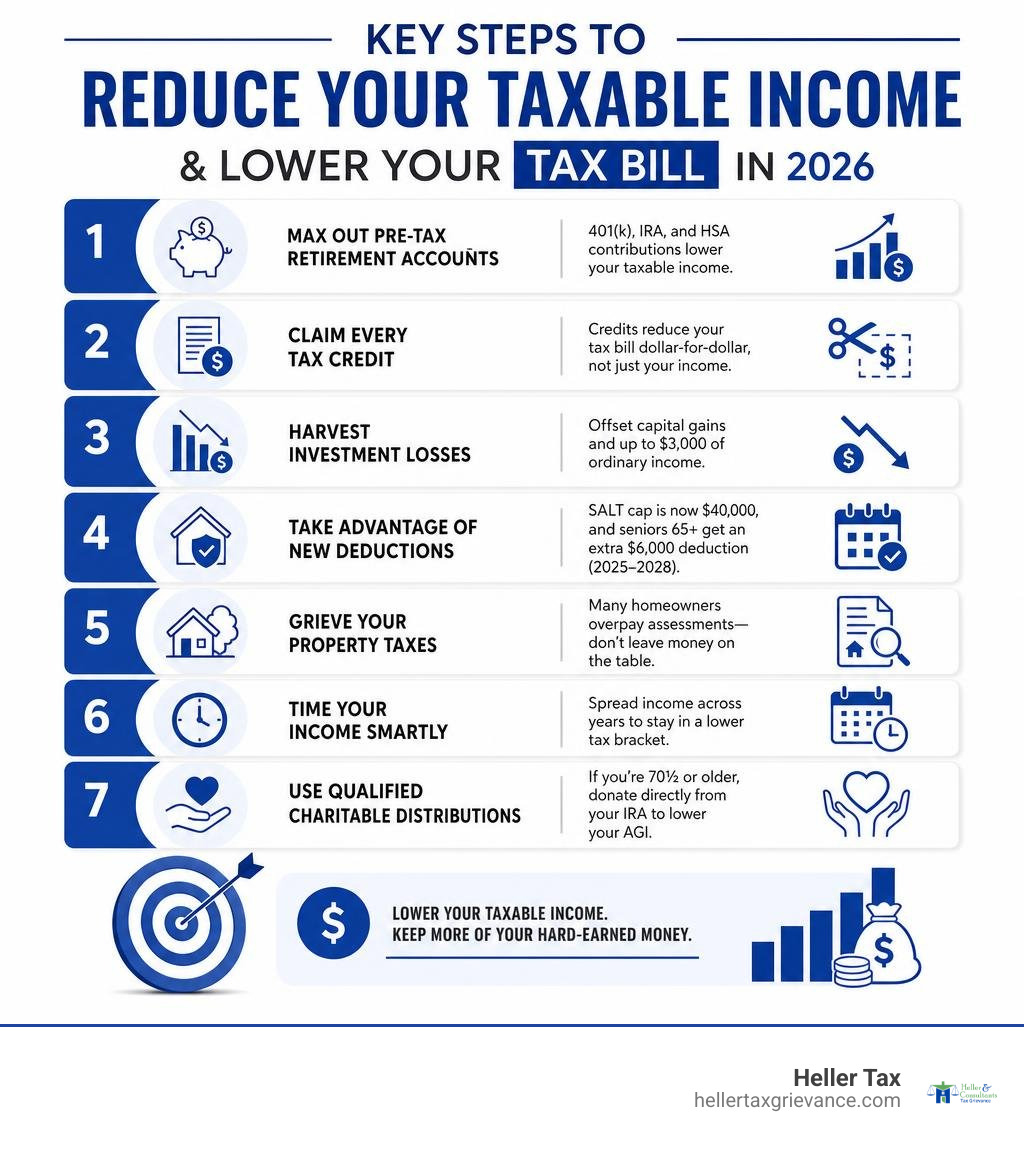
Here are the fastest ways to reduce what you owe:
- Max out pre-tax retirement accounts — 401(k), IRA, and HSA contributions directly reduce your taxable income
- Claim every tax credit you qualify for — credits cut your bill dollar-for-dollar, not just your income
- Harvest investment losses — offset capital gains and up to $3,000 of ordinary income
- Take advantage of new deductions — the SALT cap is now $40,000, and seniors 65+ get an extra $6,000 deduction (2025–2028)
- Grieve your property taxes — Long Island homeowners often overpay assessments and never push back
- Time your income smartly — spreading income across years can keep you out of a higher bracket
- Use Qualified Charitable Distributions — if you’re 70½ or older, donate directly from your IRA to avoid raising your AGI
These strategies work for W-2 employees, self-employed filers, retirees, and property owners alike. The sections below explain each one in plain language.
I’m Adam Heller, founder of Heller Tax, and I’ve spent nearly two decades helping Long Island homeowners find every legal way to lower their tax bill — starting with property tax grievances that have saved clients tens of thousands of dollars in a single year. Whether your burden comes from the IRS or your county assessor, the same principle applies: you should never pay more than your fair share.
Discover more about lower my tax bill:
5 Proven Financial Strategies to Lower My Tax Bill

When taxpayers ask us how to lower my tax bill, we always point to structured, repeatable financial moves first. Minimizing your tax liability does not require risky maneuvers; it simply takes an understanding of how the tax code treats savings, investments, and health costs.
How Pre-Tax Retirement Contributions Lower My Tax Bill
The most effective way to lower your taxable income for the current tax year is to redirect salary into tax-deferred retirement accounts. Every dollar contributed pre-tax effectively subtracts one dollar from your reported gross income on Form 1040.
In 2026, the IRS allows workers to contribute up to $24,500 to workplace 401(k), 403(b), or 457 plans. If you are 50 or older, you can make an additional catch-up contribution of $8,000, bringing your maximum total deferral to $32,500. Under recent legislative changes, workers who turn age 60, 61, 62, or 63 during calendar year 2026 qualify for an enhanced catch-up limit of $11,250, allowing total employee pre-tax contributions up to $35,750.
Traditional Individual Retirement Accounts (IRAs) offer another layer of pre-tax savings. For 2026, the IRA contribution limit is $7,500 for taxpayers under 50, with an additional $1,100 catch-up option for those 50 and older.
By taking advantage of these accounts, you defer federal and state income taxes until retirement, allowing your investments to grow compounded without annual tax drag. For an extensive look at how these contributions shift your tax baseline, see Fidelity’s guide on reducing taxable income.
HSA Contributions and Last-Minute Pre-Filing Actions
Health Savings Accounts (HSAs) remain the single most tax-advantaged vehicle available in the entire tax code because they offer a triple-tax benefit:
- Contributions are 100% pre-tax or tax-deductible.
- Account balances grow tax-free without capital gains taxes.
- Withdrawals spent on qualified medical expenses are completely federal and state income tax-free.
For tax year 2026, individual HDHP coverage allows HSA contributions up to $4,400, while family plans allow up to $8,750. Taxpayers aged 55 and older can contribute an additional $1,000 catch-up amount.
What makes HSAs and IRAs unique is that you don’t have to make all your contributions by December 31. The IRS allows you to make prior-year contributions right up until the official April tax filing deadline.
Here is a quick checklist of last-minute tax moves you can make before filing your return:
- Fund a Traditional IRA: Contribute up to the maximum limit prior to April tax day to retroactively drop your prior year AGI.
- Top Off Your HSA: Make direct, lump-sum tax-deductible contributions into your HSA before the filing deadline.
- Establish or Fund a SEP-IRA: Self-employed taxpayers can establish and fund a Simplified Employee Pension (SEP) IRA right up to their tax filing deadline (including extension deadlines) to deduct up to 25% of net self-employment earnings.
- Review Pre-Tax Commuter Benefits: Ensure all workplace spending for transit and parking was properly routed pre-tax.
Optimizing Deductions, Tax Credits, and Recent Law Changes
To effectively lower my tax bill, you must understand how the IRS measures what you owe after gross income is calculated.
Tax Credits vs. Tax Deductions: Which Saves You More?
A common point of confusion is the distinction between a tax deduction and a tax credit. While both reduce what you owe, they work at entirely different stages of your tax return:
- Tax Deductions: Lower your total taxable income. The actual dollar savings depend on your marginal tax bracket. For instance, if you are in the 24% tax bracket, a $1,000 deduction saves you $240 in federal taxes.
- Tax Credits: Directly subtract dollar-for-dollar from your final tax liability. A $1,000 tax credit reduces your tax bill by exactly $1,000, regardless of your marginal tax bracket.
Furthermore, refundable tax credits (such as portions of the Child Tax Credit or Earned Income Tax Credit) can result in a cash refund check even if your total tax liability is reduced to zero.
| Feature | Tax Deduction | Tax Credit |
|---|---|---|
| Primary Mechanism | Reduces total taxable income | Subtracts directly from calculated tax owed |
| Value Basis | Tied to your marginal tax bracket percentage | Fixed dollar-for-dollar value |
| Typical Example | 401(k) contributions, SALT deduction | Child Tax Credit, Saver’s Credit |
| Refundability | Never directly refundable | Can be refundable (e.g., EITC, CTC) |
Navigating OBBBA Updates: SALT Cap, Senior Deductions, and Charitable Rules
Recent federal legislation, including the One Big Beautiful Bill Act (OBBBA), brought key structural updates to tax calculations:
- Expanded SALT Deduction Cap: The State and Local Tax (SALT) deduction cap — which limits deductions for property taxes and state income taxes — was temporarily raised from $10,000 to $40,000 for single and joint filers. This change provides significant relief to homeowners in high-tax regions like New York. The cap begins phasing out for filers with modified adjusted gross income (MAGI) exceeding $500,000.
- Temporary Senior Bonus Deduction: Tax years 2025 through 2028 feature a special senior deduction of up to $6,000 for taxpayers aged 65 and older. This deduction phases out for single filers earning over $75,000 and joint filers above $150,000.
- Updated Charitable Rules: Itemized charitable cash contributions face a 0.5% AGI floor. However, non-itemizers can take an above-the-line cash donation deduction of up to $1,000 for single filers or $2,000 for married joint filers.
To review available itemized and standard deduction options for your profile, explore the ReturnMyTax deduction finder.
Portfolio Optimization: Tax-Loss Harvesting, Asset Location, and QCDs

Investors can manage their portfolios with tax efficiency in mind to keep more of their capital gains.
Offsetting Capital Gains Through Tax-Loss Harvesting
Tax-loss harvesting involves selling underperforming assets at a loss to offset realized capital gains from winning investments.
If your total capital losses exceed your realized capital gains for the year, the IRS allows you to use up to $3,000 of net capital losses to offset ordinary taxable income (such as W-2 wages). Capital losses beyond $3,000 do not expire; you can carry them forward indefinitely into future tax years.
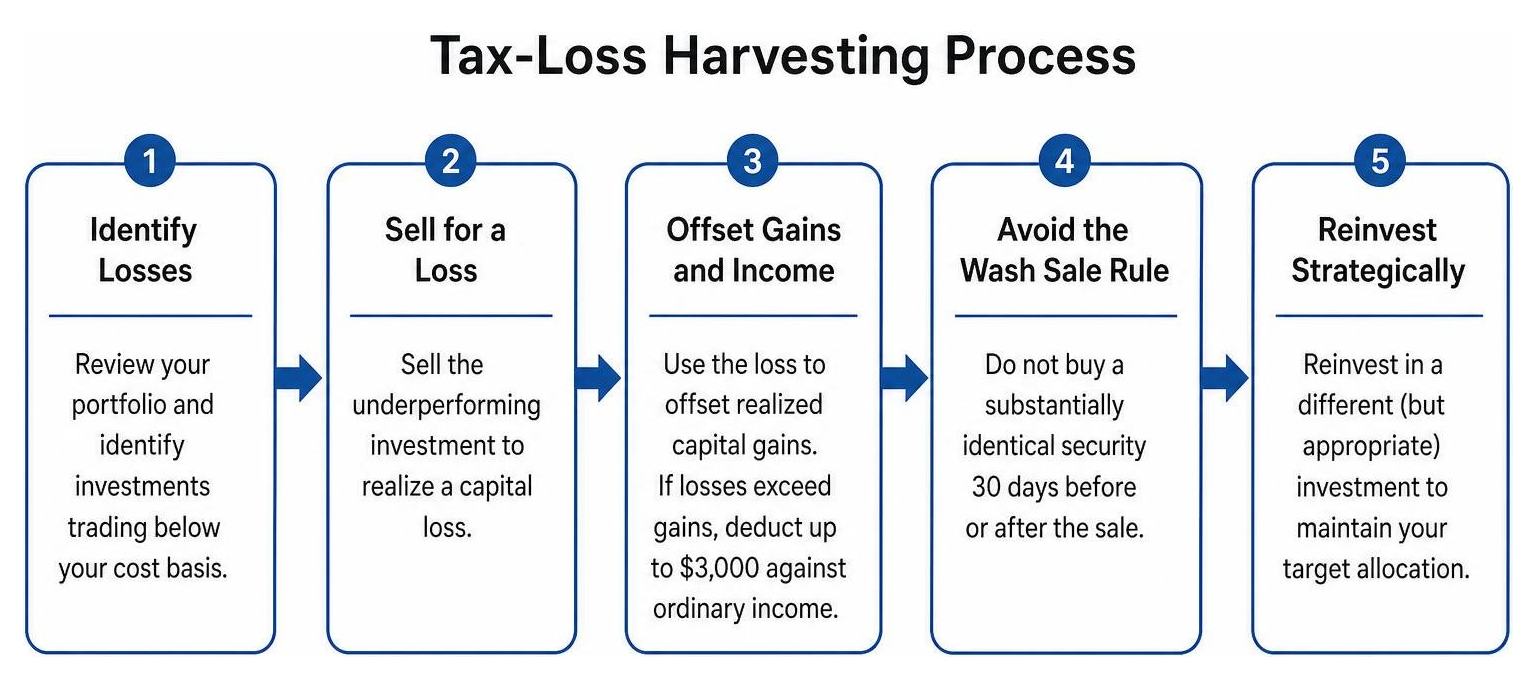
When harvesting losses, you must strictly follow the IRS 30-day wash-sale rule. This rule prohibits claiming a loss on a security if you purchase a “substantially identical” security within 30 days before or after the sale.
Asset Location, Roth Conversions, and Senior QCD Strategies
Holding the right assets in the right account types — known as asset location — optimizes long-term yields:
- Taxable Brokerage Accounts: Ideal for index funds and growth stocks that qualify for lower long-term capital gains tax rates and yield qualified dividends.
- Tax-Deferred Accounts (Traditional IRA/401k): Best suited for tax-inefficient assets like high-turnover mutual funds, corporate bonds, and REITs.
- Roth Accounts: Best reserved for high-growth assets, as all future earnings and distributions are 100% tax-free.
For retirees over age 70½, Qualified Charitable Distributions (QCDs) offer a powerful strategy. A QCD allows you to transfer up to $111,000 annually per individual directly from a Traditional IRA to a qualifying 501(c)(3) charity. The transferred amount counts toward your Required Minimum Distribution (RMD) for the year without being added to your Adjusted Gross Income (AGI). Keeping your AGI lower helps prevent higher Medicare Part B/D surcharges (IRMAA) and reduces taxes on Social Security benefits.
Business Write-Offs and Beating Inflationary Tax-Bracket Creep
Self-employed individuals, independent contractors, and business owners have access to deductions that can reduce their taxable income.
Maximizing Self-Employed Expenses, Entity Structure, and Section 280A
Self-employed individuals can deduct ordinary and necessary business expenses directly on Schedule C or entity tax forms. Common deductions include:
- Self-Employed Health Insurance: You can deduct 100% of health, dental, and qualified long-term care insurance premiums paid for yourself and eligible dependents as an above-the-line deduction.
- Solo 401(k) Plans: As both employer and employee, self-employed taxpayers can shelter up to $72,000 in total contributions in 2026.
- S-Corp Election: Business owners making over $80,000 in net income can elect S-Corporation status to split earnings between a reasonable W-2 salary and owner distributions. Owner distributions skip the 15.3% self-employment (FICA) tax, resulting in significant annual tax savings.
- Section 280A (The Augusta Rule): This IRS rule allows homeowners to rent their personal home to their business entity for up to 14 days per calendar year. The business receives a legitimate tax write-off for venue rental, while the individual receives the rental income completely tax-free.
To evaluate business expense write-offs and structural setups, consider reviewing Deductsy tax optimization tools.
Strategies to Prevent Tax-Bracket Creep and Income Clustering
Tax-bracket creep occurs when nominal wage increases push you into a higher marginal tax bracket, even if inflation offsets your purchasing power gains. Income clustering occurs when multiple financial events — like a bonus, stock vesting, and property sale — happen in the same calendar year.
To counter bracket creep and income clustering, consider these moves:
- Defer Income: Push year-end bonuses or consulting invoices into January of the next calendar year if doing so keeps you in a lower marginal bracket.
- Installment Sales: Spread large capital gains (such as selling a business or investment property) across multiple tax years using installment contracts.
- Monitor Surtax Thresholds: Keep MAGI below the $200,000 (single) or $250,000 (joint) thresholds to avoid triggering the 3.8% Net Investment Income Tax (NIIT) on portfolio profits.
Local Property Tax Reduction: Nassau and Suffolk County Grievances
While most taxpayers focus exclusively on federal income tax forms each spring, local real estate property taxes represent one of the largest ongoing expenses for Long Island homeowners. Overassessed properties mean homeowners end up overpaying thousands of dollars in property taxes every year.
At Heller Tax Grievance, we specialize in helping property owners across Nassau County and Suffolk County push back against incorrect government valuations to secure meaningful, lasting property tax reductions. Understanding The Top 5 Secrets You Must Know to Successfully Lower Your Property Taxes can make a substantial difference in your yearly costs.
Utilizing Local Property Tax Grievances to Lower My Tax Bill
A property tax grievance is an official administrative complaint challenging your home’s assessed valuation established by county tax assessors. It is important to realize that filing a tax grievance:
- Is your legal right as a homeowner under New York State real property tax law.
- Cannot cause your property taxes to increase — by law, the tax grievance process can only lower your assessment or keep it the same.
- Does not require home visits — county assessors will not come inspect the interior of your home because you filed a grievance.
If local tax authorities place a theoretical market value on your property that exceeds real market conditions or overstates your home’s value relative to comparable properties in your neighborhood, your assessment is incorrect. Lowering your assessed value reduces your property tax bill proportionately, helping you lower my tax bill at the local level year after year. Read our full checklist of 10 Tips for Lowering Your Property Taxes as Much as Possible 2026 to see how assessment appeals work.
Navigating Long Island Assessment Calendars and Grievance Deadlines
To successfully challenge your property assessment, you must strictly follow the official county tax grievance calendars. Missing a county deadline means waiting an entire year for your next opportunity.
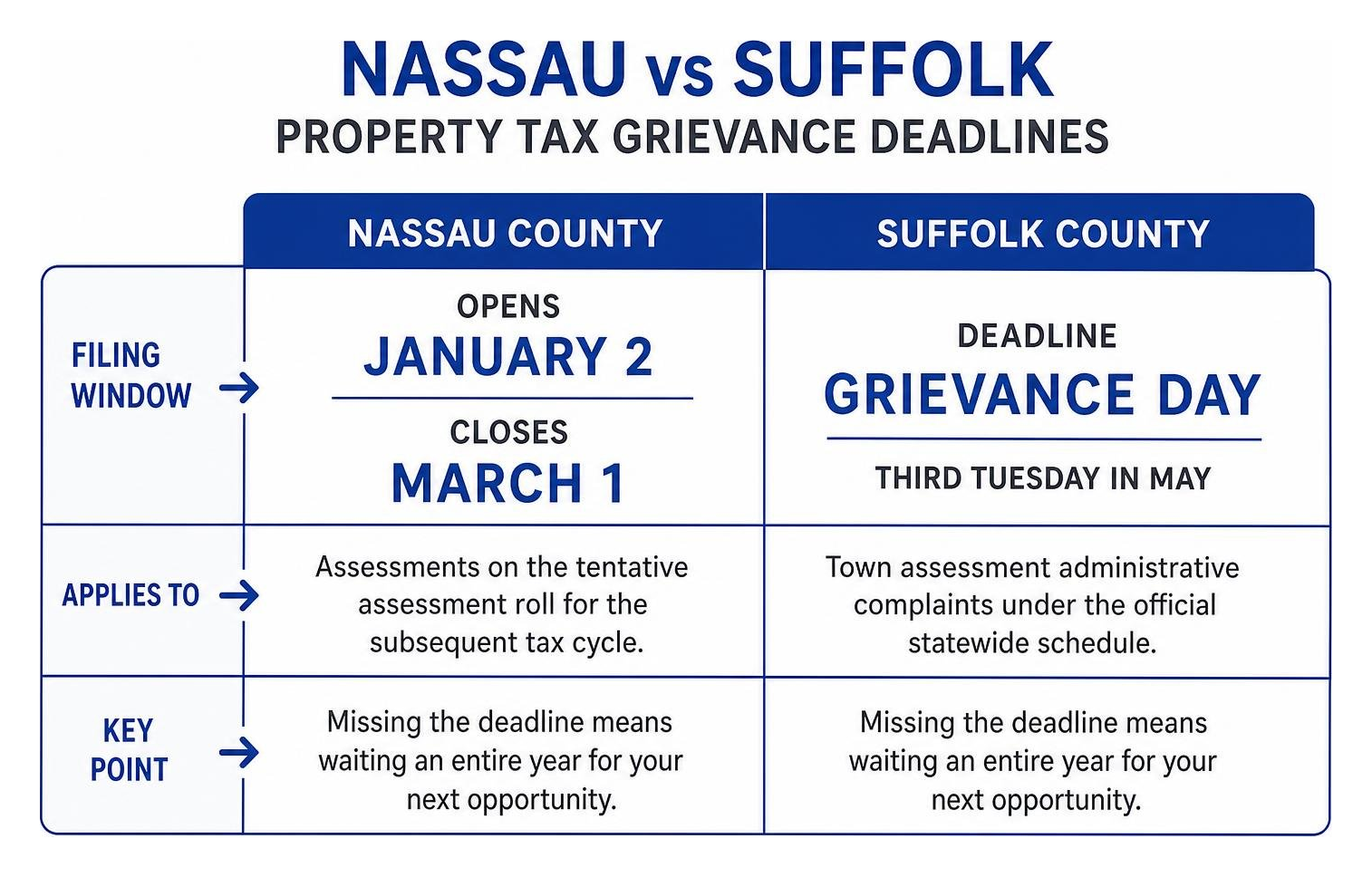
Here are the key county deadlines for Long Island homeowners:
- Nassau County: The official tax grievance filing window opens on January 2 and closes on March 1 each year. Assessments published on the tentative assessment roll determine property tax charges for the subsequent tax cycle.
- Suffolk County: Town assessment administrative complaints follow the official statewide schedule. Property tax grievances in Suffolk County towns are due on Grievance Day, which occurs on the third Tuesday in May annually.
Because navigating county comparative sales data, property tax grievance forms, and administrative review boards requires precise legal documentation, our expert team handles the entire grievance procedure from start to finish. Our USP is simple: we operate under a “You Don’t Pay Unless You Save” guarantee. With over $160 million saved for homeowners in Massapequa, Farmingdale, Deer Park, Stony Brook, Massapequa, Miller Place, Brookville, Syosset, Upper Brookville, Rocky Point, and across Nassau and Suffolk counties, we deliver the largest property tax reductions in the region.
Learn more in A 2026 Property Tax Grievance Guide: Why This Is the Year.
Frequently Asked Questions About Tax Savings
What immediate actions can I take before the filing deadline to lower my taxes?
You can make prior-year contributions to a Traditional IRA (up to $7,500, or $8,600 if 50+) or a Health Savings Account (up to $4,400 for individual, $8,750 for family) right up until the April tax filing deadline. If you are self-employed, establishing and funding a SEP-IRA before your filing deadline allows you to deduct up to 25% of net earnings.
What is the main difference between a tax credit and a tax deduction?
A tax deduction lowers your overall taxable income, saving you a percentage based on your marginal tax bracket (e.g., a $1,000 deduction saves $240 in the 24% tax bracket). A tax credit subtracts directly from your tax liability dollar-for-dollar (e.g., a $1,000 credit reduces your final tax bill by exactly $1,000).
How does tax-loss harvesting work to offset gains?
Tax-loss harvesting involves selling investments that are sitting at a loss to offset capital gains realized from other profitable sales. If your losses exceed your capital gains, you can apply up to $3,000 of net losses against ordinary wage income per tax year, carrying any remaining unused losses forward into future tax years.
Conclusion
When taxpayers ask us how to lower my tax bill, we emphasize taking a complete approach. Minimizing what you pay requires looking at federal income tax strategies alongside local property tax obligations.
By maxing out retirement plans, taking advantage of HSA contributions, harvesting capital losses, applying the expanded $40,000 SALT cap deduction, and structuring business write-offs, you can keep a larger share of your hard-earned earnings.
Equally important for Long Island property owners is ensuring you aren’t paying more than your fair share in local real estate taxes. Through our professional Property Tax Grievance Services, Heller Tax Grievance makes challenging overassessed property simple, stress-free, and risk-free. With our “You Don’t Pay Unless You Save” guarantee and over $160 million saved for Nassau and Suffolk County homeowners, we ensure you never pay more than your fair share. Contact our team today to file your grievance before the upcoming county deadline!