

Why Your Suffolk County Commercial Property Tax Bill Deserves a Second Look
Filing a Suffolk commercial property tax grievance could be one of the most valuable financial decisions you make as a commercial property owner on Long Island. Property taxes in Suffolk County rank among the highest in the nation — and for commercial owners, an inflated assessment can quietly eat into your income, cash flow, and return on investment every single year.
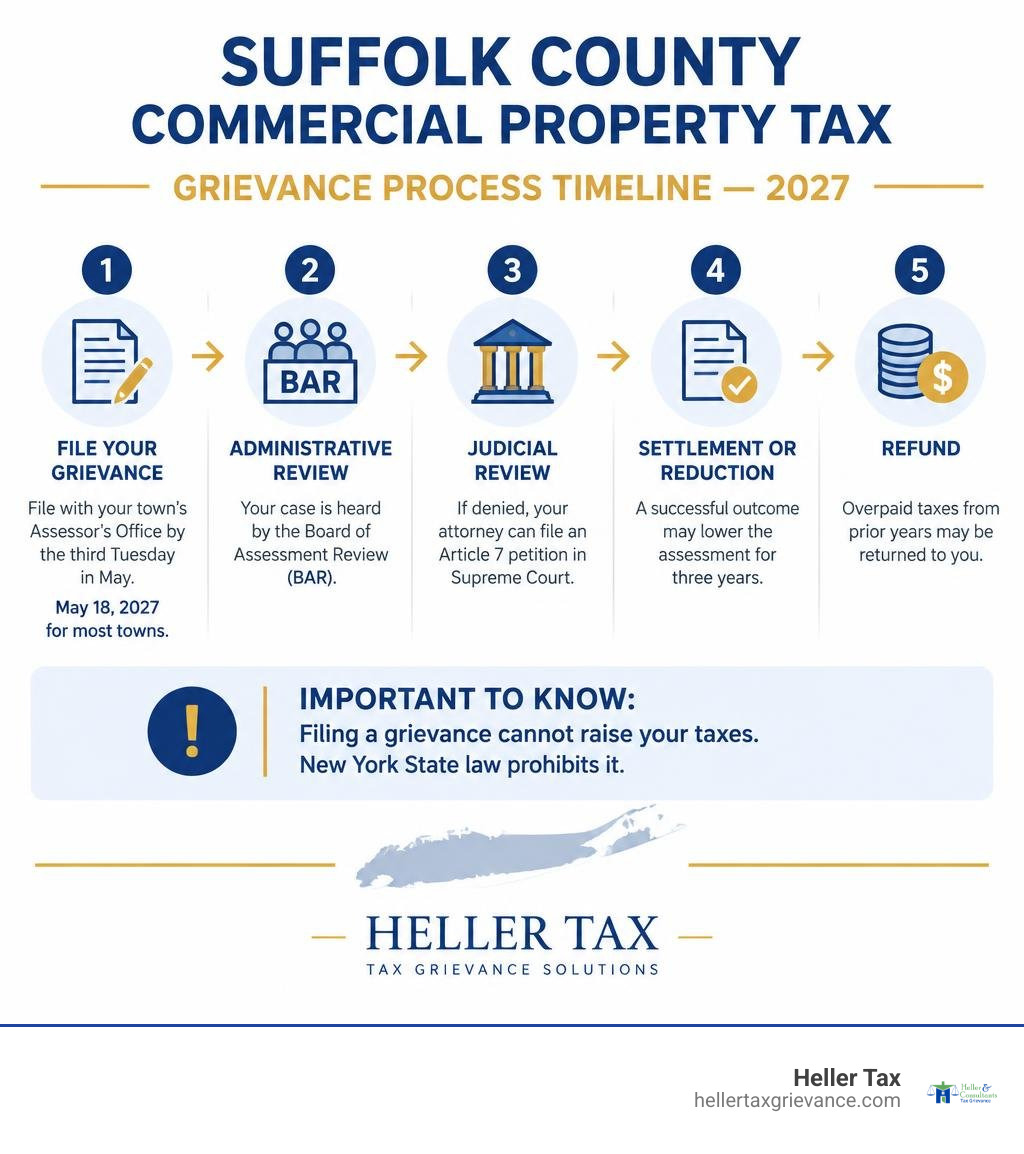
Here’s how the Suffolk County commercial grievance process works at a glance:
- File your grievance with your town’s Assessor’s Office by the third Tuesday in May (May 18, 2027 for most towns)
- Administrative review — your case is heard by the Board of Assessment Review (BAR)
- Judicial review — if denied, your attorney can file an Article 7 petition in Supreme Court
- Settlement or reduction — a successful outcome locks in a lower assessment for three years
- Refund — overpaid taxes from prior years may be returned to you
The key fact to know right now: filing a grievance cannot raise your taxes. New York State law prohibits it. The only risk is the status quo — paying more than your fair share.
I’m Adam Heller, founder of Heller Tax Grievance. I’ve spent nearly two decades helping commercial and residential property owners across Long Island challenge over-assessed properties, including securing record-breaking reductions in Suffolk County for Suffolk commercial property tax grievance cases. That hands-on experience is what shapes every strategy in this guide.
Suffolk commercial property tax grievance terms explained:
Navigating Your Suffolk Commercial Property Tax Grievance
Commercial real estate is a major driver of the Long Island economy, but it is also one of the most heavily taxed assets you can own. In fact, Suffolk County Ranks 12 in the Nation in Property Taxes, placing an immense financial burden on local businesses. Recent county budgets, including a massive $4.3 billion budget featuring a 3.18% property tax hike, mean that the cost of doing business on Long Island continues to climb.
For many local businesses, property taxes are not just another line item; they are often the single largest recurring fixed expense. Industry data shows that up to 35% of a commercial building’s operating income can go directly toward paying real estate taxes. If your property is over-assessed, that number climbs even higher, directly undermining your net operating income (NOI) and the overall valuation of your physical asset. Understanding Commercial Real Estate Property Taxes and how to challenge them is essential to protecting your bottom line.
What is a Suffolk Commercial Property Tax Grievance?
A Suffolk commercial property tax grievance is a formal, legal challenge to the tentative assessed value placed on your property by the local town assessor. The goal of this process is simple: to prove that the town’s estimated market value of your property is higher than its actual fair market value, earning a property tax reduction.
Unlike residential property assessments, which are primarily based on recent neighborhood sales, commercial assessments are highly complex. They must account for the income-producing potential of the property, market lease rates, operating expenses, and physical depreciation. When the town assessor’s valuation fails to align with these real-world economic factors, property owners have the legal right to file a tax protest.
How Commercial Assessments are Determined and Why Over-Assessment Occurs
To understand why so many commercial properties are over-assessed, it helps to understand how assessors calculate your property’s value. In Suffolk County’s ten towns (including Babylon, Brookhaven, Huntington, Islip, and Smithtown), assessors primarily rely on the income approach to valuation.
Under the income approach, the assessor estimates how much income your property should generate under idealized market conditions, subtracts standard operating expenses, and applies a capitalization rate (cap rate) to determine the property’s assessed value.
However, this standardized approach is highly prone to error. Assessors frequently make incorrect assumptions that do not reflect the actual performance of your asset. Common mistakes include:
- Assuming 100% Occupancy: Assessors often calculate value based on a fully leased building, completely ignoring actual, real-world vacancy rates.
- Outdated Market Rent Data: The town may assume your tenants are paying top-of-market lease rates, even if your actual rent roll features older, below-market leases or significant tenant concessions.
- Ignoring Deferred Maintenance: Standardized assessment models do not account for physical realities. If your building needs a new roof, has a failing HVAC system, or suffers from structural damage, its actual market value is lower than the town’s estimate.
- Rising Operating Expenses: Inflation, rising utility costs, and increased insurance premiums can slash your net operating income, but assessors rarely adjust their expense ratios to match these modern economic pressures.
When these valuation errors occur, a commercial tax grievance is the only legal mechanism available to correct the record and align your tax bill with reality.
Eligibility, Property Types, and Key Deadlines
Before launching an assessment challenge, it is important to understand who has the legal standing to file, when the filing window opens, and which commercial properties are eligible for relief during the Suffolk County Property Tax Grievance Season.
Who Qualifies to File a Grievance in Suffolk County?
To file a commercial property tax grievance in Suffolk County, you must have legal standing as an aggrieved party. Generally, this includes:
- Property Owners: Anyone who holds the deed to a commercial property within Suffolk County.
- Commercial Tenants: A tenant has legal standing to file if their lease agreement explicitly obligates them to pay the property taxes directly to the municipality, and the lease authorizes them to challenge the assessment.
- Contract Vendees: A buyer who is under contract to purchase a commercial property and has the written consent of the current owner to file.
Key Deadlines for a Suffolk Commercial Property Tax Grievance
Timing is everything when it comes to property tax appeals. In Suffolk County, commercial property tax assessments and deadlines are handled strictly at the township level rather than through village-level systems.
For all ten townships in Suffolk County, the tentative assessment roll is published on or about May 1st. This marks the official opening of the grievance filing window.
The absolute deadline to file a commercial tax grievance is always the third Tuesday in May. For the current tax cycle, the deadline is May 18, 2027.
Because this filing window is incredibly short—typically lasting just 13 business days from the release of the tentative roll—preparation must begin months in advance. Missing this date means you forfeit your right to challenge your taxes for the entire year, ensuring your tax burden remains locked in.
For more details on key dates, see our guides on the Suffolk County LI Property Tax Filing Deadline is May and the Suffolk County Property Tax Grievance Legal Filing Deadline for All Townships.
Eligible Commercial Property Types
Virtually any income-producing or commercial-use property in Suffolk County is eligible for an assessment review. This includes, but is not limited to:
- Retail Spaces: Shopping centers, strip malls, standalone retail stores, and supermarkets.
- Office Buildings: Professional complexes, medical suites, and corporate headquarters.
- Industrial & Warehouse Facilities: Manufacturing plants, distribution centers, and self-storage facilities.
- Multifamily Properties: Apartment buildings, co-ops, and large-scale residential rental complexes.
- Specialty Properties: Hotels, motels, auto dealerships, country clubs, and recreational facilities.
Building a Strong Case: Evidence and the Two-Step Appeal Process
Filing a successful Suffolk commercial property tax grievance requires a data-driven approach. You cannot simply argue that your taxes are “too high.” You must present clear, convincing evidence that the assessor’s valuation of your property exceeds its actual market value.
Our Commercial Tax Grievance Long Island Step by Step Guide outlines the complete strategic path, which begins with thorough evidence preparation.

Essential Financial Records and Property Data
Because commercial properties are valued primarily on their economic performance, your financial records are the foundation of your case. To determine if you have a viable claim, we analyze several key documents as discussed in our guide on how to Think You Are Over Assessed How to Determine if You Have a Property Tax Grievance Case in Suffolk County:
- Certified Rent Rolls: Highlighting actual occupancy, vacancy rates, tenant concessions, and lease expiration dates.
- Three Years of Income and Expense (I&E) Statements: Detailed operating statements showing the actual cash flow, utility costs, maintenance fees, and insurance expenses of the property.
- Recent Property Appraisals: Independent, professional appraisals conducted for refinancing or sales purposes within the last few years.
- Evidence of Property Condition: Photos, contractor estimates, or engineering reports documenting deferred maintenance or structural issues that lower the property’s utility and value.
Administrative Review (BAR) vs. Judicial Review (Article 7)
The tax appeal process in Suffolk County is a two-step system.
First, we file an administrative complaint (Form RP-524) with the local town’s Board of Assessment Review (BAR). The BAR is an appointed panel that reviews the grievance and the supporting financial documentation. In many cases, because of the sheer volume of filings and the complexity of commercial valuations, the BAR will issue a cursory denial or offer only a minor reduction.
If the BAR does not grant the necessary relief, we immediately escalate the case to the second step: Judicial Review. For commercial properties, this involves filing an Article 7 petition (a tax certiorari proceeding) in the New York State Supreme Court.
This judicial phase is where the real negotiations occur. Your attorney will present your detailed financial data, expert appraisals, and market analysis to the town’s legal counsel and assessor to negotiate a settlement. If a settlement cannot be reached, the case proceeds to a trial before a judge who specializes in tax certiorari cases.
For more information on these legal rights, you can consult the official Grievance procedures – Department of Taxation and Finance – NY.Gov.
| Feature | Administrative Review (BAR) | Judicial Review (Article 7 Certiorari) |
|---|---|---|
| Filing Forum | Local Town Board of Assessment Review | New York State Supreme Court |
| Filing Deadline | Third Tuesday in May (May 18, 2027) | Within 30 days of the filing of the final assessment roll |
| Representation | Can be filed by owner or representative | Must be filed by a licensed attorney for corporations |
| Resolution Method | Board review of submitted paperwork | Settlement negotiations or court trial |
| Typical Outcome | High rate of administrative denials | Highly successful rate of negotiated settlements |
Frequently Asked Questions about Suffolk Commercial Property Tax Grievances
Challenging a commercial assessment can feel daunting, but having the right information makes all the difference. Here are answers to some of the most common questions we receive from Long Island business owners looking for how to get some much-needed commercial property tax relief.
What are the potential savings from a successful commercial tax grievance?
The savings from a successful commercial tax grievance can be substantial, often running into tens or hundreds of thousands of dollars. Because commercial valuations are tied to operating expenses, any reduction in property taxes goes directly to your bottom line, immediately increasing your net operating income (NOI) and boosting your property’s overall cash flow.
Furthermore, under New York State law, once a commercial property tax assessment is reduced through a settlement or court order, that lower assessment is locked in under a three-year moratorium. This means the town cannot arbitrarily raise your assessment for the next three years, ensuring predictable overhead and long-term savings. For strategic tips on lowering your tax liability, explore the Top 5 Ways Can Use Pay Fewer Commercial Property Taxes.
How do contingency fees and costs work for commercial grievances?
At Heller Tax Grievance, we believe that seeking tax justice should be entirely risk-free. That is why we operate on a strict contingency fee basis.
- No Reduction, No Fee: If we do not successfully reduce your property tax assessment, you owe us absolutely nothing.
- Contingency Rate: Our fee is a set percentage of the actual tax savings achieved in the first year.
- Disbursements: Any necessary court filing fees (such as the Supreme Court index number fee for an Article 7 petition) or specialized appraisal costs are clearly outlined and discussed upfront.
This structure ensures our interests are perfectly aligned with yours—we only succeed when we save you money.
Why should I hire a specialist or attorney instead of filing myself?
While New York law allows property owners to file their own administrative grievances, commercial property tax appeals are highly technical legal proceedings.
An experienced tax certiorari attorney understands how to correctly analyze complex income data, select appropriate capitalization rates, and counter the aggressive assumptions made by town assessors. Furthermore, once a case moves past the administrative BAR level, an Article 7 judicial petition for a commercial property must be filed and argued by a licensed attorney. Trying to navigate the Supreme Court system without specialized legal representation almost always results in a dismissal or an unfavorable settlement.
Conclusion
With property taxes on Long Island continuing to rise, commercial property owners cannot afford to accept the town’s valuation at face value. Over-assessed properties drain vital capital that could otherwise be reinvested into upgrading your facility, hiring staff, or expanding your business operations.
Challenging your assessment is a legal right, and with our “You Don’t Pay Unless You Save” guarantee, there is absolutely no financial risk to taking action. Our team at Heller Tax Grievance has helped save Long Island property owners over $160 million, securing some of the largest tax reductions in both Nassau and Suffolk counties.
Don’t let an inflated assessment quietly erode your hard-earned profits. The deadline of May 18, 2027, is approaching quickly. Contact us today for a free, no-obligation evaluation of your commercial property’s assessment, and let us help you secure the tax relief you deserve.
Ready to take control of your property expenses? Visit our Heller Tax Grievance Commercial Info page today to get started.